TIKTOK SHOP U.S. · Q4 OPERATIONS
Set TikTok Shop Order Capacity Before a Q4 Demand Spike Sets It for You
Direct answer: set TikTok Shop Order Handling Capacity to the maximum daily order volume your operation can repeatedly pick, pack, label and hand to the correct carrier without borrowing from tomorrow. Do it before the promotion starts. TikTok's current guide says capacity changes take effect the next day, so a same-day reaction cannot protect the first surge.
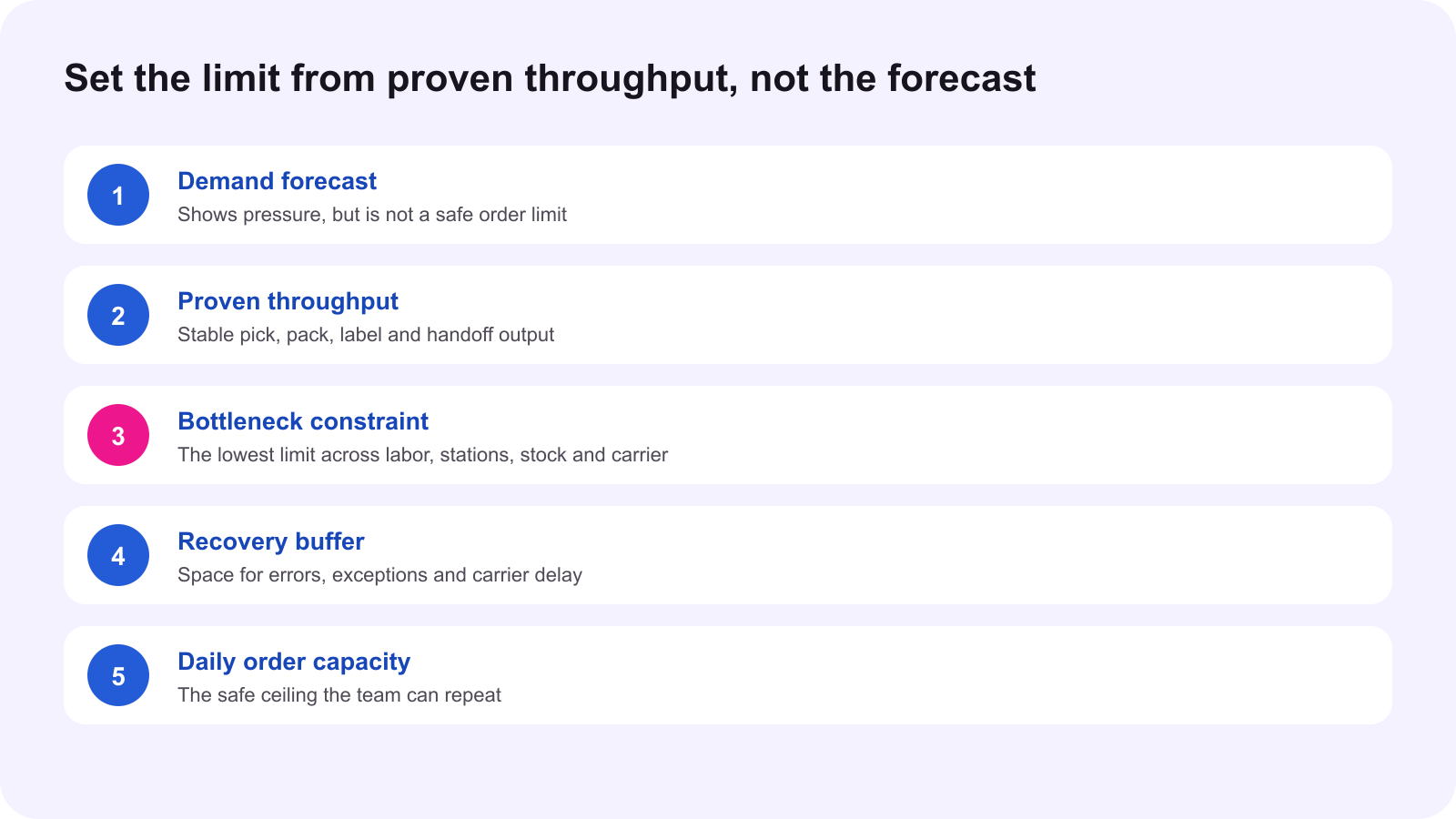
The number should not be a sales target. It is a fulfillment promise backed by observed throughput. A forecast may say 2,000 orders are possible, but if the smallest stable constraint can finish only 900 orders with a recovery buffer, 900 is the defensible ceiling until evidence changes. Capacity protects customer promises, warehouse control and the next day's ability to recover.
Operating rule: demand can be aspirational. Capacity must be proven. Set the ceiling from the narrowest real constraint and change it only after a full native readback.
What the official capacity setting does
TikTok Shop describes daily order handling capacity as the estimated maximum number of orders a shop can efficiently dispatch in a day. The feature is intended to help sellers manage large volume. When eligible order volume exceeds the configured capacity, estimated delivery timing and dispatch requirements may be extended automatically. The setting is an operating control, not a guarantee that every downstream exception disappears.
The same guidance states that changes take effect on the next day. That detail determines the planning sequence. The team must set capacity before a campaign, LIVE, creator drop or seasonal event can create the spike. If orders already arrived, changing the number may support tomorrow, but today's queue still needs an incident plan with owners, cutoffs and customer-promise review.
Build capacity from four constraints
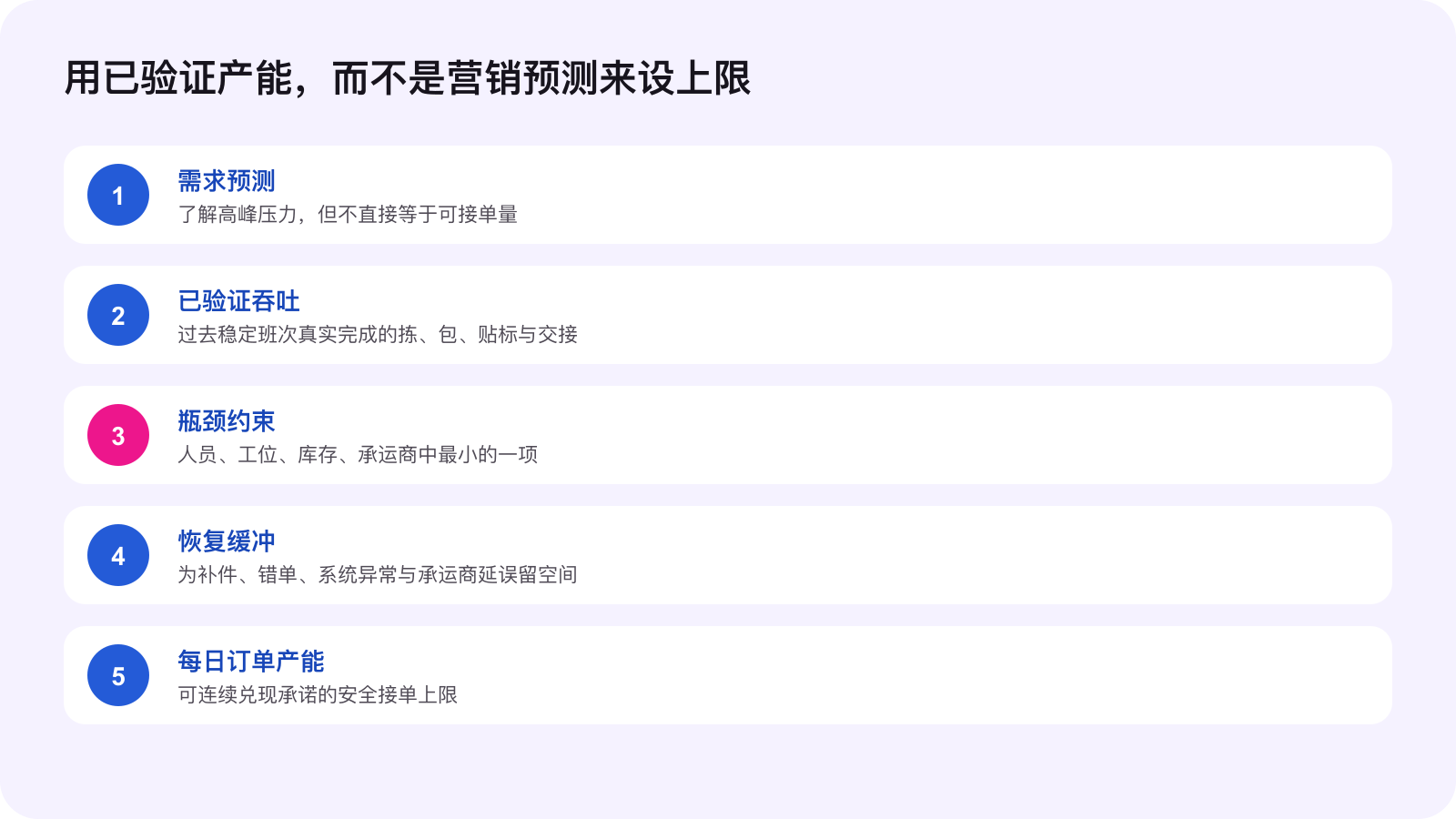
Start with stable paid orders and follow them to carrier handoff. Measure the slowest dependable output across inventory availability, picking labor, packing stations, label generation and carrier collection. Do not average away the bottleneck. If packing completes 1,200 parcels but the last reliable carrier pickup accepts 850, the operating capacity is constrained near 850, not 1,200.
Then subtract a recovery buffer. The buffer absorbs wrong-item checks, damaged packaging, address issues, label failures, inventory discrepancies, shift changes and missed pickups. A team running at exactly 100 percent of theoretical output has no room to repair exceptions. The safer capacity is repeatable under ordinary variance, not achievable once during an unusually clean shift.
Separate orders, units and complexity
One order is not always one unit or one touch. A single-SKU parcel may require seconds, while a multi-item order can require bin travel, substitutions, protective packing and a larger label workflow. Capacity should be tested against the real mix. Record orders per hour, units per order, multi-line share, exception share and completed carrier handoffs.
If the product mix changes during Q4, recalculate before assuming yesterday's output still applies. Bundles, fragile items, regulated categories and gift packaging can consume additional time. A promotion focused on the easiest hero SKU may raise order capacity; a promotion mixing long-tail variants may lower it. Keep the capacity decision linked to assortment and warehouse route.
Use trigger levels instead of one red line
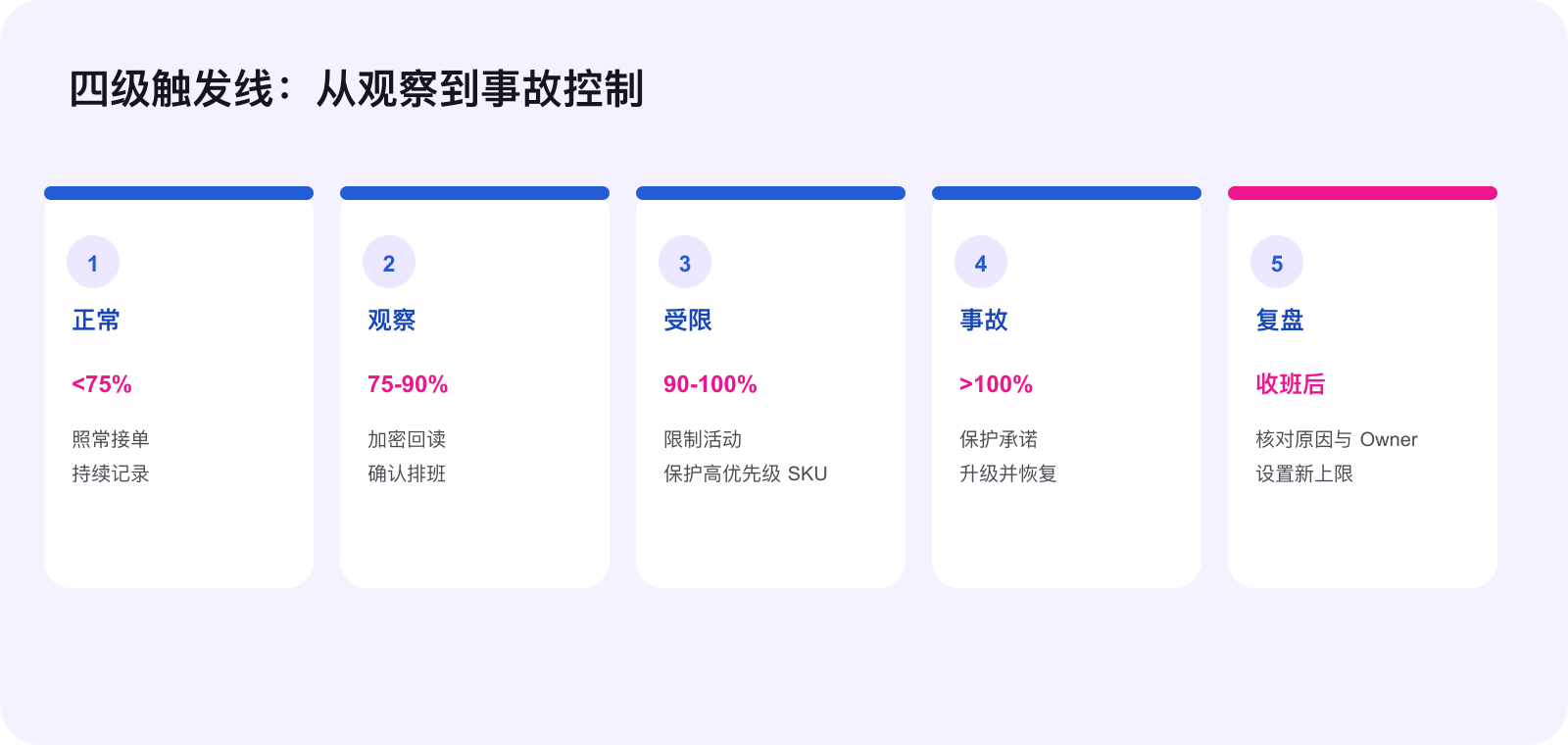
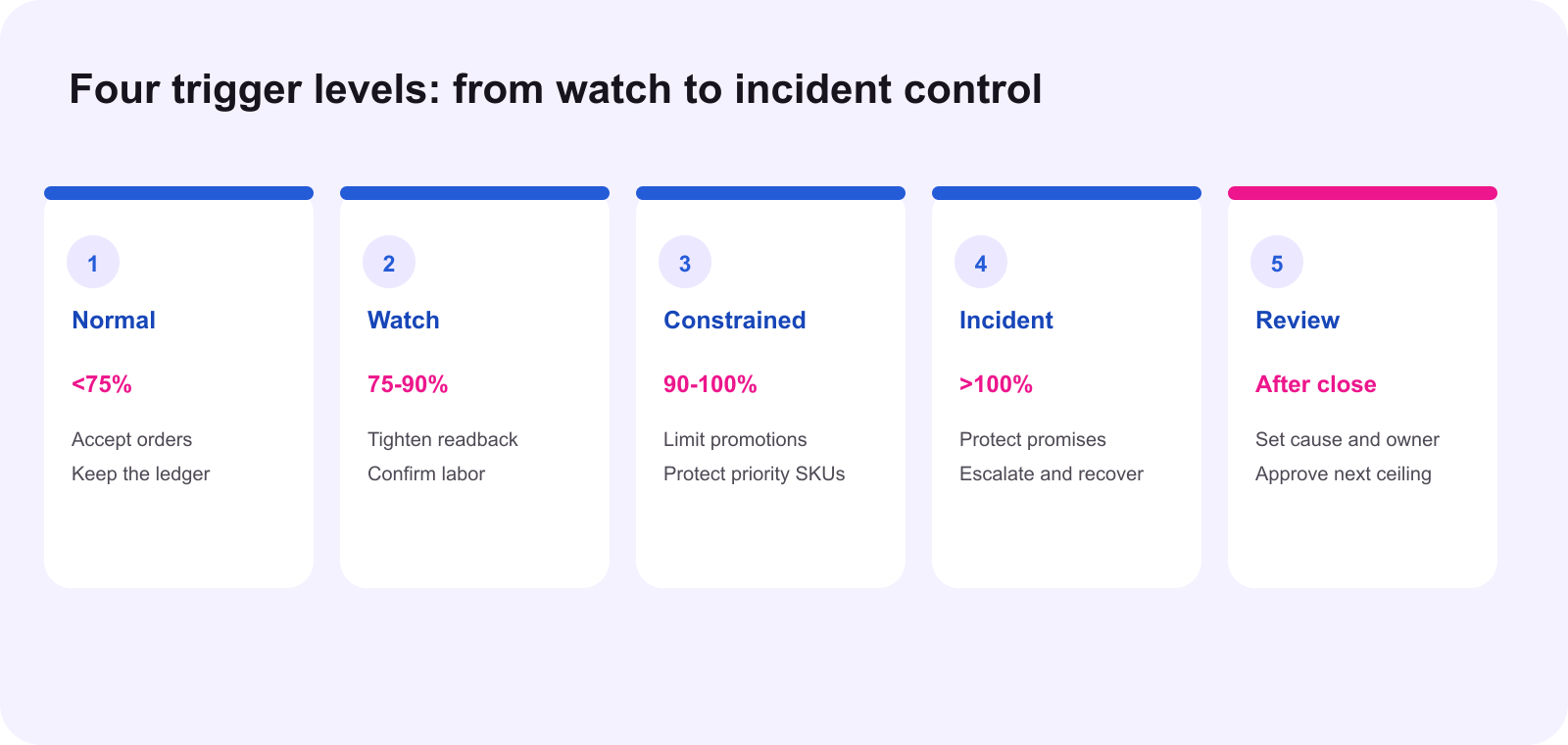
A single limit tells the team when it is already full. A trigger ladder creates time to act. Below 75 percent of proven capacity, run normally and maintain the ledger. From 75 to 90 percent, confirm inventory, labor, supplies and carrier slots. From 90 to 100 percent, reduce optional demand pressure and protect the highest-confidence SKUs. Above 100 percent, treat the queue as an incident.
These percentages are a WEM operating framework, not TikTok policy thresholds. They should be calibrated to the seller's variation and recovery speed. The point is ownership. Every level needs a named decision maker, allowed actions, evidence source and next readback time. Without those fields, a dashboard color is decoration rather than control.
Know what happens above capacity
TikTok's current Order Handling Capacity guide says eligible orders that exceed the daily setting can receive automatic estimated-delivery and Dispatch SLA extensions. The guide also says that when orders exceed three times the configured capacity, surge protection may pace incoming orders. Those mechanisms help manage pressure, but they are not a reason to set an unrealistically low or high number.
A low setting can unnecessarily restrict growth and distort planning. A high setting can leave the team with promises it cannot execute. The correct number is the smallest defensible ceiling that still reflects the operation's current capability. Preserve the date, input data, approver and reason for every change so performance can be compared with the decision that created it.
Protect the fulfillment promise, not just the order count
The current U.S. Fulfillment Policy says sellers using Order Handling Capacity can receive one additional business day of custom handling time for orders above daily capacity. Eligibility and exact behavior must be verified in the current Seller Center and order record. The seller still owns accurate preparation, timely handoff and the buyer experience.
Capacity control therefore needs promise control. Review the actual estimated delivery date, custom handling time, dispatch requirement, carrier route and later tracking movement for affected orders. Do not assume an extension occurred merely because the queue exceeded an internal limit. Close the loop on native order readback.
Keep the October 14 score boundary accurate
On this article's publication date, TikTok's new Logistics and Fulfillment Score version was not yet officially launched. The official page described September 21 through October 14, 2026 as a trial run in which the new score was available for preview only and current benefits remained based on the old version. It scheduled official launch for October 15, with phased rollout and eligibility conditions.
That timing matters. This playbook does not claim October 15 score benefits were live on October 14. Sellers should verify the current score version, eligibility, metrics and benefits in their own account before acting. Capacity is still useful as an operational control, but no future score threshold should be treated as current evidence one day early.
Run a daily Q4 capacity cadence
- Morning baseline. Read paid orders, backlog, inventory holds, labor plan, packing stations, supplies and carrier appointments.
- Midday forecast. Compare order velocity with the proven hourly curve and trigger ladder.
- Pre-cutoff gate. Confirm the physical batch, label success and carrier handoff capacity.
- Exception split. Separate inventory, labor, system, package and carrier constraints.
- Next-day decision. Approve any capacity change early enough for the next-day effective time.
- Close on readback. Record completed handoffs, native order timing and unresolved owners.
A hypothetical operating example
This is a planning example, not a client result. A warehouse has shown repeatable output of 960 orders per day. Packing stations can handle 1,100, inventory can support 1,400, but the reliable carrier handoff slot is 900. The team keeps a 10 percent recovery buffer, so it sets daily capacity at 810 before a creator campaign.
At noon, paid orders reach 620 and velocity is accelerating. The team enters the watch level, adds a packing shift and confirms the carrier slot. At 760, it pauses a low-confidence bundle and protects the hero SKU. At close, 804 orders are handed off with six exceptions assigned to named owners. The next-day setting changes only after those six orders and the confirmed carrier capacity are read back.
The smallest useful next action
Take one recent stable operating day. Write down paid orders, completed packages, successful labels, parcels handed to the carrier and unresolved exceptions. The smallest reliable number, minus a recovery buffer, is the first capacity candidate. Record the calculation and approver, then set it before the next demand event rather than during it.
Source notes and execution boundary
This original WE Marketing capacity-control framework draws on current TikTok Shop U.S. Seller University materials for Order Handling Capacity, the Fulfillment Policy, the Logistics and Fulfillment Score and the BFCM Seller Guide, revalidated October 14, 2026. Official materials define current platform behavior and seller duties. WEM adds the bottleneck model, recovery buffer, trigger ladder and decision ledger. Features, eligibility, thresholds, interfaces and policy wording can change. Verify the current U.S. Seller Center, order record and carrier plan before execution.
Frequently asked questions
What is TikTok Shop Order Handling Capacity?
It is the estimated maximum number of orders a shop can efficiently dispatch in one day. TikTok says eligible excess volume can receive adjusted delivery and dispatch timing.
When does a capacity change take effect?
The current Seller University guide says changes take effect the next day, so a same-day demand spike is too late for a preventive setting change.
Should capacity equal the sales forecast?
No. Base capacity on repeatable warehouse throughput, the narrowest constraint and a recovery buffer. Forecasts describe demand, not execution ability.
What happens when orders exceed the set capacity?
TikTok says eligible orders above capacity may receive automatic timing extensions. Orders above three times capacity may trigger surge protection that paces incoming orders.
Was the new Logistics and Fulfillment Score live on October 14, 2026?
No. The official page described September 21 through October 14 as a preview-only trial and scheduled the official launch for October 15.
What is the first action for a seller preparing for Q4?
Measure one stable day from paid order to carrier handoff, find the smallest reliable bottleneck and set a conservative next-day capacity before increasing promotion.