Put TikTok Shipping Peak-Season Rates Into SKU Contribution Margin Before You Scale
Turn current shipping evidence into one SKU-level margin gate before paid, creator or LIVE volume increases.
Direct answer: do not scale a TikTok Shop SKU from a single product margin or a remembered shipping rate. Build contribution margin by order source and package path. Keep LIVE under-five-pound, LIVE over-five-pound and non-LIVE orders separate; use current calculator evidence; include the larger applicable actual or dimensional weight; and count every seller-funded shipping amount. Scale only the paths that remain above a named margin floor after those costs.
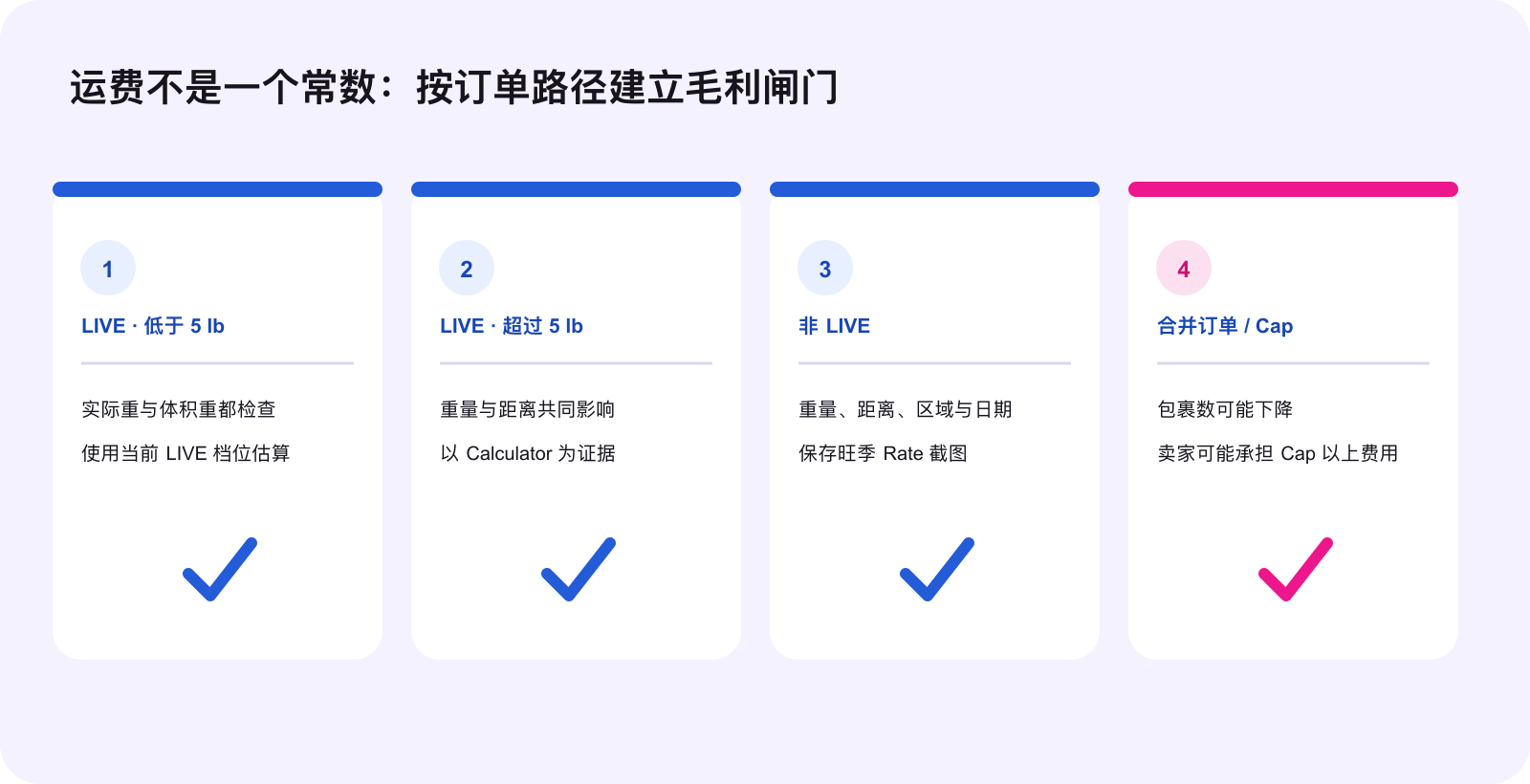
This matters in the 2026 peak window because TikTok Shop says Standard Delivery rates are temporarily adjusted from October 5, 2026 through January 17, 2027 Pacific Time, while Collection by TikTok rates remain unchanged. LIVE packages below five pounds use a weight-tier flat-rate structure, while heavier LIVE packages and non-LIVE packages use weight and distance differently. One blended shipping assumption hides the exact SKU and order path creating the loss.
Contribution margin is the scale decision, not gross margin
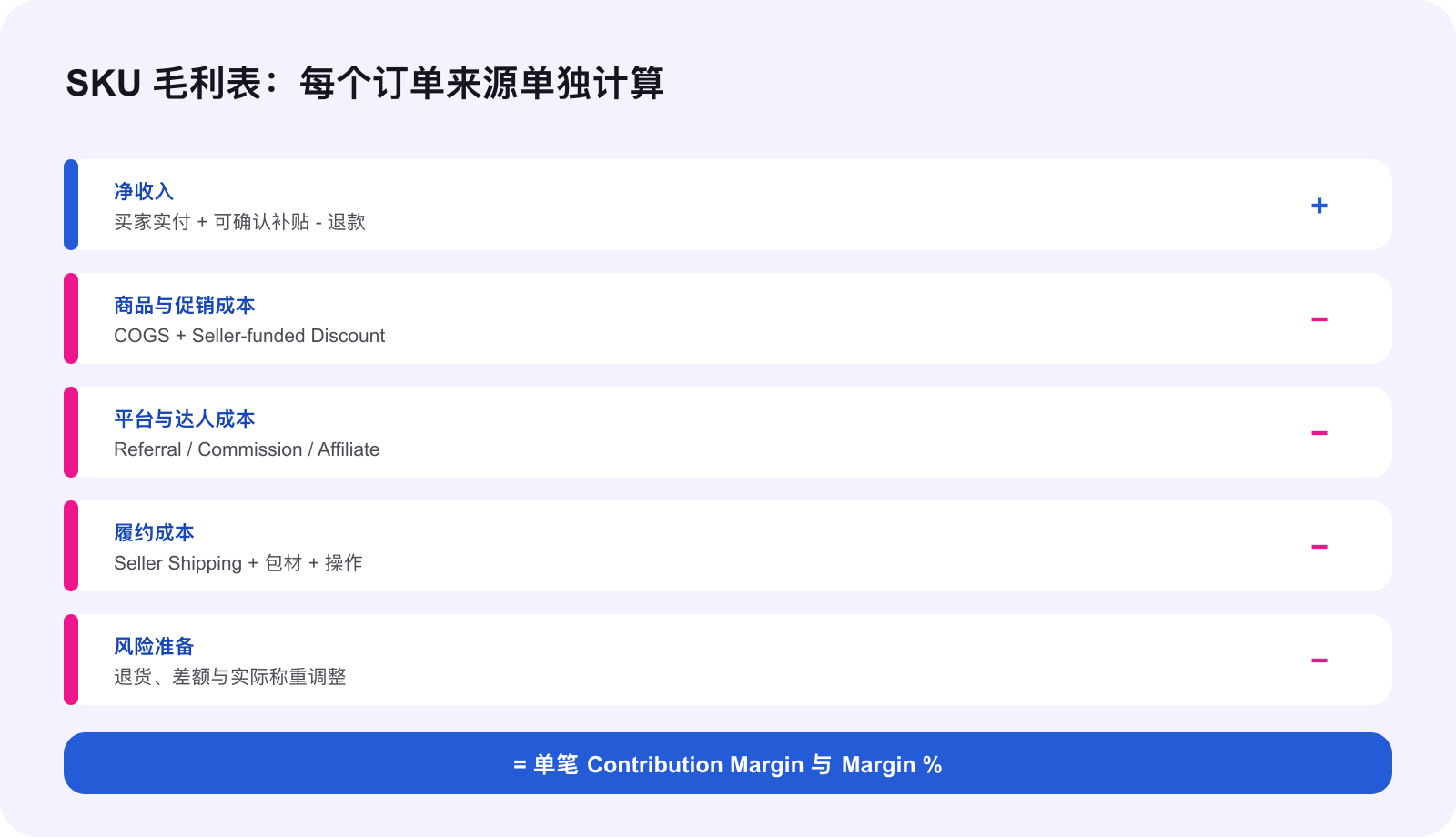
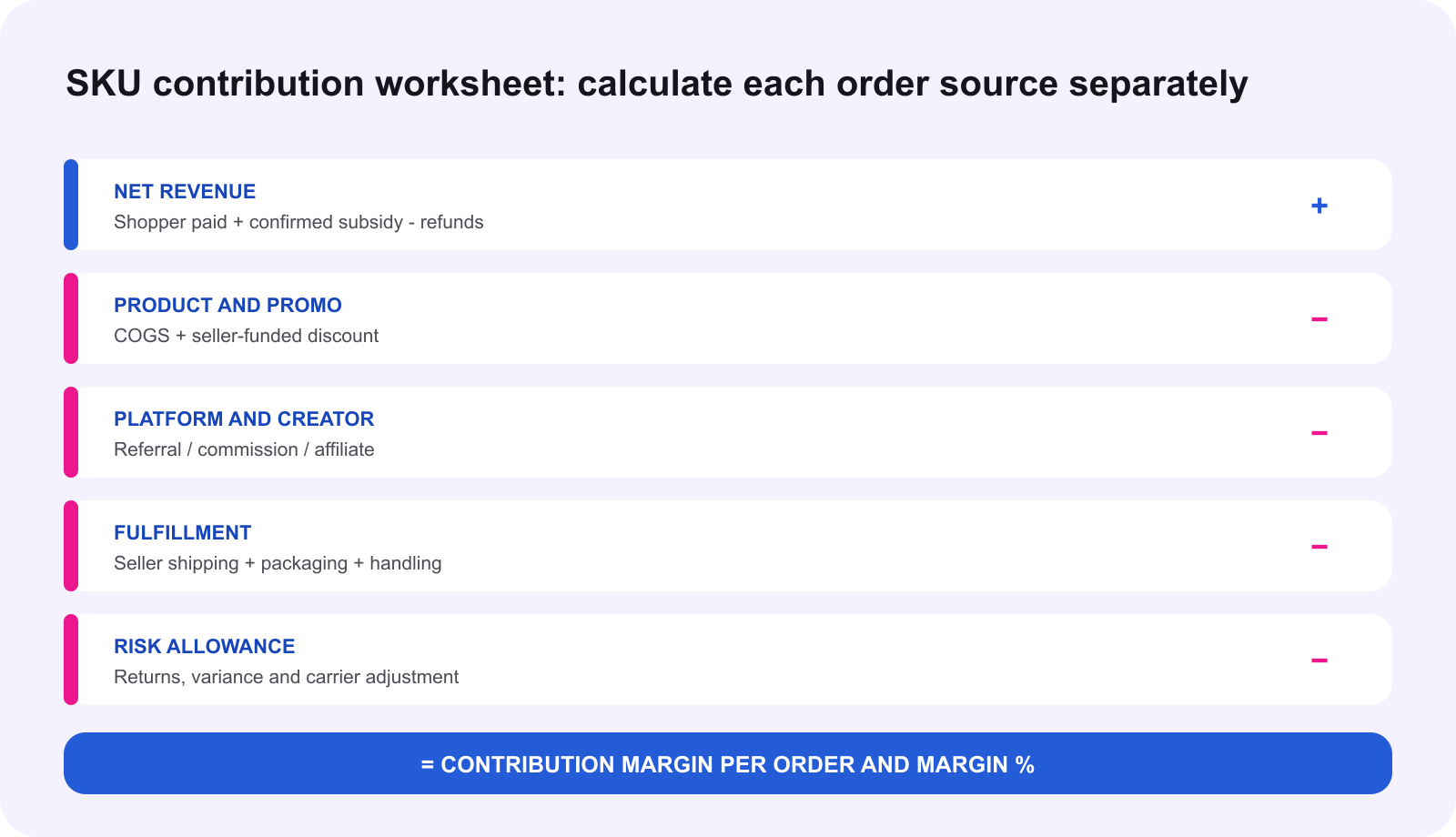
Gross margin usually subtracts product cost from revenue. Contribution margin goes further. It asks how much one additional order contributes after the variable costs required to win, process and fulfill it. For this operating decision, start with recognized net revenue, then subtract product cost, seller-funded discount, platform and creator costs, seller shipping settlement, packaging, pick-and-pack handling, and a realistic returns or adjustment allowance.
Use fields, not guesses: Contribution margin per order = recognized net revenue - COGS - seller-funded promotion - platform and affiliate costs - seller shipping - packaging and handling - variable risk allowance. Contribution margin percentage divides that amount by recognized net revenue. Leave any unknown input visibly blank or marked for verification. A blank field blocks scale; it is not permission to substitute zero.
Build the worksheet at SKU and path level
| Field | Evidence | Why it changes the decision |
|---|---|---|
| Product identity | Product ID, SKU, variant, bundle quantity | Dimensions, COGS and offer can differ |
| Order source | LIVE or non-LIVE | Different shipping logic can apply |
| Package | Actual weight, dimensions, dimensional weight | The larger applicable weight may drive billing |
| Route | Warehouse, destination zone, service | Distance and eligibility can change cost |
| Settlement | Dated calculator or rate-card capture | Rate evidence must match the path |
| Shopper shipping | Current shipping-fee configuration and cap | Shopper payment is not seller settlement |
| Margin result | Per-order dollars and percentage | Scale only above the named floor |
Duplicate the row when any of those fields changes. A beauty bundle sold from a LIVE, the same bundle sold from a video, and a single unit sold outside LIVE are three rows, even if they share one listing. That separation makes the operating choice visible: scale the healthy path, repair the weak path, or stop the SKU.
Separate seller settlement from shopper shipping
The current LIVE flat-rate guidance warns that its rate card applies to seller settlement. The shopper-side rate takes effect independently according to the seller shipping-fee configuration. Therefore, never enter “free shipping” or a shopper cap as the seller shipping cost. A shopper may pay less while the seller still absorbs the remaining fulfillment amount.
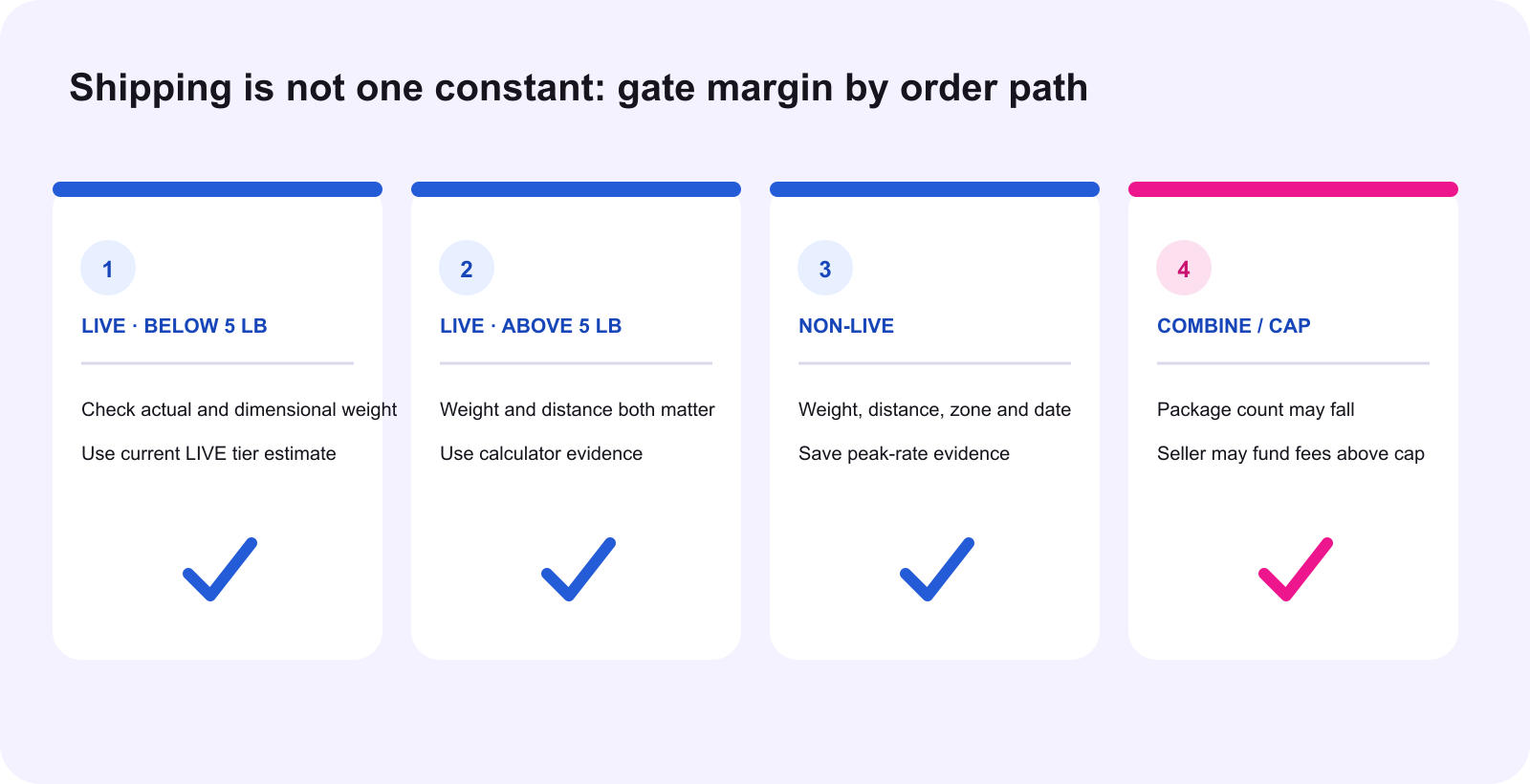
If capped shipping is enabled for LIVE orders, record the shopper contribution and the seller-funded remainder separately. The cap can improve conversion, but it is also a variable promotion cost. The correct question is not whether the shopper likes the cap. It is whether contribution margin still clears the floor at the likely basket and package configuration.
Use billable package evidence, not catalog weight
TikTok Shop Standard Delivery guidance says shipping fees can be based on the greater of actual and volumetric or dimensional weight. Seller Center or an ERP may estimate from maintained product data; after handoff, the carrier can measure the parcel and adjust the final charge. That makes packaging data a finance input, not just a warehouse field.
Measure the packed unit and the packed bundle. Record the source and time of the dimensions. Reconcile estimated settlement against completed-order settlement. If the actual charge repeatedly differs, repair the dimensions, packaging or allowance before increasing volume. A small carton change can move a SKU into another billing outcome even when product weight is unchanged.
Route LIVE and non-LIVE orders through different gates
For an eligible package generated from LIVE orders and weighing below five pounds by both actual and dimensional rules, the current guidance uses a weight-tier LIVE flat rate whether the package contains one order or combined orders. Above five pounds, weight and distance enter the calculation. For non-LIVE packages, the Shipping Calculator uses the standard weight- and distance-based rate card.
That does not mean a team should manually reproduce every current rate in a permanent spreadsheet. Store the Calculator result, input conditions and timestamp. Reference the official page for the governing rule. This keeps the worksheet auditable while avoiding stale constants when rates, eligibility or the interface changes.
Model combined LIVE orders without inventing savings
TikTok Shop notes that combining eligible orders placed by the same shopper during the same LIVE may reduce total shipping charges because fewer packages are created. Model this as a scenario, not a guaranteed discount. Compare separate packages with the actual combined package weight, dimensions, handling effort and damage or split risk.
Use an observed combine rate from your own orders when available. Until then, keep separate and combined outcomes as two scenarios. Do not average the optimistic result into every order. The margin gate should pass under the scenario the team can reasonably operate, not only under the best possible packing outcome.
Peak-season scale sequence
- Freeze one product ID, SKU, bundle and package configuration.
- Measure packed actual weight and dimensions.
- Create separate LIVE and non-LIVE rows.
- Save dated Shipping Calculator evidence for each route.
- Enter shopper-paid shipping and seller settlement separately.
- Complete all remaining variable-cost fields and mark unknowns.
- Calculate contribution margin dollars and percentage.
- Compare the result with the brand's named minimum floor.
- Run a small observed batch and reconcile final settlement.
- Scale only the path that still passes after reconciliation.
Operating example without fabricated rates
Suppose a brand wants to increase LIVE spend on a bundled skincare SKU. The team first measures the packed bundle, then obtains the current eligible LIVE estimate and a non-LIVE estimate using the same warehouse and realistic destination assumptions. It does not copy a public example rate into the model. It records the actual outputs as time-stamped evidence.
The LIVE row may benefit from a different rate structure or combined orders, but a shopper shipping cap may move more cost to the seller. The non-LIVE row may show greater zone sensitivity. If one path remains above the margin floor and the other does not, the decision is path-specific: scale the first and repair the second. This is a WEM operating example, not a promise about a particular account's rate or profitability.
The smallest useful action today
Choose one priority SKU. Measure one packed unit, create one LIVE row and one non-LIVE row, and save the current Shipping Calculator evidence for both. Fill every variable-cost field you can verify. Name the margin floor and one owner. If any required field is unknown, keep the scale decision on hold and assign the missing evidence rather than entering zero.
Source notes
This original WE Marketing operating framework draws on the complete current TikTok Shop U.S. Seller University TikTok Shipping Peak Season Shipping Rate dated September 26, 2026, What Is TikTok Shipping LIVE Flat Rate dated September 21, 2026, and What is TikTok Shipping - Standard Delivery, all revalidated October 11, 2026. Platform rates, eligibility, package rules, calculators, fee configuration and settlement can change. Verify the current U.S. Seller Center and completed-order settlement before execution. This framework does not guarantee a rate, margin, distribution or sales result.
Common questions
Should I copy TikTok Shop peak-season rates into every SKU margin sheet?
No. Save the current calculator result or applicable rate card as dated evidence for each shipping path. Use that evidence in the worksheet, and refresh it when the package, route, order source or platform rate changes.
Is a LIVE flat rate the same as the shipping fee a shopper pays?
No. The official LIVE guidance says the rate card applies to seller settlement, while the shopper-side rate is controlled separately by the seller shipping-fee configuration. Keep both fields separate.
Which weight should I use for TikTok Shipping margin?
Use the billable weight supported by the current shipping workflow. TikTok Shop states that shipping fees may use the greater of actual and dimensional weight, and a carrier audit can create a later adjustment.
Does combining LIVE orders always improve margin?
Not always. Combining eligible orders from the same shopper may reduce the number of packages and total shipping charges, but package weight, dimensions, split risk, handling and the final rate still need to be checked.
How should capped LIVE shipping fees appear in contribution margin?
Treat the amount above the shopper cap that the seller covers as a seller-funded fulfillment cost. Do not record the shopper cap as though it also caps seller settlement.
What is the smallest useful peak-season margin test?
Choose one priority SKU, one LIVE path and one non-LIVE path. Save current calculator evidence, calculate contribution margin for each, set a minimum margin floor, and pause scale if either path falls below it.