TIKTOK SHOP U.S. · HOLIDAY OPERATIONS
TikTok Shop Black Friday Cyber Monday Playbook 2026: Prepare the Shop Before the Promotion
The direct answer
TikTok Shop sellers should prepare for BFCM as an operating test, not a registration task. The official 2026 campaign guide says the US campaign runs from November 11 through November 30 PT, but eligibility, product approval, inventory, dispatch and aftersales can all determine whether a registered offer remains useful.
The practical sequence is simple: protect shop eligibility, register only campaign-ready products, reserve inventory against a real forecast, stress-test fulfillment and give the customer-service team a holiday return plan. If the product is expensive or takes longer to evaluate, add a sixth track now: create the education, proof and creator touchpoints that help shoppers move from awareness to comparison to trust before the peak offer appears.
This is not a promise that BFCM will create sales. It is a way to remove preventable reasons a qualified product misses or loses the moment.
Start with the gate, not the promotional calendar
The official Academy page sets a shop-level entry gate. A participating shop generally needs a Shop Performance Score of 3.5 or higher, a 30-day Late Dispatch Rate of 20% or lower, acceptable account health and successful platform safety checks. TikTok says Account Health Rating should ideally be above 150. At or below 150, temporary enforcement can restrict campaign registration.
Newer shops without an SPS are not automatically excluded. The Academy page says a shop without an SPS may be permitted when it has fewer than three serious violations in the previous 30 days. That is useful, but it should not be read as permission to ignore operational readiness. A new shop may pass the formal gate and still be unprepared for a sudden increase in orders, questions, returns or creator activity.
WEM's operating question is not only, “Can we register?” It is, “What could remove our benefits after we register?” The page says campaign benefits may be revoked if SPS falls below 3.0, and seller performance is monitored during the campaign. A team that is already close to the line should repair dispatch, complaints and policy issues before adding more promotional pressure.
What to check this week
- Open Seller Center > Marketing > Campaigns and review Campaign Details.
- Review Shop Criteria, Account Health, current SPS and the 30-day LDR.
- List open violations, OVL restrictions, overdue orders and complaint-heavy products.
- Assign an owner and a repair date to every risk that could block registration or continued participation.
- Capture the current status before making changes, then read it back after the repair.
Shop eligibility does not make every SKU campaign-ready
TikTok reviews products separately from the shop. The Academy guide says participating products should have a low complaint rate relative to comparable products, accurate listings, compliant content, no counterfeit or other intellectual-property problem, available stock and the ability to ship.
That means the biggest catalog is not automatically the strongest campaign assortment. A product can be technically buyable and still be a poor BFCM choice because its listing creates confusion, its return reason is unresolved, its margin cannot support the campaign price, its inventory is fragile or its warehouse cannot absorb the likely order pattern.
Start with a controlled hero assortment. For each candidate SKU, document:
- the customer problem and why the product is relevant during the holiday period;
- the regular price, proposed campaign price, contribution margin and non-stackable promotion risk;
- available units, inbound units, inventory reserved for other channels and the replenishment cutoff;
- complaint and return themes that could become more expensive at higher volume;
- the listing, claims, images, video, variations and creator content that must be final before registration;
- the owner who can stop promotion if stock, fulfillment or product quality moves outside the safe range.
The Academy page notes that registered variations cannot be added or deleted during the campaign. It also says strike-through pricing appears only when the campaign sale price is below the regular retail price, and that some seller promotions do not stack with campaign pricing. Price architecture and variations therefore belong in the pre-registration review, not in a last-minute creative meeting.
High-price products need a runway before the discount
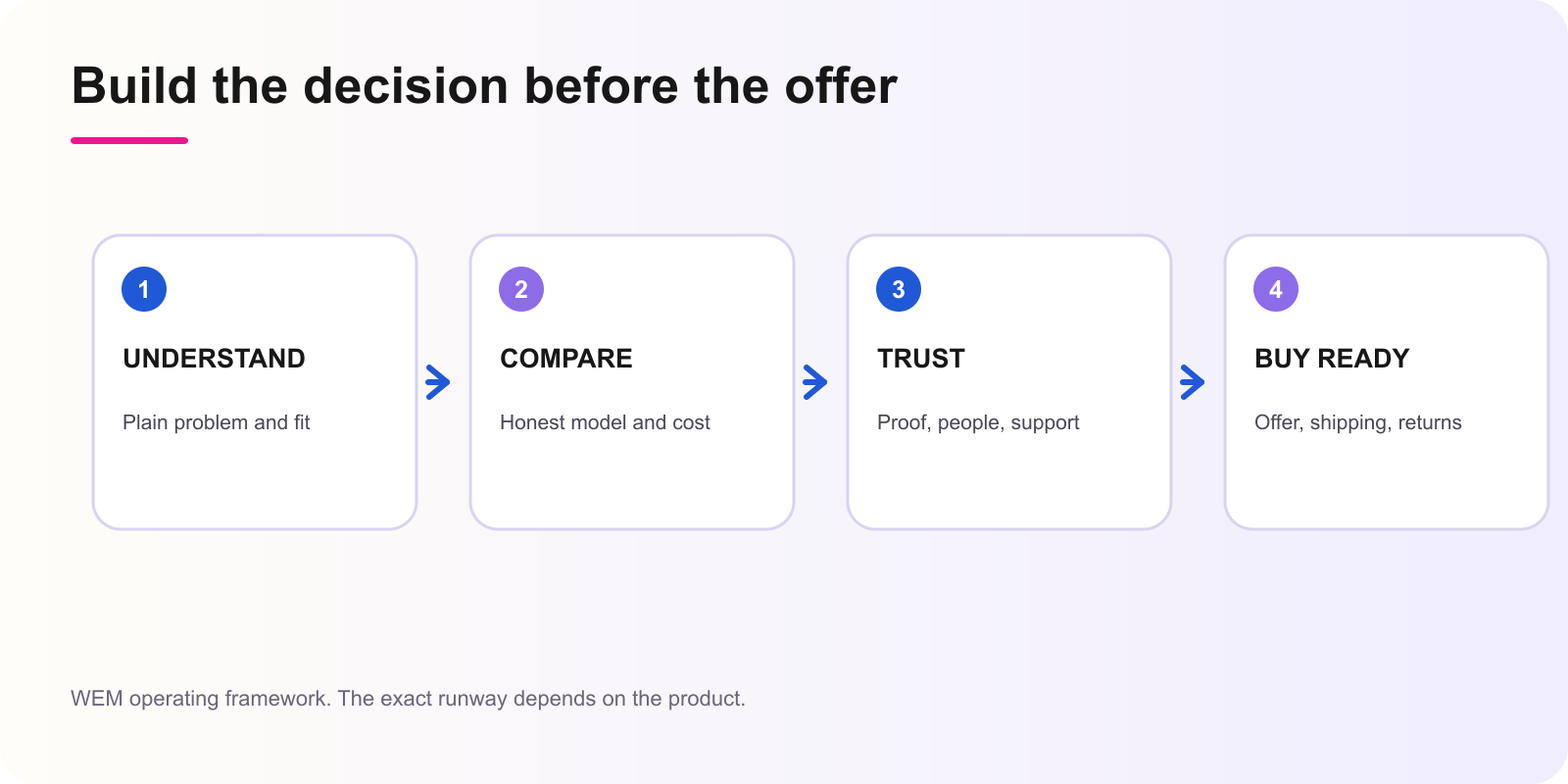
Wendy's operating judgment is especially important for high-ticket or high-consideration products: if shoppers need more time to understand, compare and trust the purchase, the brand must start building that decision path now. Waiting until Black Friday to explain the product gives the discount too much work to do.
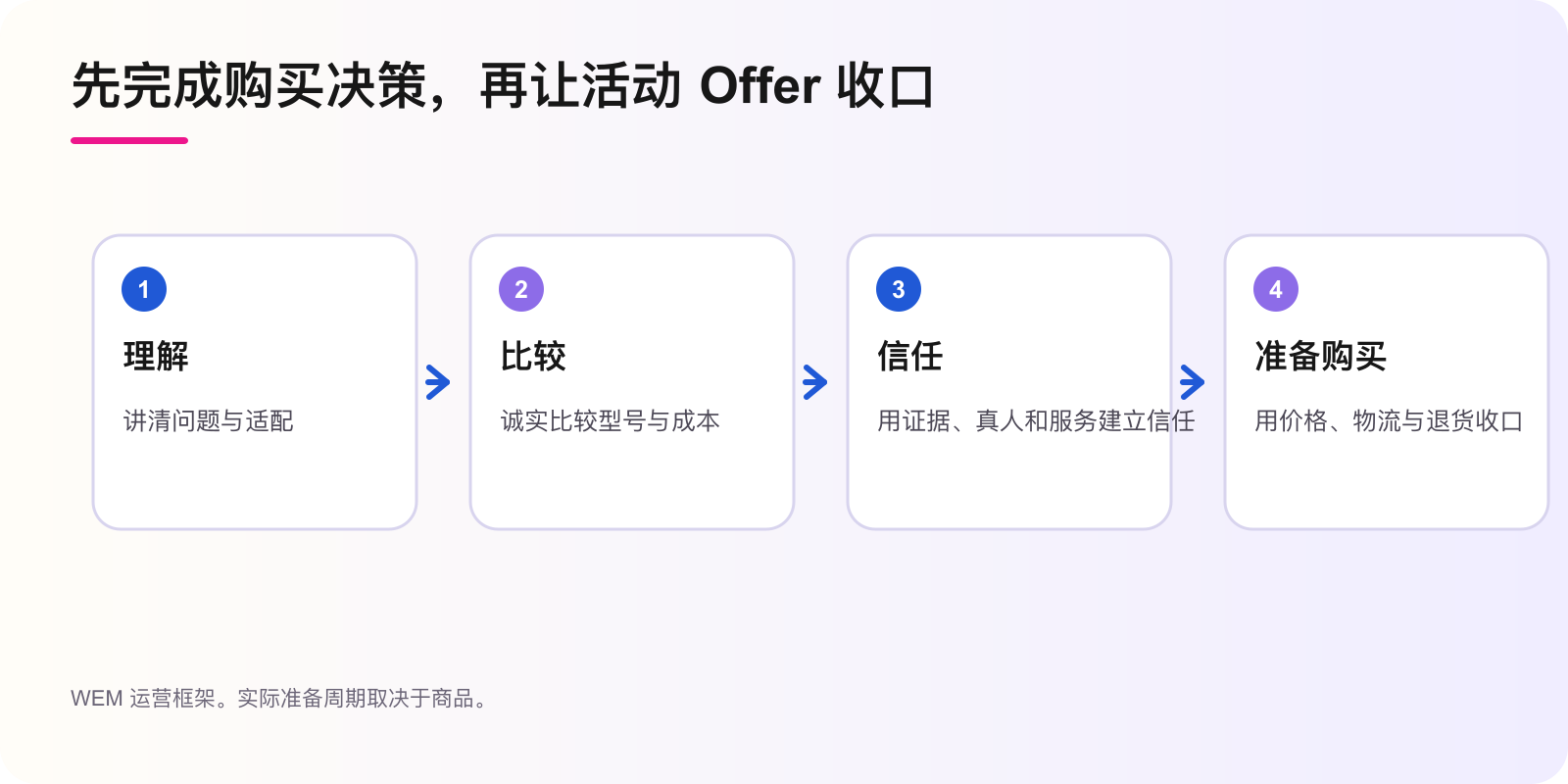
The purchase path usually has four different jobs:
1. Understanding
Show what the product is, who it is for and what problem it solves. Do not begin with a crowded feature list. A shopper first needs a plain-language reason to keep evaluating.
2. Comparison
Answer the questions that make the shopper hesitate: what is included, what makes this model different, what ongoing cost exists, what the size or fit means, and which alternative is better for a different buyer. Honest comparison can reduce the wrong purchase, not only improve persuasion.
3. Trust
Use demonstrations, creator explanations, reviews, warranty or support information and claim-safe evidence. The brand should decide which concerns require an expert voice, a real-user demonstration, a product-page answer or a live Q&A. One creator video should not be expected to carry every trust job.
4. Purchase readiness
Only after the first three jobs are covered should the campaign price, bundle, shipping promise and return terms close the decision. The offer should make an informed shopper comfortable acting now. It should not hide an unresolved question.
Creator work should follow that sequence. Seed products early enough for creators to learn the product, identify believable angles and produce content that can be reviewed for accuracy. Use early short videos to surface recurring questions. Route those questions back into the listing, FAQ, comparison content and LIVE talking points. Reserve peak-period creator posts for the strongest proven explanations and the actual offer.
Hypothetical example: a premium at-home beauty device
This is an operational example, not a WEM client result. Imagine a premium beauty device with a higher price than the category's impulse purchases. The likely barriers are not only price. Shoppers may question who should use it, how it fits into a routine, what is included, how often it is used, what support exists and whether a cheaper tool would be enough.
The brand can begin with educational demonstrations and creator routines that show the use case without unsupported performance claims. Next, it can publish a comparison that says which buyer may not need the premium model. It can collect the most repeated questions, improve the listing and train customer support. Before BFCM, the team can test whether the bundle, product page and creator explanation reduce confusion. During BFCM, the discount then gives an already-informed shopper a reason to act. The campaign is closing accumulated demand, not introducing the product from zero.
Build an inventory and fulfillment control room
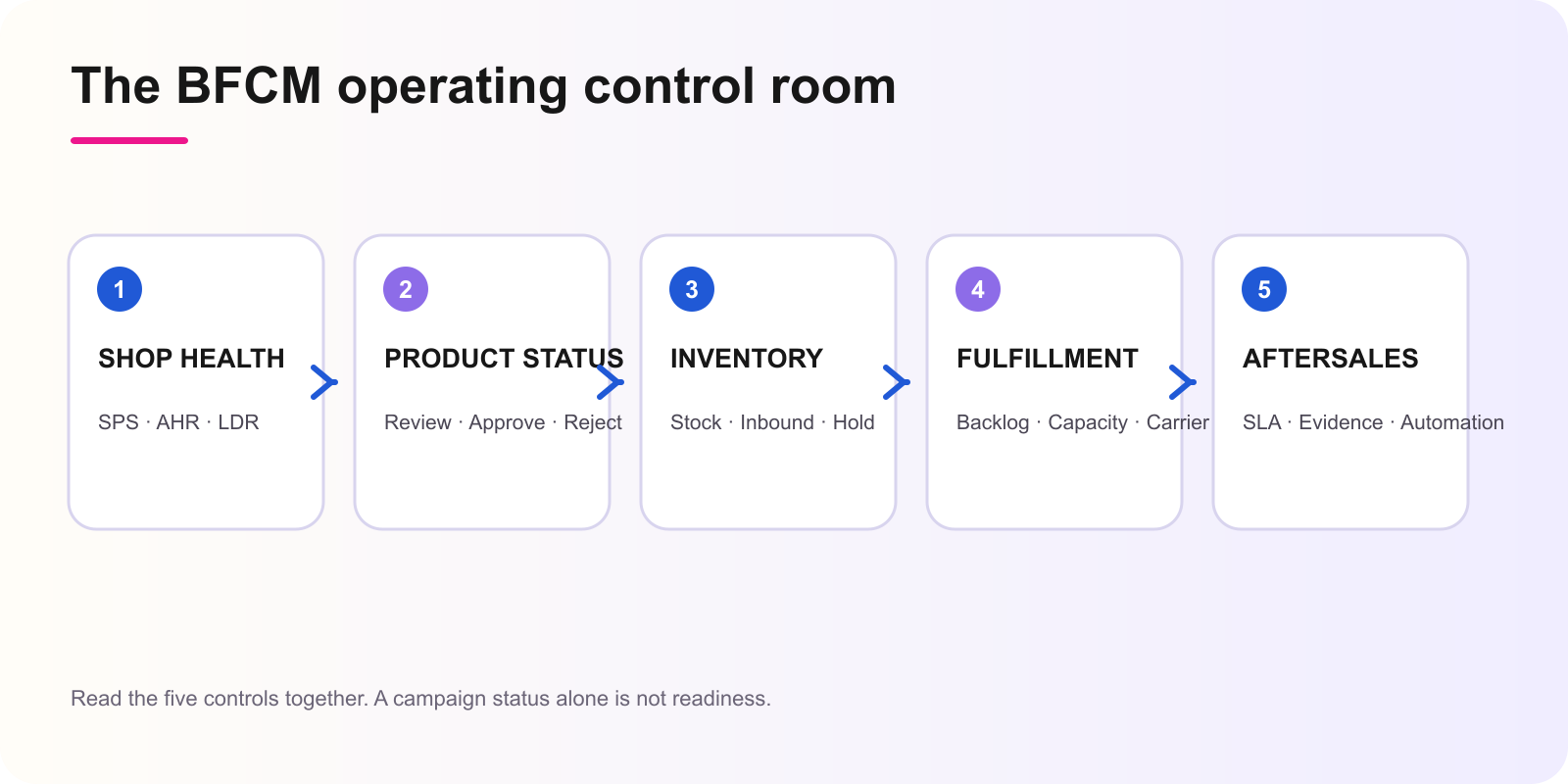
The Academy guide identifies out-of-stock status, Holiday Mode, unavailable warehouses, Order Volume Limits and overdue unshipped orders as reasons products can be rejected or removed. The operating lesson is that inventory, warehouse capacity and campaign status must be reviewed together.
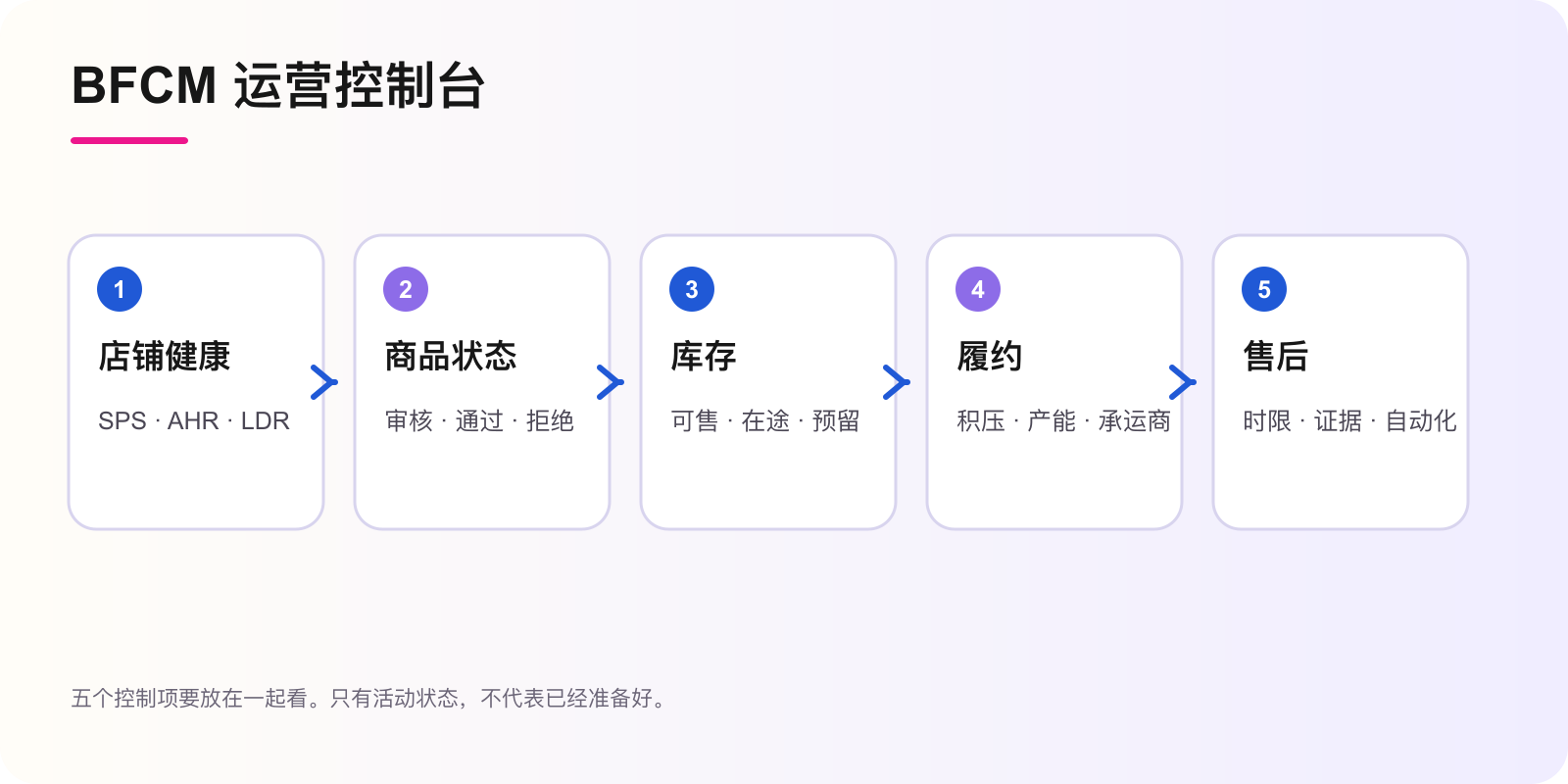
Create one daily control view for the campaign assortment:
| Control | What the owner needs to see | Stop or repair signal |
|---|---|---|
| Available inventory | Sellable units after channel reservations | Coverage falls below the next replenishment window |
| Orders awaiting dispatch | Units and oldest order age by SKU | Backlog grows faster than the warehouse can clear it |
| Warehouse capacity | Pick, pack and label throughput | Staffing, material or carrier handoff misses the plan |
| Product status | Under review, Approved, Rejected or Scheduled | A status changes without an assigned response |
| Complaints and returns | New reasons, ratings and high-risk SKUs | A repeated quality or listing issue appears |
| Account health | SPS, AHR, LDR, OVL and policy notifications | Any metric or restriction approaches the campaign gate |
TikTok's guide publishes temporary BFCM fulfillment-SLA extensions for defined order-date windows and separates local from international shipping. It also says the extensions do not apply to pre-order and back-order. Treat an extension as capacity relief, not permission to delay every order. The faster the team identifies a risky SKU or carrier bottleneck, the more options it has before customer complaints and overdue orders affect the campaign.
Prepare aftersales before the first peak order
The official guide says eligible items sold from November 11, 2026 at 16:00 PT through December 31, 2026 at 23:59 PT receive an automatic extended return window through February 10, 2027. Selected categories may keep standard rules, and auction orders are not eligible for the extension.
The extended customer window does not extend the seller's everyday review discipline. The Academy page says standard aftersales review SLAs remain in place during BFCM, and a missed review SLA may auto-approve a buyer request. It also warns that rejecting requests without solid evidence can raise Invalid Seller Rejection Rate and lead to platform-managed review.
Before the campaign, decide:
- who reviews cancellations, refund-only requests and return-and-refund requests each day;
- what photos, tracking records and timestamps the team preserves;
- which low-value or low-risk requests may use seller-controlled automation;
- which categories or auction orders follow different return rules;
- how January and early-February staffing will cover the longer holiday return tail.
Automatic returnless refunds, approvals, partial refunds and replacements can reduce manual work when configured carefully. They should reflect product economics and abuse risk, not serve as a blanket substitute for review.
If a product is rejected, repair the reason before escalating
The Register Products page can show Under review, Approved, Rejected or Scheduled. A rejection is not one generic problem. High complaints, content-policy violations, out-of-stock status, Holiday Mode, OVL, platform risk and overdue unshipped orders require different owners and evidence.
Use this order:
- read the exact reason and preserve the current status;
- identify whether the failure is listing, product quality, inventory, warehouse, account health or policy;
- fix the underlying condition and confirm the new state;
- re-register when the interface permits;
- use an available Account Health appeal only when the decision is actually appealable and the evidence supports it;
- contact Seller Support after the team has reviewed the status and completed the available repair path.
The Academy guide says some risk-related or high-complaint cases may not offer an online appeal. Repeatedly submitting the same explanation does not replace fixing the condition that created the status.
The smallest useful BFCM planning meeting
A two-hour meeting is not required to start. Put the shop owner, catalog owner, creator/content lead, warehouse owner and aftersales owner around one page. Review the eligibility gate, pick the hero assortment, name the highest-risk operational dependency and assign the first repair. For high-consideration products, add the first customer question that must be answered before the shopper can compare confidently.
Then set a weekly review until launch and a daily control rhythm during the peak. BFCM does not need more disconnected activity. It needs one shared operating picture.
Related operating guides
Use the 2026 TikTok Shop campaign calendar to place BFCM inside the wider holiday plan. Then connect this playbook to the shop health and growth-risk system, the pre-order, made-to-order and back-order guide, and the fulfillment growth system. If a decision reaches Account Health, use the correct-or-appeal framework before submitting evidence.
Source notes and execution boundary
Primary source read in full on September 23, 2026: TikTok Shop US Academy, “2026 Black Friday & Cyber Monday (BFCM) Seller Campaign Guide”, dated September 20, 2026 and applicable to the United States. The page provides the official facts about campaign dates, eligibility, registration, product status, removal reasons, SLA extensions and holiday returns used here. Platform interfaces, eligibility and account-specific status can change. Verify the current Campaign Details, Shop Criteria, Account Health and Register Products pages before execution.
The high-consideration-product framework, operating sequence and premium beauty-device scenario are WEM analysis. The scenario is hypothetical and does not claim client performance, a universal purchase cycle or a TikTok requirement.
Frequently asked questions
When does the 2026 TikTok Shop US BFCM campaign run?
The Academy guide observed on September 23 says November 11 through November 30 PT. Sellers should confirm the current campaign page because registration and account-specific status live in Seller Center.
What SPS does a shop need for BFCM?
The guide says 3.5 or higher. A shop without an SPS may still be permitted with fewer than three serious violations in the last 30 days. Benefits may be revoked if SPS falls below 3.0.
When should a high-ticket product begin BFCM preparation?
Begin before the peak offer must do the selling. The exact runway depends on the product, but the team needs time to explain the product, answer comparison questions, build trust, test creator angles, correct the listing and prepare inventory. This is WEM operating guidance, not a platform deadline.
Can a seller add a new color or size after registering a product?
The 2026 Academy guide says registered variations cannot be added or deleted during the campaign. Finalize the variation structure before registration and verify the current product status in Seller Center.
Do BFCM fulfillment extensions apply to pre-orders and back-orders?
No. The Academy page says the published BFCM SLA extensions do not apply to pre-order and back-order. Sellers should review the exact current table for their shipping model and order date.
Does the extended holiday return window change aftersales review deadlines?
No. The shopper's eligible return window is longer, but the guide says standard seller review SLAs remain in force. A missed review SLA may result in automatic approval in the buyer's favor.
What should a seller do when a product is rejected?
Read the exact reason, repair the underlying listing, inventory, fulfillment, account-health or policy problem, then re-register when available. Appeal only when the interface offers a valid appeal path and the evidence supports it.