TIKTOK SHOP U.S. · ACCOUNT HEALTH
Correct or Appeal a TikTok Shop Violation? Choose by Facts, Evidence and Deadline
WE Marketing Team · Aug 28, 2026 · 15 min read
Direct answer
Choose Correction when the live ticket offers it and the seller can truthfully repair a fixable listing issue. Choose Appeal when the enforcement decision is disputed and the seller has specific evidence that the cited facts or policy application are wrong. Never select a path merely because it sounds faster or more forceful.
Current Seller University explains that Correction is available only for eligible, fixable issues and occurs before enforcement during the displayed correction window. The seller updates the live listing and submits required proof. If approved, enforcement is canceled; if unsuccessful or expired, enforcement may take effect and an appeal may still be available. An appeal formally disputes the decision or enforcement.
WEM treats correction-versus-appeal decision as an operating system, not a shortcut. The platform can accelerate navigation and pattern finding, but a seller still owns the commercial promise made to shoppers, creators, employees, and regulators. Any missing account fact remains unknown. It must not be converted into zero, approval, eligibility, or a public claim.
Define the decision before touching the tool
Start with one sentence: “We need to decide whether to keep, repair, expand, pause, or stop this specific object.” Name the object, owner, deadline, and evidence source. This keeps the work focused when Seller Center exposes several related cards, reports, tickets, products, or workflows at once.
Then separate four layers: the platform record, the AI or human interpretation, the proposed action, and the terminal result. Those layers often look adjacent in the interface but they are not interchangeable. A recommendation is not permission, a submission is not approval, and an activity count is not a business outcome.
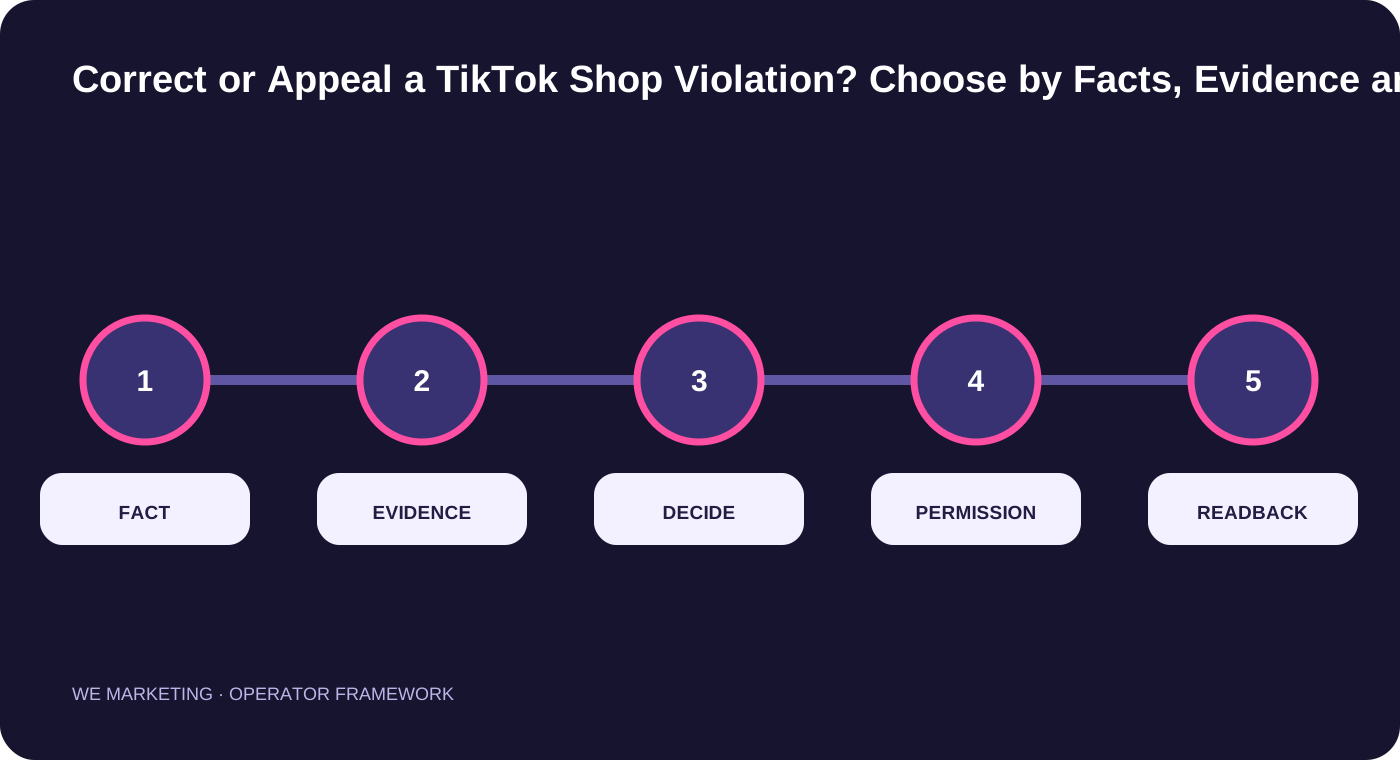
The five-part WEM control gate
| Gate | Required question | Stop condition |
|---|---|---|
| Availability | Which paths are displayed on this ticket? | The team assumes a feature exists. |
| Fact position | Does the seller accept the cited defect or dispute it? | The response contradicts its own evidence. |
| Repairability | Can the exact issue be corrected on the live listing? | The proposed edit does not address the ticket. |
| Proof | What file or record proves correction or supports appeal? | The submission contains opinion without evidence. |
| Timer | Can the complete path finish before the live deadline? | The team works from an old SLA. |
Use the gate in order. Do not compensate for one missing layer by adding confidence to another. A clear recommendation with the wrong product ID is still wrong. Strong evidence submitted after a live deadline may still fail. A successful click without terminal readback remains an attempt.
Build an evidence packet that another operator can audit
The minimum packet contains the account and object identity, current status, relevant date window, source record, decisive screenshots or exports, proposed change, owner, and next readback. For a policy or claim decision, add the exact wording and supporting document. For an analytics decision, add metric definition, filter, timezone, granularity, and refresh time. For an AI-assisted action, add the permission boundary and the final live record.
Keep originals before editing. A team cannot defend an appeal, explain a change, or learn from a failed recommendation if the prior state disappeared. Store evidence with a stable name and date. If privacy or account restrictions apply, record where the evidence lives rather than copying sensitive data into an open document.
Run the operating sequence
- 1. Read the ticket and current status before changing anything.
- 2. Write one sentence stating whether the cited fact is accepted or disputed.
- 3. Confirm which response paths are actually available.
- 4. Map each ticket element to a correction action or appeal exhibit.
- 5. Prepare files in the accepted format and size.
- 6. Submit once through the chosen path and preserve the receipt.
- 7. Read Under Review, Canceled, Enforcement Action Taken, or other terminal status before closure.
Each step should leave a visible state. “Reviewed” needs a named reviewer and source. “Submitted” needs a receipt. “Live” needs the public or account-side record. “Resolved” needs a terminal status. This discipline matters most when several teams share product, compliance, affiliate, fulfillment, finance, and advertising responsibilities.
Separate reversible actions from high-consequence actions
Low-consequence actions include opening a report, drafting a checklist, comparing a record, or preparing a proposed change. Higher-consequence actions include changing price or commission, publishing a claim, editing fulfillment data, submitting a policy response, refunding an order, launching spend, or altering bank and business information. Require more explicit evidence and permission as consequence rises.
Batch actions require their own gate. A safe decision for one SKU, ticket, creator, or campaign does not automatically generalize. Test the smallest useful scope, observe the result, and expand only when the rule and exception path are stable. This is how speed becomes repeatable rather than merely fast.
Measure decision quality, not just activity
Track whether the team found the correct record, reproduced the source number or status, acted before the real deadline, avoided unnecessary scope, and closed with terminal evidence. Also track reversals, unresolved exceptions, and how often a recommendation changed after a native report or policy source was opened. Those are useful signals about the operating system.
Do not reward the team for generating more prompts, reports, edits, or submissions. Reward fewer unforced errors, faster exception ownership, clearer evidence, and a smaller gap between the proposed action and the verified result. A good system makes the next decision easier to explain.
Hypothetical operating example
This is a hypothetical example, not a WEM client result. A product image is low resolution and Correction is offered. The seller agrees with that narrow defect, replaces the image, confirms the updated listing is live, and submits the required screenshot. In a separate ticket alleging unauthorized brand use, the seller disputes the finding and prepares dated authorization documents for Appeal. The team does not reuse the first ticket’s correction language for the second case.
The important outcome is not that the tool “worked.” The important outcome is that the team could reconstruct why it acted, which boundary it respected, and what live evidence proved the next state. If the evidence had disagreed, the same process would have stopped or reversed the action.
Weekly review questions
- Which decisions used a complete live record and which relied on an assumption?
- Which deadlines, filters, or eligibility rules changed during the week?
- Where did a generated explanation disagree with a native report or policy page?
- Which action lacked a named terminal readback?
- Which exception should become a new checklist item, permission boundary, or stop rule?
- What is the single smallest repair that reduces the most operating risk next week?
Keep the review bounded. The goal is not to rewrite every SOP. Choose one repeated error, add one control, assign one owner, and inspect the next occurrence.
Smallest useful next action
Choose one current correction-versus-appeal decision decision. Write the object, live status, source, exact proposed action, possible consequence, approving owner, and terminal readback in one row. If any field is unknown, resolve that field before expanding the scope. This one-row discipline is more valuable than a broad automation promise.
Source notes
This original WEM operating framework draws on complete current U.S. TikTok Shop Seller University materials revalidated on August 31, 2026: How to Correct Seller Violations, What To Do When You Receive A Violation, TikTok Shop Seller University source 2380042836166443. Platform interfaces, availability, eligibility, limits, metric definitions, enforcement records, and account-level actions can change. Verify the current U.S. Seller Center record and the brand's own facts before execution.
Frequently asked questions
Can the team rely on an AI or platform summary alone?
No. Use it to navigate and form a hypothesis, then check the native record, exact scope, and current source before acting.
What does a successful submission prove?
Only that a submission was accepted for processing. Read the live status or terminal record before calling the business outcome complete.
Should unknown data be treated as zero?
No. Unknown means the source was unavailable, not refreshed, or not in scope. Label it and resolve it before making a dependent decision.
When is a batch action appropriate?
Only after the rule has worked on a bounded scope, the exception path is known, and the owner can stop or reverse the action.
Who should own correction-versus-appeal decision?
One accountable operator should own the final decision, with product, policy, finance, fulfillment, or analytics reviewers added according to consequence.
How often should the framework be reviewed?
Review after every material exception and during the weekly operating cadence. Revalidate volatile platform paths and rules at execution time.