TIKTOK SHOP U.S. · ACCOUNT HEALTH
Account Health, Shop Experience and Growth: Fix the Right Risk First
WE Marketing Team · Sep 20, 2026 · 15 min read

Direct answer
Do not respond to every score decline with more sales activity or a generic “improve the store” plan. First identify whether the issue is an Account Health Rating compliance event, a Shop Performance Score customer-experience signal, a product-level defect, or an operational capacity problem. Protect buyers and stop the violating or harmful activity first, preserve evidence and deadlines, then repair the earliest controllable cause before rebuilding growth access.
A growth-risk map separates enforcement risk from experience performance. AHR reflects policy compliance and can carry milestone or case-specific enforcement. SPS compares product satisfaction, fulfillment and customer service performance and can affect access to growth benefits, but a low SPS is not itself the same as a violation. The operating record must connect the exact ticket or metric to affected products, orders, customers, owners, deadlines and a verified terminal state.
The operating question is never “what can the tool do?” It is “what decision can the team safely make from current evidence, and who owns the readback?”
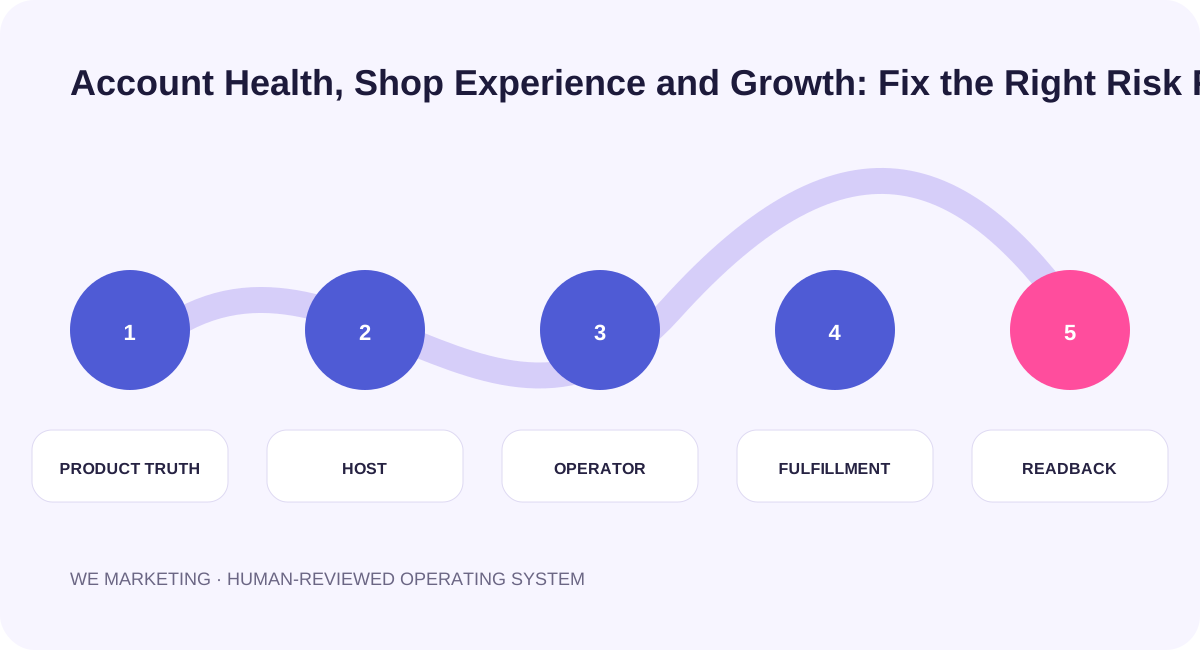
Why immediate harm and enforcement gate comes before execution
A team can keep selling or promoting the source of harm while focusing on a cosmetic dashboard improvement. That is why the first operating move is specific: Check for product safety, prohibited items, fraud, counterfeit or IP risk, active restrictions, frozen funds, account access loss or another condition that requires an immediate hold. Stop the affected activity before optimizing a score. The evidence is equally specific: Exact violation ticket, policy citation, affected listing or order, enforcement state, deadline, buyer impact and current Seller Center readback. A fast interface cannot repair a wrong classification or an unverified starting point. It can only execute the team's assumption more quickly.
This article therefore treats immediate harm and enforcement gate and classify ahr versus sps as connected release gates. The team does not advance because a recommendation looks confident or a dashboard tile turns green. It advances when the exact object is known, the current account evidence supports the action and the consequence of being wrong is inside a written guardrail.
The evidence packet for this decision
Build one packet from the evidence families used across this workflow: Exact violation ticket, policy citation, affected listing or order, enforcement state, deadline, buyer impact and current Seller Center readback. AHR page, SPS page, metric definition, calculation window, category context, violation history and benefit state. Ticket timestamp, screenshots, source records, product and order IDs, appeal requirements, owner, submitted package and readback time. These records answer different questions and should not be collapsed into one score. Platform evidence describes access and observed state. Brand evidence describes product truth, cost, stock, staffing and what the customer can actually receive.
Keep the later-stage records beside them: Negative reviews, non-buyer-fault returns, cancellations, delivery records, service cases, content or listing version and operator log. Correction record, submission receipt, final decision, restored or restricted permissions, live listing, affected orders and customer resolution. Recovered permissions, current SPS dimensions, stable product and fulfillment evidence, test budget, inventory, owner, review window and stop rule. Mark unavailable facts as unknown, with an owner and resolution date. If the missing fact affects product identity, permission, customer safety, sellable inventory, fulfillment or the economic floor, it is a stop condition. If it only limits confidence in an optimization idea, the team may choose a smaller reversible test.
1. Immediate harm and enforcement gate
Operating move: Check for product safety, prohibited items, fraud, counterfeit or IP risk, active restrictions, frozen funds, account access loss or another condition that requires an immediate hold. Stop the affected activity before optimizing a score.
Required evidence: Exact violation ticket, policy citation, affected listing or order, enforcement state, deadline, buyer impact and current Seller Center readback.
Failure mode: A team can keep selling or promoting the source of harm while focusing on a cosmetic dashboard improvement.
Before closing this gate, assign one owner and one readback time. Save the exact page, asset, product, session or order identifier. If the live state differs from the approved state, stop the sequence, record the exception and repair the earliest broken handoff rather than compensating later with more traffic, discount or content.
2. Classify AHR versus SPS
Operating move: Identify the system and object. AHR is a seller compliance rating with points and enforcement context. SPS is a shop-experience score built from product satisfaction, fulfillment and customer service metrics. Record both when they interact, but never substitute one for the other.
Required evidence: AHR page, SPS page, metric definition, calculation window, category context, violation history and benefit state.
Failure mode: Combining two scores hides whether the next action is appeal, correction, operational repair or growth planning.
Before closing this gate, assign one owner and one readback time. Save the exact page, asset, product, session or order identifier. If the live state differs from the approved state, stop the sequence, record the exception and repair the earliest broken handoff rather than compensating later with more traffic, discount or content.
3. Protect deadlines and evidence
Operating move: For a violation or enforcement, record the appeal or correction deadline, permitted path and original evidence before editing the underlying listing or workflow. For an SPS issue, preserve order-level examples and category benchmarks before changing several systems.
Required evidence: Ticket timestamp, screenshots, source records, product and order IDs, appeal requirements, owner, submitted package and readback time.
Failure mode: Late, generic or unverifiable evidence can close a valid correction path, while simultaneous edits destroy root-cause learning.
Before closing this gate, assign one owner and one readback time. Save the exact page, asset, product, session or order identifier. If the live state differs from the approved state, stop the sequence, record the exception and repair the earliest broken handoff rather than compensating later with more traffic, discount or content.
4. Find the earliest controllable cause
Operating move: Trace the affected metric or ticket to product truth, inventory, fulfillment, service, content or account control. Use the specific orders and buyer language behind the signal, not the total score alone.
Required evidence: Negative reviews, non-buyer-fault returns, cancellations, delivery records, service cases, content or listing version and operator log.
Failure mode: A low-level symptom can be repaired temporarily while the product, promise or operating process keeps generating the same risk.
Before closing this gate, assign one owner and one readback time. Save the exact page, asset, product, session or order identifier. If the live state differs from the approved state, stop the sequence, record the exception and repair the earliest broken handoff rather than compensating later with more traffic, discount or content.
5. Repair and verify the live state
Operating move: Correct the source issue, submit an appeal only where evidence supports it, and read back the actual account, product, order or permission state. Passing a quiz, sending a ticket or uploading a document is not equivalent to reinstatement.
Required evidence: Correction record, submission receipt, final decision, restored or restricted permissions, live listing, affected orders and customer resolution.
Failure mode: Teams may resume campaigns because a task was submitted even though the enforcement or customer problem remains open.
Before closing this gate, assign one owner and one readback time. Save the exact page, asset, product, session or order identifier. If the live state differs from the approved state, stop the sequence, record the exception and repair the earliest broken handoff rather than compensating later with more traffic, discount or content.
6. Rebuild growth deliberately
Operating move: After buyer harm is controlled and the relevant state is verified, choose the smallest growth action supported by the repaired operation. Monitor the specific metric, not only the composite score, and keep a rollback rule.
Required evidence: Recovered permissions, current SPS dimensions, stable product and fulfillment evidence, test budget, inventory, owner, review window and stop rule.
Failure mode: A rapid return to full promotion can recreate the same violation or customer-experience failure before the repair is proven.
Before closing this gate, assign one owner and one readback time. Save the exact page, asset, product, session or order identifier. If the live state differs from the approved state, stop the sequence, record the exception and repair the earliest broken handoff rather than compensating later with more traffic, discount or content.
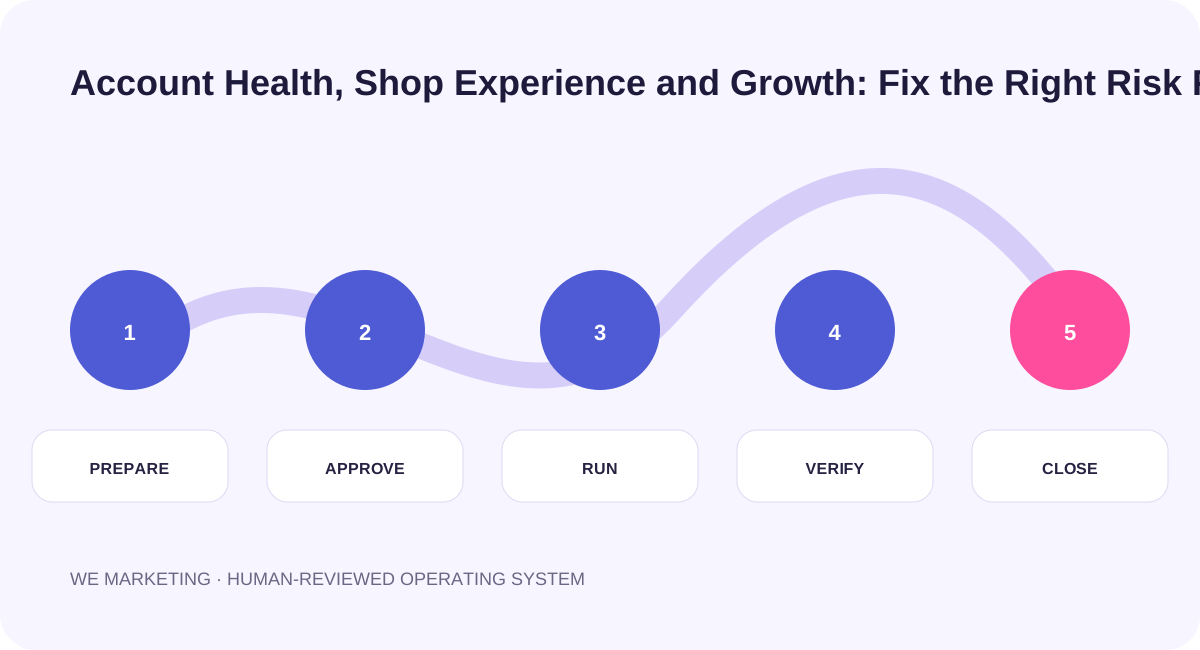
Tradeoffs and stop rules for repair and verify the live state
The central tradeoff is between protect deadlines and evidence and repair and verify the live state. Moving early may capture demand or learning, but it also exposes the failure mode already named in the workflow: Teams may resume campaigns because a task was submitted even though the enforcement or customer problem remains open. Waiting for perfect information may waste a time-bound opportunity. The practical answer is not maximum speed or maximum caution. It is the smallest release whose downside the owner can observe and stop.
Write stop rules from the actual failure modes: A team can keep selling or promoting the source of harm while focusing on a cosmetic dashboard improvement. Combining two scores hides whether the next action is appeal, correction, operational repair or growth planning. Late, generic or unverifiable evidence can close a valid correction path, while simultaneous edits destroy root-cause learning. A low-level symptom can be repaired temporarily while the product, promise or operating process keeps generating the same risk. Teams may resume campaigns because a task was submitted even though the enforcement or customer problem remains open. A rapid return to full promotion can recreate the same violation or customer-experience failure before the repair is proven. Convert the relevant conditions into observable thresholds and give one person authority to pause. The rule should also name the safe state after a stop, such as hold the product, end paid support, remove the item from the session, repair the listing or reconcile affected orders.
Hypothetical operating example
A hypothetical seller sees affiliate access pause and a lower composite performance score on the same day that a listing violation appears. The team does not assume one caused the other. It freezes the affected product, records the violation ticket and correction deadline, and confirms whether other products remain eligible. Separately, SPS detail shows that seller-fault cancellations are the largest experience opportunity, driven by one oversold variation. The compliance owner corrects the listing evidence and waits for a verified decision; the operations owner repairs inventory synchronization and reconciles affected orders. Only after the product state and cancellation process are stable does the growth owner reopen a small creator test on an unaffected SKU. One response protects policy rights; the other repairs buyer experience.
This example is illustrative, not a WEM client result. The point is the decision sequence: classify the object, gather current evidence, separate hard gates from optimization choices, release the smallest defensible action and verify the named live state. If the conditions change materially, the team starts a new comparison rather than forcing the result into the old test.
Review the six gates as one sequence
The review order is Immediate harm and enforcement gate, Classify AHR versus SPS, Protect deadlines and evidence, Find the earliest controllable cause, Repair and verify the live state, Rebuild growth deliberately. Keep one active row for each unresolved gate and connect it to the exact product, event, campaign or decision. A row is pending when its required evidence is missing, blocked when a named condition prevents safe work, released when the approved action is visibly live and verified only after rebuild growth deliberately closes the consequence.
The weekly decision must be topic-specific. Close the row as repeat when the same controlled conditions should run again, repair when an earlier gate failed, expand when comparable evidence supports more exposure, monitor when no action is currently justified or stop when the risk or economics no longer support the path. A draft, upload, submission or recommendation cannot close this sequence.
Smallest useful next action
Open the current AHR and SPS pages. Create two separate rows: one for the most consequential open ticket or restriction, one for the weakest customer-experience metric. Attach the exact affected objects, deadline, evidence and owner, then stop any activity that creates immediate buyer or policy harm before choosing the first repair.
Source notes
This original WEM growth-risk map draws on current TikTok Shop U.S. Seller University guidance on Account Health Rating Requirements, the Guide to Shop Performance Score and the Seller Enforcement Policy, revalidated September 20, 2026. The official sources distinguish seller compliance and enforcement from customer-experience performance and growth benefits. WEM adds the immediate-harm gate, separate case records and earliest-cause repair order. Scores, thresholds, benefits, timelines and interface paths may change. Verify the current Seller Center ticket, metric and permission state before acting.
Frequently asked questions
Is AHR the same as SPS?
No. AHR concerns seller policy compliance and enforcement context; SPS reflects product, fulfillment and customer-service experience.
Should we appeal every violation?
No. Appeal only when the current requirements and verifiable evidence support it. Otherwise correct the source issue within the allowed path and deadline.
Does passing a policy quiz remove the violation?
Not by itself. A quiz may affect points or milestone duration under current rules, but the team must read the exact violation and permission state.
Does a low SPS itself mean the shop violated policy?
No. SPS is experience and benefit oriented. The underlying orders may still reveal operational problems that require repair.
Which problem comes first when several appear together?
First stop immediate buyer or policy harm, then protect deadlines, then repair the earliest controllable cause with the largest consequence.
What is the smallest useful action today?
Separate the top open AHR case from the weakest SPS metric and assign evidence, deadline, owner and next readback to each.