TIKTOK SHOP U.S. · SMART PROMOTION
TikTok Shop Smart Promotion: Read Performance and Cost Before You Call It Growth

Direct answer: Smart Promotion performance is not the same thing as incremental growth
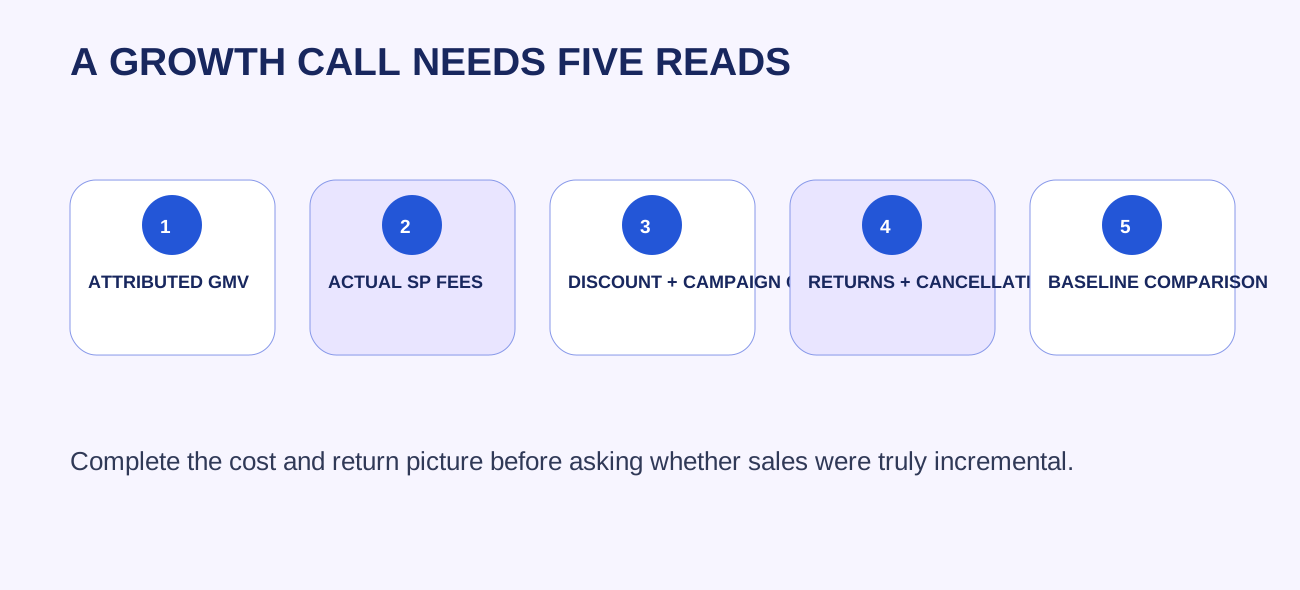
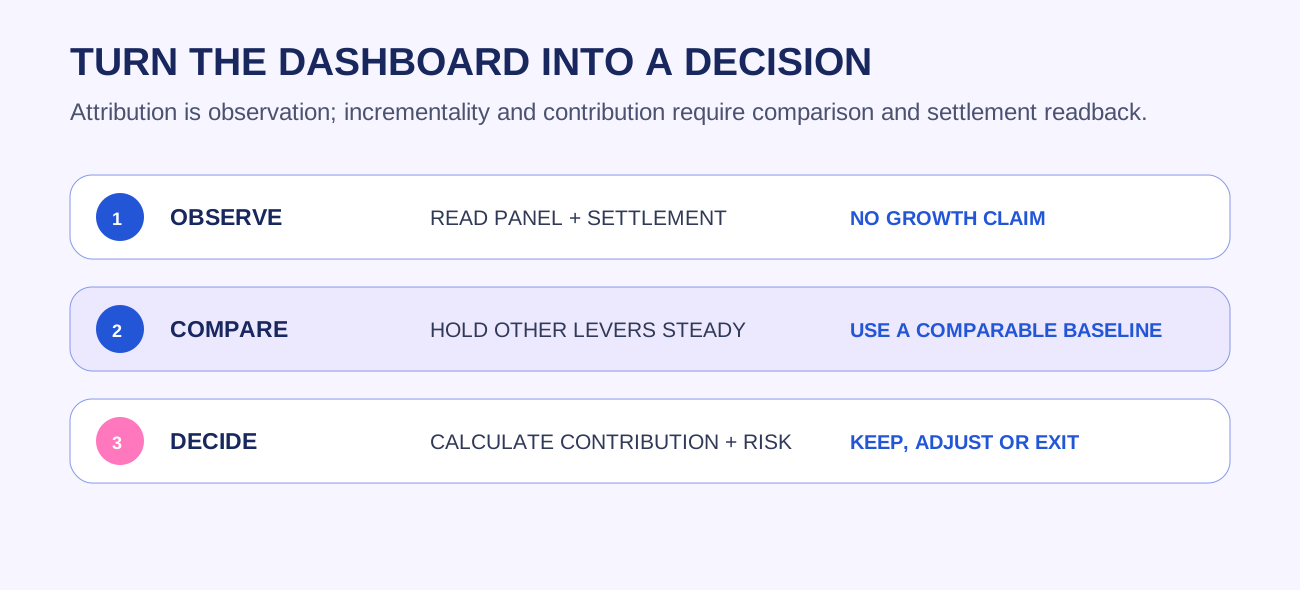
Read Smart Promotion in three layers. First, use the program panel to understand attributed sales, discount support, exposure and access. Second, use settlement records to identify the actual Smart Promotion fee and any campaign-period fee charged on eligible GMV. Third, compare contribution after product cost, creator commission, ad spend, fulfillment, returns and other discounts against a credible baseline. Only the third layer can support a growth decision.
The smallest next action is to export or record one recent seven-day period and reconcile it to order settlements before changing budget, price or creator activity. A rising dashboard can be useful, but it cannot by itself show that the program caused sales that would not otherwise have happened.
1. Separate visibility from economics
The official performance view is designed to show program activity: performance, discount breakdown, exposure benefits, unlocked campaign access, actual fee rates and costs. Treat each field according to its name. Exposure is a distribution signal. Attributed GMV is a measurement rule. A fee rate is a contractual cost input. None of those fields, by itself, is contribution profit.
Build a simple reading sheet with the dashboard date range, data freshness, attributed orders, attributed GMV, discount amounts, fee rates and the exact settlement lines for the same orders. The official material says dashboard data can update on T+2, so a same-day judgment may be incomplete.
2. Use settlement as the cost readback
The order page may display discounts or benefits, but the official guidance distinguishes those values from actual program cost. Actual charges are identified in settlement records. Current material names a Smart Promotion Fee calculated at 3.5% of GMV and, during mega campaigns, a Smart Promotion Campaign Period Fee of 1%. Eligibility, terms and rates can change, so verify the live account before acting.
Reconcile a small sample order by order. Record gross item value, seller-funded discount, platform-funded discount where visible, Smart Promotion fee, campaign-period fee, creator commission, ad cost allocation, fulfillment, refunds and net settlement. This prevents a visible discount number from being mistaken for the amount the seller actually paid.
3. Do not double-count attributed sales
A sale can involve several channels at once. A creator may introduce the product, ads may retarget the shopper, and Smart Promotion may add a discount or exposure benefit. If every dashboard claims the whole order, adding their attributed GMV creates fictional revenue.
Create one order-level contribution view even if channel reports remain separate. Keep platform attribution labels, but add a deduplication key and a primary decision question: would this order, basket size or conversion probability likely differ without this lever? The answer may be uncertain; label that uncertainty instead of turning overlapping attribution into certainty.
4. Define a comparable baseline before enrollment changes
A useful baseline is not simply last week. Match periods for traffic mix, product availability, price, creator output, ad intensity, campaign calendar and fulfillment capacity. If several levers changed together, call the result observed performance, not an isolated Smart Promotion lift.
For a practical first test, choose stable SKUs and compare adjacent periods with the fewest material changes. Track sessions, conversion, units, average order value, cancellations, returns and contribution per order. Document every concurrent change so later reviewers understand what the comparison can and cannot prove.
5. Calculate contribution, not only ROAS
ROAS is usually an advertising ratio, while Smart Promotion can affect fees, discounts, campaign access and conversion. A clearer operating equation is net merchandise revenue minus product cost, seller-funded discounts, program fees, creator commission, paid media, fulfillment, expected return cost and other variable expenses.
Calculate both total contribution and contribution per order. A program may raise GMV while reducing contribution per order; that can still be rational for an intentional acquisition test, but it should not be reported as uncomplicated growth. State the investment thesis, loss boundary and review date in advance.
6. Read discount support carefully
The official panel can show discount breakdowns and program benefits. Use those fields to understand who appears to fund each visible incentive and which campaign access was unlocked. Then confirm actual seller cost in settlement and applicable program terms.
Avoid building a permanent price promise around temporary support. If conversion improves only at a funded price point, record the buyer response and test whether the product page, bundle or repeat purchase economics can sustain demand when support changes.
7. Include returns, cancellations and delayed outcomes
A seven-day sales view can overstate value when cancellations, returns or settlement adjustments arrive later. Maintain a warm cohort until the return and refund window is sufficiently mature for the decision being made.
Use a provisional label for early results. Recalculate contribution after cancellations, refunds, chargebacks and material customer-service costs. Growth is not fully read when the sale appears; it is read when the operating outcome is mature enough for the decision.
8. Choose a decision rule before reading the result
Write the keep, adjust and exit rules before looking at the final week. For example: keep when incremental contribution is positive and service metrics remain inside the operating boundary; adjust when conversion improves but contribution or return quality falls; exit when cost rises without a credible demand or retention signal.
Predefined rules reduce the temptation to explain every result as success. They also make the next action clear: continue the cohort, narrow SKUs, change the offer, repair a fulfillment issue or stop the test.
9. Assign one owner to the complete cost picture
Marketing can read exposure and attributed sales, but finance or operations may own settlement and refunds. Name one reviewer responsible for joining those records into a single decision table, with source links and retrieval dates.
The owner should not overwrite missing data with zero. Use explicit states such as pending T+2, settlement not available, return window open or attribution overlap unresolved. A decision made with partial information can still be valid if the missing fields and risk are visible.
10. Run a seven-day reconciliation before the next change
Select one recent seven-day cohort, freeze the query date, export the Smart Promotion view and reconcile at least ten attributed orders to settlement. Add creator, advertising and fulfillment costs, then compare the same SKU group with the best available stable baseline.
End with one sentence: continue, adjust or stop, followed by the evidence and the next review date. This WEM framework is an operating method, not a platform guarantee or financial advice; revalidate current Seller Center terms and account eligibility before execution.
Source notes
This WEM operating framework draws on complete current TikTok Shop U.S. material read and revalidated October 22, 2026: How to View Program Performance and Costs? and the Smart Promotion FAQ. Rates, eligibility, benefits, interface paths and update timing can change; verify the current Seller Center and actual settlement before acting. The baseline, overlap and contribution review method is WEM operational design.
Related WEM guides
Frequently asked questions
Does attributed GMV equal incremental GMV?
No. Attribution follows a measurement rule; incrementality requires a credible comparison or experiment.
Where should actual Smart Promotion cost be checked?
Use the applicable settlement records and current program terms, not only the discount values shown on an order page.
Why can the dashboard and settlement differ today?
The official material says dashboard data can update on T+2, and later order outcomes can also change the mature economics.
Can ads, creators and Smart Promotion all claim the same order?
Their reports can overlap, so use an order-level deduplication and contribution view before adding results together.
What should a baseline control for?
Control as much as possible for SKU availability, price, traffic mix, creator output, ad intensity, campaigns and fulfillment.
What is the smallest next action?
Reconcile ten attributed orders from one seven-day cohort to settlement and write a continue, adjust or stop decision.