TIKTOK SHOP · BETA FIT REVIEW
Growth Autopilot vs. GMV Max Pro: Which TikTok Shop Setup Fits Your Business?
Wendy Lin · Sep 23, 2026 · 11 min read
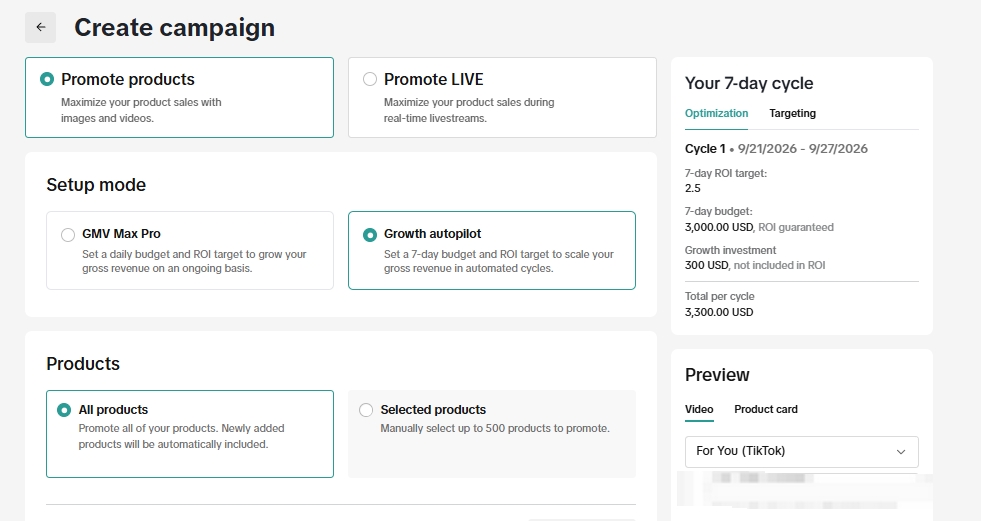
The first question is not which label sounds more advanced. It is whether your shop can safely commit to the operating rhythm the interface is asking for. In the Growth Autopilot beta screen reviewed for this article, the seller chooses a seven-day budget and a seven-day ROI target, then sees recurring cycles. GMV Max Pro appears as a separate setup choice whose card refers to a daily budget and ROI target. TikTok's public GMV Max Pro documentation describes a solution pack built on GMV Max, with account-dependent building blocks around affiliate cost, coupons and eligible commission savings. These are not interchangeable descriptions.
The practical choice is therefore not a feature checklist. It is a fit decision: can this SKU, its inventory, its content permissions, and its margin survive the next cycle without the team changing every variable halfway through? If not, a seven-day automatic cycle can turn an unclear operating situation into a more expensive unclear operating situation.
The visible comparison, and the boundary around it
| Question | Growth Autopilot beta screen | GMV Max Pro public description | What an operator should not assume |
|---|---|---|---|
| Planning window | Seven-day ROI target and seven-day budget in automated cycles. | The setup card shown beside it refers to daily budget and ROI target. | That every GMV Max Pro campaign uses the same UI in every account. |
| Protection | The beta screen says 90% of the ROI target is protected if the listed criteria are met. | Standard GMV Max has separate public campaign-level credit rules. | That the standard formula, order floor, exclusions, or credit terms apply unchanged to beta. |
| Extra spend | A separate growth investment is shown as charged as used and not included in ROI protection. | GMV Max Pro may bring affiliate costs, coupons, and eligible commission savings into a broader view. | That the beta includes every Pro building block or that every cost is covered. |
| Product scope | The shown product setting offers All products, including newly added products automatically, or selected products up to 500. | Product GMV Max publicly optimizes selected promoted products and may use authorized affiliate assets. | That the screen proves any particular creator asset, product, or market is eligible. |
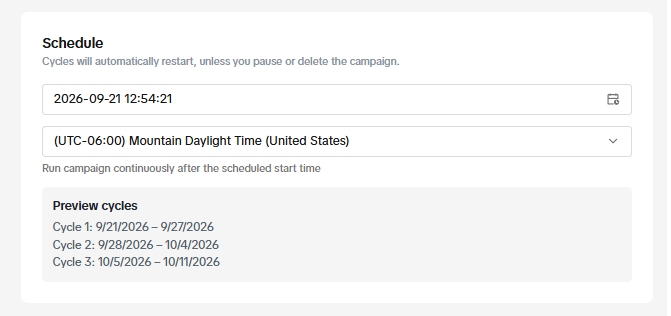
| Continuity | The schedule screen says cycles restart automatically unless paused or deleted. | Pro availability and building blocks vary by market, eligibility, setup, and rollout stage. | That a seller has access, or that a recurring cycle is right for every shop. |
The table is deliberately narrow. It separates what was visible in one beta account from what TikTok documents publicly about GMV Max Pro. A beta campaign screen is strong evidence of that screen. It is not a public product manual, eligibility promise, or campaign-result case study.
A seven-day cycle changes the readiness test
Daily control and seven-day commitment are different management problems. A daily setup can still be mishandled, but it gives the team a shorter natural readback. A recurring seven-day cycle asks the brand to prepare a fuller operating window: stock has to remain sellable, the product page cannot become ambiguous after creator content starts moving, and the commercial owner needs a contribution floor before the budget begins.
That is why WEM would start with a release gate, not a budget field. Confirm the priority SKU, live price and offer, available variants, sellable inventory, delivery promise, creator authorizations, product proof, and the owner who can pause or correct a real exception. Then decide whether the business can learn from one stable cycle. A target ROI does not repair a weak product page, a missing variant, an unapproved creator video, or an unsupported claim.
Two shops, two sensible answers
Hypothetical shop A: ready to test a stable hero SKU. A skincare brand has one hero SKU with confirmed inventory, a stable offer, several authorized creator videos, clear ingredient and use instructions, and a person who checks stock and customer questions daily. Its margin owner can separate campaign spend from any separate growth investment and can leave the learning lane intact for a full cycle. This shop may be able to evaluate whether the visible Growth Autopilot cycle is worth testing, provided the feature is actually available in its account and the live terms are acceptable.
Hypothetical shop B: too many moving parts. A fashion seller has newly arriving variants, changing bundle prices, stock gaps, unapproved creator assets, and no agreed answer to return or sizing questions. A seven-day cycle is not a shortcut around that work. The right move is to stabilize one product and one offer, get usable authorized content, and make the weekly owner accountable for exceptions. The shop may later choose a GMV Max route available to its account, but it should not use either label as permission to scale an unfinished buying system.
Neither example predicts performance. They show why readiness is a commercial condition, not an ad setting.
GMV Max Pro is broader, not automatically better for this decision
TikTok's current GMV Max Pro page says the solution pack can help advertisers consider ad spend alongside affiliate costs, coupons and platform commissions, with available building blocks varying by account and rollout. That matters for a brand with active creator costs or a deliberate incentive plan. But it does not make GMV Max Pro a default answer, and it does not prove that Growth Autopilot includes the same levers.
For the comparison in front of an operator, use two separate questions. First, does the account expose the setup mode and its live terms? Second, what business cost or operational constraint must the next campaign actually manage? If the problem is that affiliate cost, coupon use and commission savings are material, inspect the actual GMV Max Pro building blocks available to the account. If the question is whether a stable SKU can accept a recurring seven-day cycle, inspect the beta cycle, protection terms, separate growth investment, and owner capacity. Do not collapse those questions into a single "best" product label.
A short fit decision before you launch
- Open the real account surface. Confirm whether Growth Autopilot or GMV Max Pro is visible to the account. Availability is not established by a screenshot from another account.
- Name the SKU and the promise. Choose one priority product, its current price, offer, variant, stock position, delivery expectation and the proof the content will use.
- Separate the cost buckets. Keep campaign cost, any beta growth investment charged, affiliate commissions, coupons, platform charges, and contribution after fulfillment separate. Do not call attributed gross revenue profit.
- Check the asset permissions. Product GMV Max can use authorized affiliate videos for selected products, but authorization and availability must be confirmed for the account and the actual post.
- Assign the cycle owner. The person who can see a stock exception or a broken product promise needs authority to stop, repair or document it. A recurring cycle cannot be ownerless.
Smallest useful next action: make a one-page cycle-readiness row for one SKU. Include the account mode actually visible, seven-day or daily planning window, price, margin floor, stock, authorized assets, product-page gap, customer-service risk, and the named owner. If one of those fields is unknown, solve that before treating automation as scale.
Source notes
Checked September 23, 2026. The campaign setup and schedule images are authorized seller-provided beta evidence. The Product GMV Max overview, GMV Max Pro overview and standard GMV Max ROI protection page are current public TikTok references. Beta access, market availability, interface labels, eligibility, protection criteria, credit calculation and product scope can vary. This article reports observed setup differences and a readiness framework, not a guarantee of feature access or results.
Frequently asked questions
Is Growth Autopilot the same as GMV Max Pro?
No. They appear as separate setup choices in the reviewed beta screen. TikTok publicly describes GMV Max Pro as a broader solution pack built on GMV Max; do not assume its building blocks are included in Growth Autopilot.
Is Growth Autopilot available to every TikTok Shop seller?
The supplied beta screen does not prove universal access. Check the current Seller Center or Ads Manager interface and the account's applicable terms.
Does the screenshot prove Growth Autopilot supports LIVE?
No. The screenshot has Promote products selected. A visible LIVE option at the top is not enough to infer how a LIVE setup works or whether it is available.
What does the seven-day cycle change for a shop?
It raises the need for stable stock, a clear offer, usable authorized content, margin room and an owner who can complete or correctly intervene in the learning cycle.
Are new products automatically included?
The reviewed All products beta option says newly added products will be automatically included. Confirm the account's live scope and whether that is commercially safe before using it.
Should we choose a mode based only on ROI protection?
No. Protection is conditional and separate from broader product, inventory, creator, service and contribution-margin readiness. Read the live terms before launch.