TIKTOK SHOP · BETA ROI REVIEW
TikTok Shop Growth Autopilot ROI Protection: What the 90% Threshold Covers
Wendy Lin · Sep 22, 2026 · 10 min read
Growth Autopilot's beta screen shows a useful promise, but it is easy to read too much into it. The screen we reviewed says that 90% of the ROI target is protected, says no conversions are required, and describes a separate growth-investment option. That does not turn an ad budget into a guaranteed profit plan. It gives a seller a threshold to verify against the account's actual terms and a set of numbers to reconcile after each seven-day cycle.
This article is about that accounting question: what is protected, what can still be charged, and what a seller needs to keep in the same ledger before approving a cycle. It is based on seller-provided beta screens reviewed September 22, 2026. Beta availability and terms can differ by account, market, and test cohort.
Start with the one calculation the screen supports
The example setup shows a 2.5 ROI target. Ninety percent of 2.5 is 2.25. That is the visible protection threshold. It is not a statement that the campaign will deliver 2.5 ROI, $7,500 in sales, a particular margin, or a cash refund.
The interface says eligible campaigns receive an ad credit. It does not show a complete credit formula, timing, caps, all exclusions, or how the credit interacts with tax, refunds, other incentives, or account status. Treat the ad credit as a line that must be confirmed after the cycle, not as money you can count before launch.
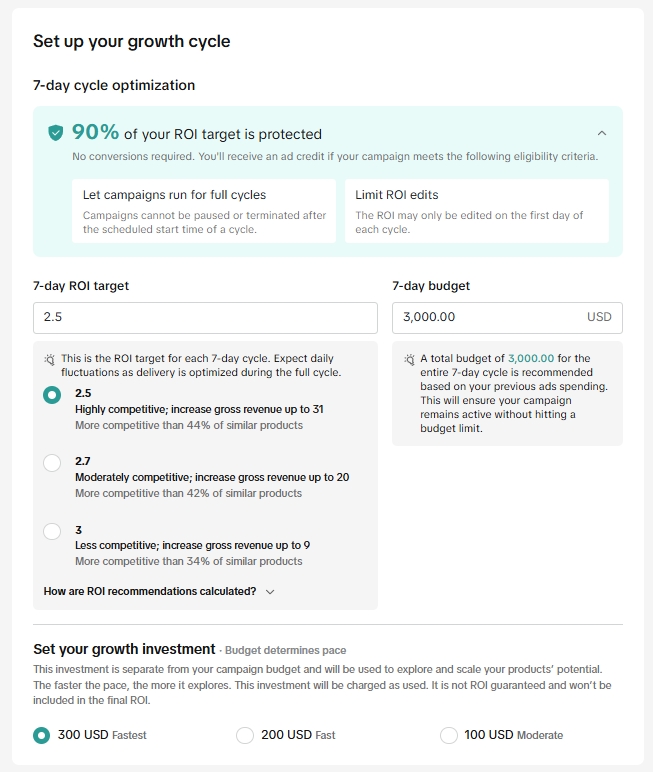 Seller-provided beta interface evidence. Check the exact terms visible in your own account before committing spend.
Campaign budget is not necessarily the total-cycle cost
The same screen separates a $3,000 campaign budget from a $300 growth investment. The visible example therefore has a $3,300 total setup amount before a seller evaluates any other business cost. The safe interpretation is not that every account will be charged exactly $300. It is that a seller should never judge the cycle from the campaign-budget field alone when a separately charged growth-investment feature is enabled.
Here is a deliberately hypothetical example. If the beta report displayed $7,500 of attributed gross revenue and the account actually charged the full $3,000 campaign amount plus $300 growth investment, $7,500 divided by $3,300 is approximately 2.27. That is a total-cycle-spend calculation. It is not evidence of incrementality, profit, or an entitlement to a credit. If the account did not charge the full investment, the denominator changes. If returns, discounts, affiliate commission, fulfillment, or product cost are excluded, the number is still not contribution.
Keep three questions separate
The first question is the beta protection question: did the cycle meet the account-specific protection conditions and threshold? The second is the billing question: what campaign spend and additional growth investment were actually charged? The third is the commercial question: after product cost, fulfillment, commission, discounts, returns reserve, and media, did the business retain acceptable contribution?
Those questions can have different answers. A cycle may qualify for a credit while still producing weak contribution after all costs. A cycle may show an attractive dashboard ROI while a separately charged growth investment changes the total-cost view. A profitable cycle may not qualify for a credit because a visible condition was not met. Do not collapse those outcomes into one headline number.
Build a cycle-reconciliation table before launch
Use one owner and one ledger for each seven-day cycle.
| Ledger field | What to record | Why it matters |
|---|---|---|
| Campaign spend actually charged | Final billed amount, not only the selected budget | Delivery may differ from a setup field |
| Growth investment actually charged | Separate billed amount and its account description | It can change total-cycle media cost |
| Attributed gross revenue | The beta or campaign reporting value and its definition | Useful for controlling the campaign, not proof of incremental profit |
| Confirmed ad credit | Amount, status, timing and the terms used | Credit is not a cash refund or a promise before confirmation |
| Contribution after other business costs | Revenue less product, fulfillment, discount, commission, returns reserve and media | This is the business decision number |
Before the cycle starts, capture screenshots of the budget, target, protection wording, investment selection, schedule and restrictions. Name the campaign owner, inventory stop, contribution floor and pause authority. The beta screen says changes are constrained after a cycle begins, so the right time to settle the ledger logic is before the start time, not after an unexpected charge appears.
Do not copy standard GMV Max protection rules into this beta
TikTok's public documentation for standard GMV Max ROI protection is useful background, but it is not a substitute for the Growth Autopilot screen. Standard documentation describes daily calculations, daily order requirements and exclusions. The beta screen we reviewed explicitly says no conversions are required and frames the program in seven-day cycles. Those are different visible operating contexts.
Use the public GMV Max material to understand how protection programs can have eligibility conditions. Use the beta account's own terms to decide what applies to this cycle. If a seller cannot see the full terms, the honest decision is to treat the credit as unconfirmed rather than filling in the missing formula from a forum post or a different campaign type.
A practical cycle close
At the close of a cycle, export or screenshot the final campaign report, billing view and protection status. Confirm actual rather than planned spend. Tie the revenue number to the report definition. Record the credit only after its status and amount are visible. Then compare total-cycle media cost with contribution after other business costs.
The smallest useful next action is simple: add a separate "growth investment actually charged" column to the same working sheet that holds campaign cost and contribution. That one column stops a common reporting mistake before it becomes a budget decision.
For the broader beta setup and seven-day-cycle context, read the Growth Autopilot beta guide. For a readiness gate before any automated product campaign, see When Should a Brand Turn On GMV Max?.
Source notes
Source note, checked September 22, 2026: seller-provided Growth Autopilot beta screenshots are the primary evidence for the visible 90% threshold, no-conversions wording, cycle view and separate growth-investment control. Background only: TikTok Product GMV Max overview and TikTok's standard GMV Max ROI protection documentation. Account-specific beta terms may change.
Frequently asked questions
Does 90% ROI protection mean the campaign is guaranteed to hit my target?
No. The visible beta screen supports a protection threshold, not a guarantee of target ROI, sales, profit, or a cash refund.
What is 90% of a 2.5 ROI target?
It is 2.25. That calculation does not reveal the full credit formula or every eligibility condition.
Is growth investment part of the campaign budget?
The beta screen presents it separately. Reconcile the amount actually charged alongside campaign spend before judging total-cycle cost.
Is an ad credit the same as profit?
No. Confirm the credit first, then calculate contribution after product, fulfillment, commission, discounts, returns reserve and media.
Can I use the public GMV Max daily-protection rules for Growth Autopilot?
No. They are useful background, but the beta screen has its own visible seven-day and no-conversions context. Verify the account-specific terms.