Offboard a TikTok Shop Agency or App Without Leaving Data Access Behind
Direct answer: ending an agency, app or service relationship does not by itself prove that TikTok Shop-related access has ended. Treat the commercial exit, Partner authorization, account roles, app or API access, credentials, data exports and open work as separate items. Close each one, then record an independent readback.
The safest operating principle is simple: no former partner should retain an active path to data or action merely because the invoice, chat group or dashboard looks closed. The goal is not a dramatic “offboarding day.” It is a controlled, evidenced transition that lets the brand continue operating while access becomes least-privilege, time-bounded and finally absent.
Start with the platform boundary
TikTok Shop U.S. Seller Terms describe features that can connect sellers with Partners and permit authorized users, including third-party developers, to access APIs in connection with a seller’s activity. The same Terms make the seller responsible for its own permissions, approvals and compliance. That means a brand needs its own current inventory and exit control; a platform connection is not a substitute for one.
Appendix 2 is particularly useful as an operating boundary: Partner authorization is tied to a service relationship and disclosed data sharing. When that relationship, service scope or data need ends, the seller should cancel the relevant authorization promptly. Appendix 3 adds a parallel API boundary: access by authorized users is still governed by the applicable developer terms. These are policy signals, not a complete legal checklist.
Operating rule: “we ended the contract” is a business fact. “the former partner can no longer access or act” is a separately verified control outcome.
Build the offboarding inventory before you revoke anything
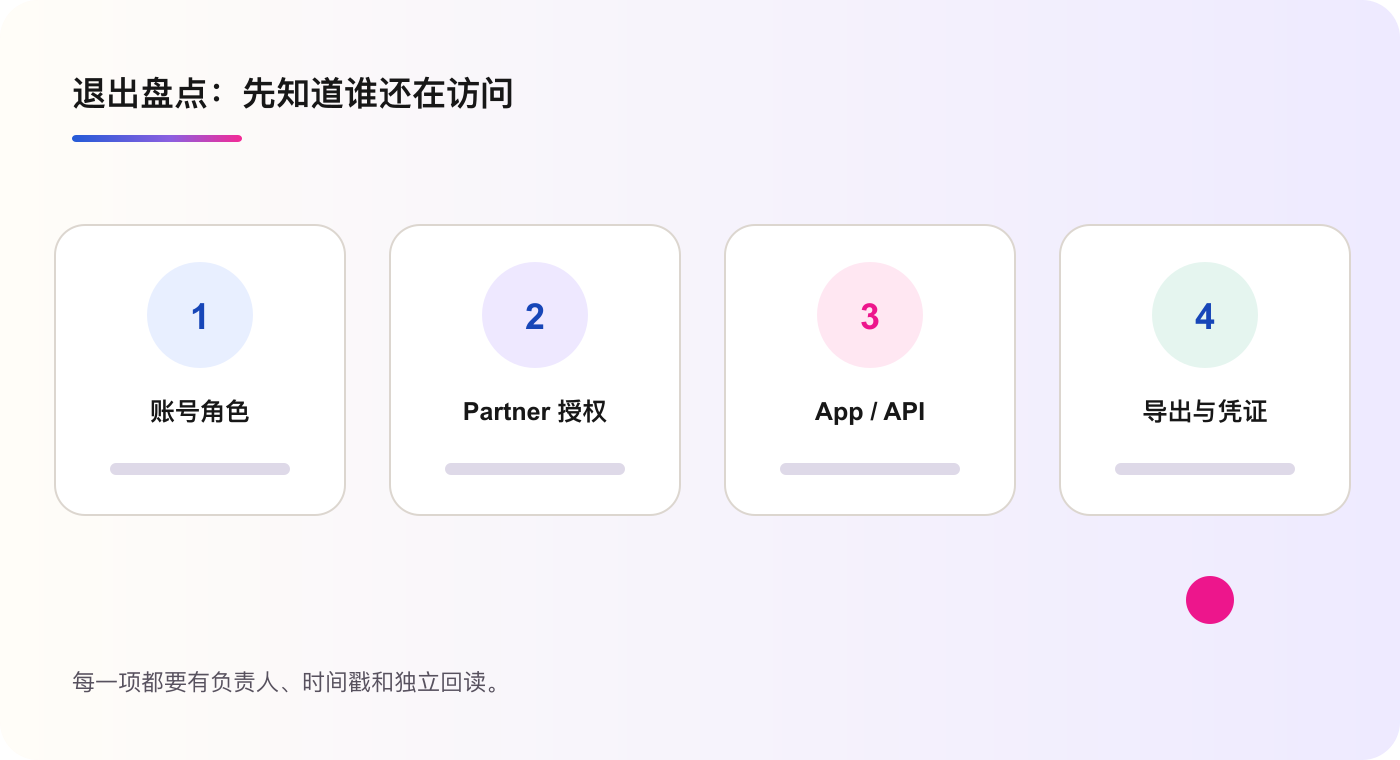
Do not begin by clicking around. First, create one dated inventory with an owner, a system, the access purpose, the access path, the last needed date, the desired end state and evidence location. Include direct staff roles, shared login recovery routes, Partner authorizations, linked apps, API keys or OAuth grants, shared storage, reporting exports, automation accounts, audience files, campaign assets and any scheduled activity.
This protects continuity. Some access may be required to hand over in-flight creator work, reconcile a report, retrieve brand-owned source files or close an agreed support period. A bounded exception can be safer than an untracked exception: identify the minimum permission, owner, end date and a calendar trigger for the next check.
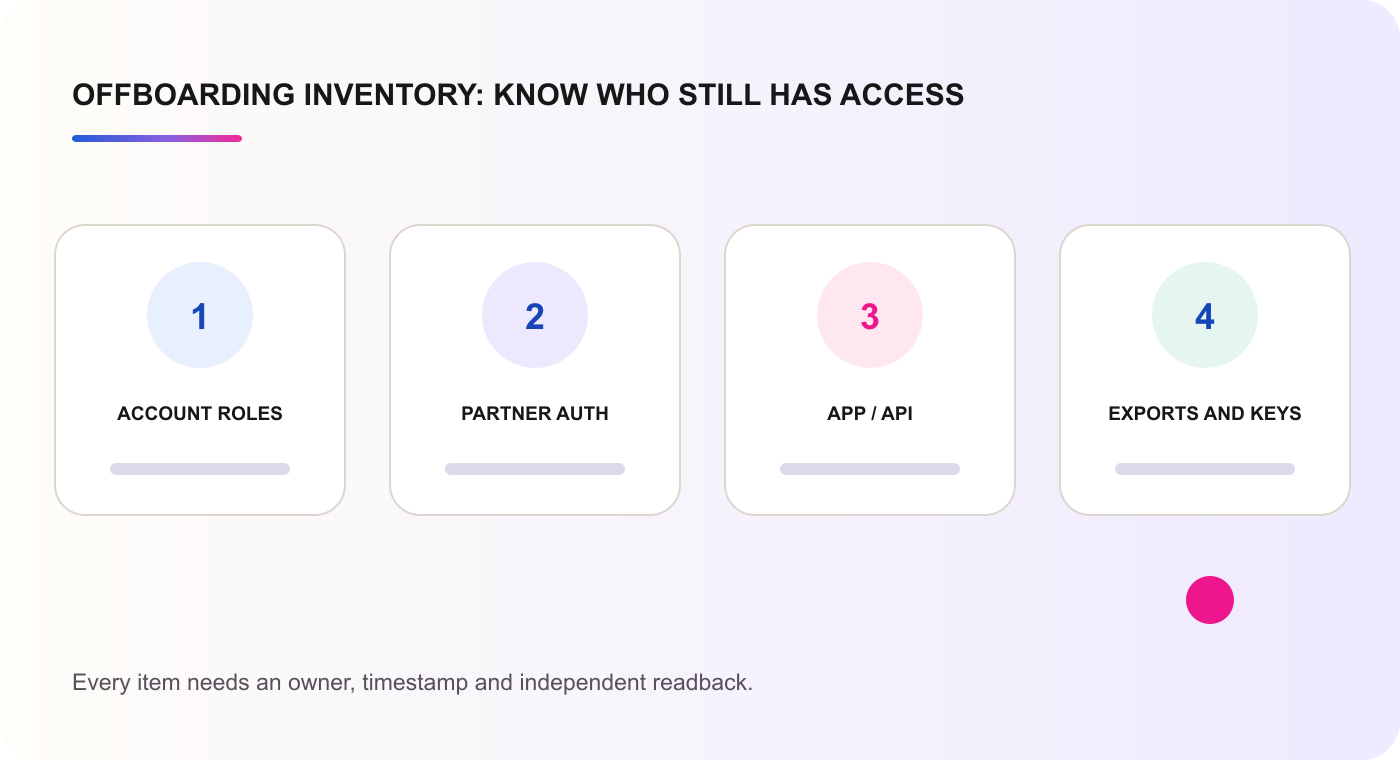
Separate four exit lanes
- Commercial lane: confirm contract notice, open deliverables, payment and asset handback. This decides what work remains.
- Human-access lane: remove or change account roles, recovery contacts, shared inbox membership and any credentials the former team can use.
- Partner and technical lane: review Partner authorizations, connected applications, developer access, tokens, integrations and automation owners. Cancel or rotate the path that no longer has a current need.
- Data and evidence lane: identify retained exports, reporting destinations, shared drives and personal data. Follow the agreed instructions and applicable requirements, then retain the closure proof.
These lanes often have different owners. Finance can confirm a final invoice without knowing whether a token still works. A platform administrator can remove a role without knowing whether an external spreadsheet is still refreshed by an app. The exit owner coordinates; each system owner certifies their own lane.
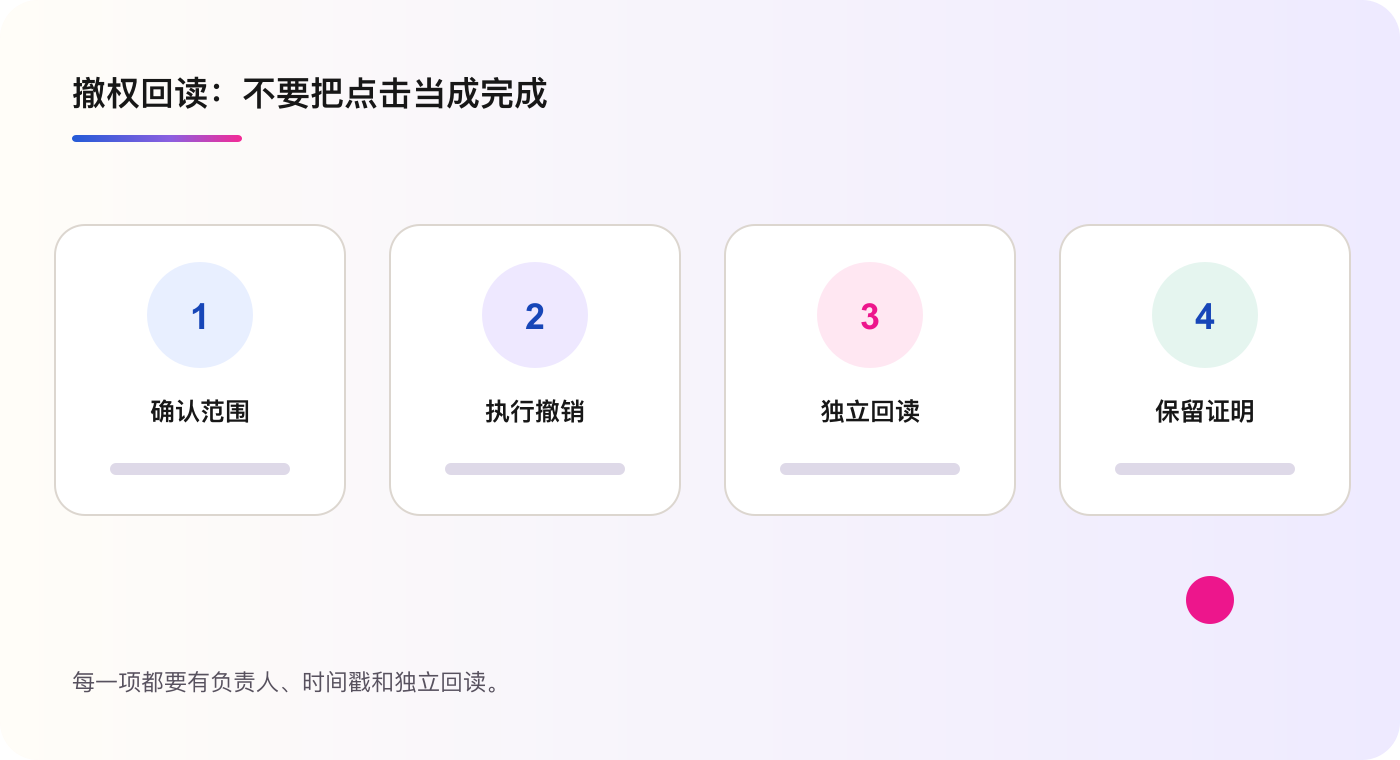
Use a revoke-and-readback sequence
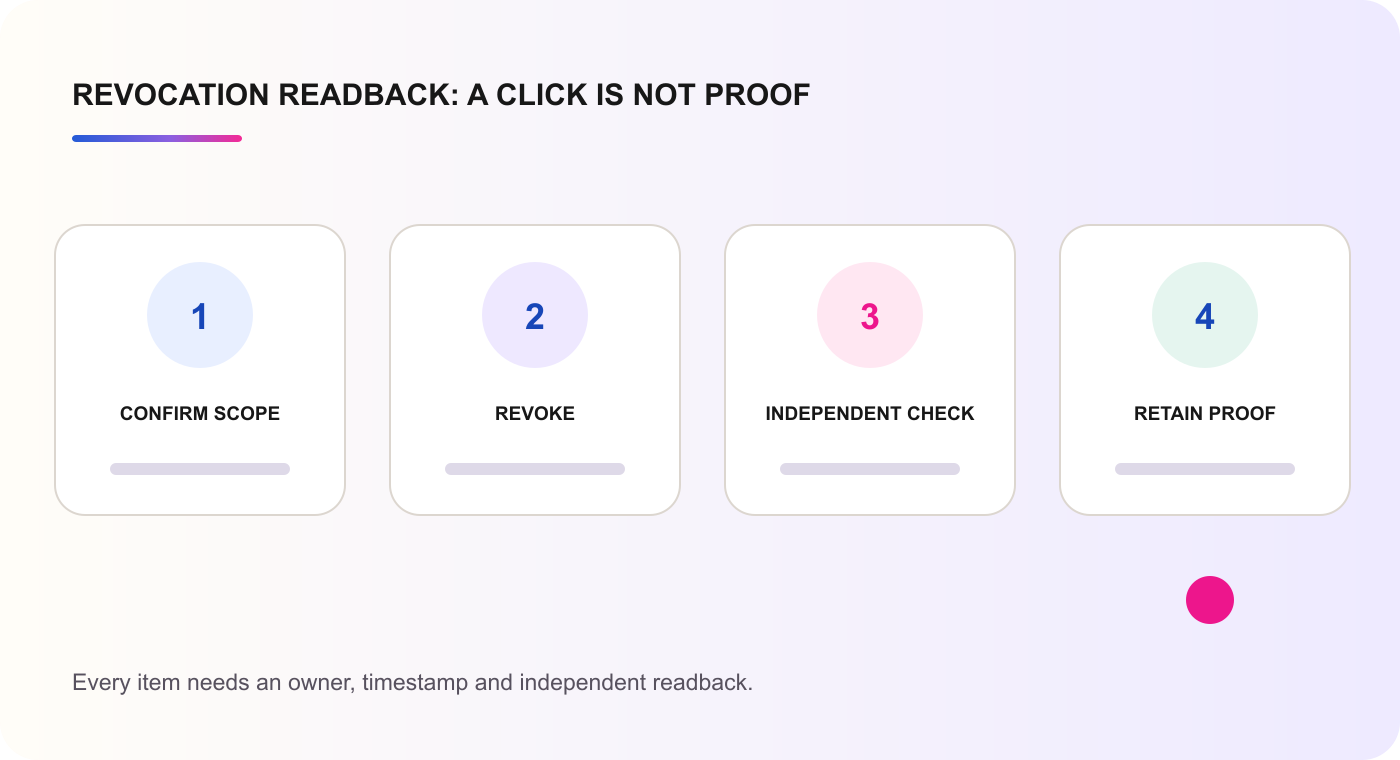
For each inventory row, follow the same small sequence. Confirm that the relationship or exception end date has arrived. Capture the pre-change state. Perform the specific removal, cancellation, rotation or ownership transfer. Then ask a different owner, a test account or a clean session to read back the resulting state. Record the timestamp, actor, method, result and unresolved exception.
A click is not proof. A success toast can be stale, an integration can retain a token, and a list can hide inherited access. Your readback should test the control that matters: the former role is absent, the authorization is no longer active, a scheduled job no longer runs under the old owner, or a former credential cannot complete a scoped action. Do not test by exposing data or attempting unnecessary actions.
Decide what must transfer, not merely what must disappear
Offboarding fails when access disappears but ownership does not transfer. Before removal, identify the brand-controlled destination for source creative, approved content, performance definitions, campaign history, creator conversations, invoices, dashboards, automation documentation and credentials. Check that the receiving owner can open the files and explain the next operating step.
Use a short handover table: asset or control, current owner, receiving owner, location, last verified date, open dependency and closure condition. If the agency owns a tool account, do not assume that a screenshot is a handoff. Establish whether the account, records and configuration can be transferred, exported, rebuilt or must be retired. Escalate the choice rather than silently losing the operating history.
Handle exceptions without recreating permanent access
Some situations need a limited post-exit window: a dispute, final reporting, a legal hold, a creator handoff or a technically staged migration. Define the exception in writing. It should name the exact purpose, minimum access, named accountable owner, end time, review cadence and deletion or revocation condition. When the condition is met, run the same revoke-and-readback sequence.
Never convert uncertainty into a broad temporary role. If no one can explain why a permission still exists, mark it unresolved, pause dependent actions where appropriate and route it to the system and contract owners. Unknown access is not low risk just because it has not caused a visible incident.
Use a closure record that can survive staff change
| Control | Accountable owner | Evidence | Done means |
|---|---|---|---|
| Contract and handover | Business owner | Notice, open-work list, asset receipt | Responsibilities and destination are clear |
| Roles and credentials | Account administrator | Before/after readback | Former users cannot act through those paths |
| Partner, app and API paths | Technical owner | Authorization/token review and result | No unneeded active connection remains |
| Data and exports | Privacy/data owner | Inventory, instructions, closure evidence | Retention and deletion duties are addressed |
Store the record where the successor can find it. Link it to the contract, access inventory, revocation evidence, exception approvals and final owner confirmation. Do not place secrets in the record; keep secure references to them instead.
The smallest useful next action
Open a one-page offboarding record for the next agency or app exit. Add four headings: human roles, Partner authorization, app/API paths, and data/export locations. Give each a named owner and one required readback. If a row is unknown, keep it marked unknown and do not claim the offboarding is complete.
Source notes and execution boundary
This original WE Marketing operating framework draws on the current TikTok Shop U.S. Seller Terms of Service, revalidated October 4, 2026, with attention to authorized user/API access and the Partner-service authorization boundary in Appendices 2 and 3. Interfaces, permissions, data fields and terms may change. Verify the current account surface and involve qualified legal or privacy counsel for contractual or regulatory decisions. This is operational guidance, not legal advice.
Common questions
Does ending an agency contract remove TikTok Shop access?
Not by itself. Treat the commercial exit and each access path as separate controls, then verify the resulting state.
What should be in an offboarding inventory?
List account roles, Partner authorizations, apps and APIs, shared inboxes, credentials, exports, scheduled work and the accountable owner for each item.
Should access be removed before the final invoice is paid?
Use the contract and operational need to decide. Preserve only the minimum bounded access needed to close agreed work, with a named owner and end date.
How do we prove access was removed?
Capture the control result, timestamp, actor and an independent readback showing the former party can no longer perform the relevant action.
What if an agency uses subcontractors?
Identify whether their access is direct or inherited, then require the agency to account for its subprocessors and preserve closure evidence.
Is this legal or privacy advice?
No. Use qualified legal and privacy counsel for your contract, data obligations and jurisdiction-specific requirements.