TIKTOK SHOP U.S. · CREATOR CONTENT OPERATIONS
How Brands Should Review TikTok Shop Creator Videos and LIVEs Before They Scale
The most dangerous creator-content mistake is not always an obviously prohibited product. It is a useful-looking video that quietly changes the product truth. The item appears larger than it is. A temporary coupon sounds universal. A beauty result looks immediate. An AI scene adds performance the real product cannot deliver. A LIVE host improvises a guarantee that never appeared in the brief.
TikTok Shop's current U.S. Content Policy applies to the whole promotional presentation, not only the spoken script. It covers LIVEs, videos, cover images, titles, descriptions, links, voiceovers, on-screen text, props, gestures, usernames and product demonstrations. For a brand, that means content review cannot be reduced to checking captions or searching for a few banned words.
The practical answer is to review every asset against one product-truth record before it goes live, then monitor the actual published video or LIVE rather than assuming the approved brief is what viewers received.
Direct answer: A TikTok Shop brand should review creator content in five passes: product identity, claims and effects, price and offer conditions, visual and AI accuracy, and LIVE or behavioral context. Any mismatch should be routed to a named owner and corrected before amplification.
This article explains an operating method. The policy requirements are TikTok Shop's. The review sequence, owner map and evidence ledger are WEM recommendations designed to help a brand apply those requirements consistently. This is not legal advice.
Content compliance starts with one source of product truth
A brand cannot review creator content accurately if the reviewer has to reconstruct the product from a listing, an old deck, a Slack message and a sample box. Start with a compact product-truth record for each promoted SKU.
At minimum, that record should identify:
- the exact product and SKU shown;
- size, color, material, quantity and included accessories;
- supported compatibility, installation and use conditions;
- approved performance language and evidence;
- current listing title, images and product attributes;
- the live price, coupon conditions, minimum spend and promotion window;
- category-specific restrictions or qualifications; and
- facts the brand cannot currently support.
TikTok Shop's policy says promoted content must be accurate, compliant and consistent with the product. It specifically calls out mismatches involving size, color, material, quantity, accessories, compatibility, safety attributes, installation and performance. The operating implication is simple: the product-truth record must be specific enough to compare with the frame the shopper actually sees.
If the brand cannot settle a product fact internally, do not ask the creator to make it sound certain. Mark it unresolved, remove the claim, and assign an owner to verify it.
Review the whole shopper impression, not isolated sentences
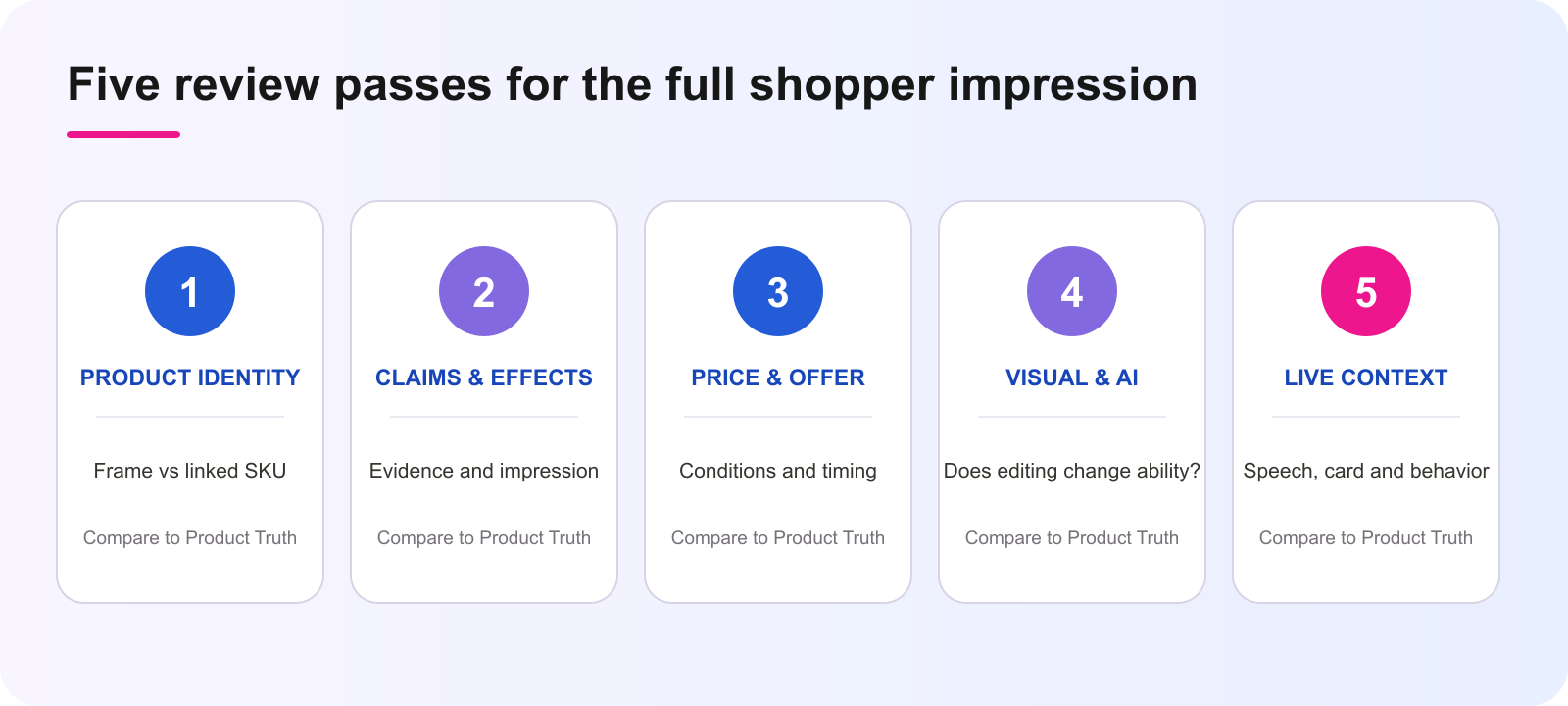
Creators communicate through more than words. A camera angle can exaggerate size. Lighting can imply a finish or coverage the product does not have. A pile of units can suggest a larger bundle. A before-and-after transition can imply an immediate effect even when the voiceover stays cautious.
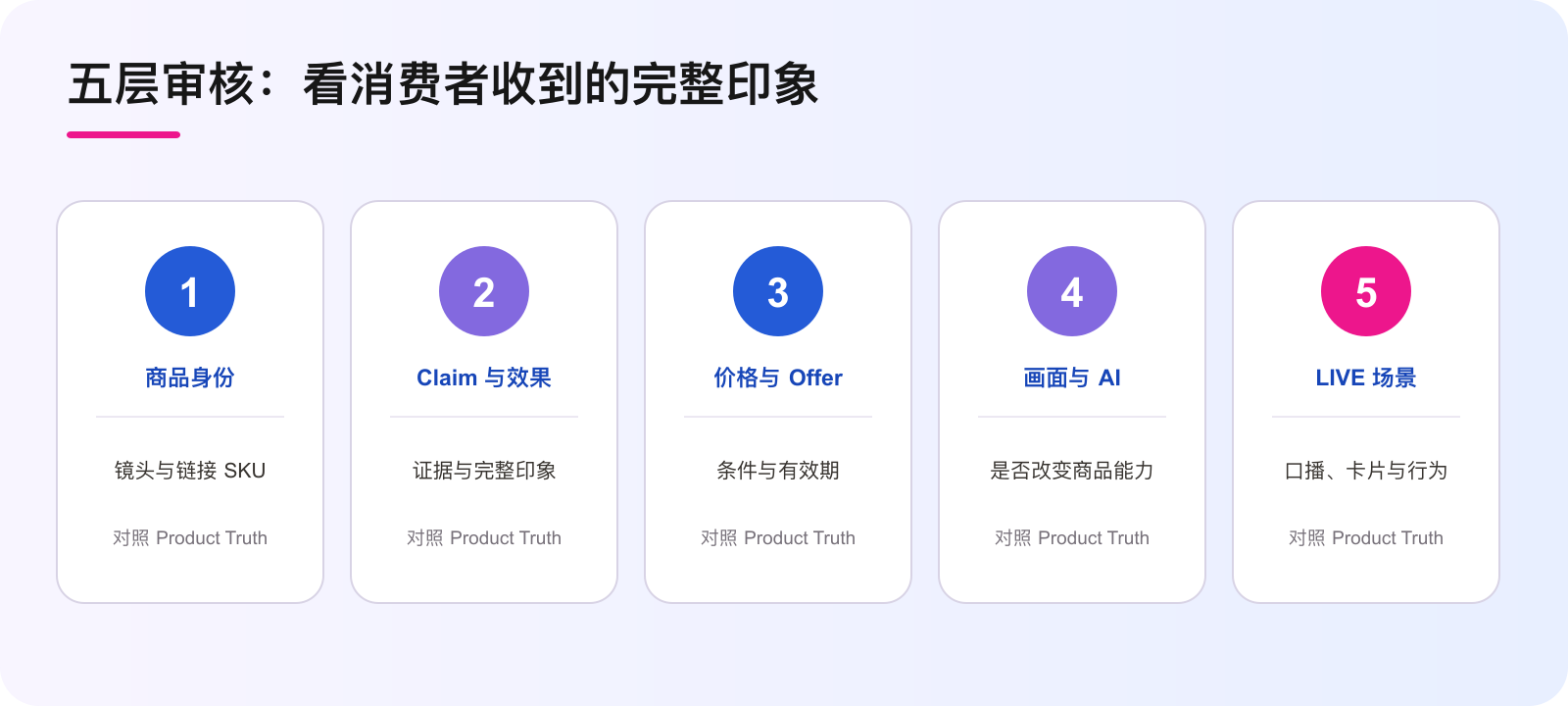
Use this five-pass review:
| Review pass | What to compare | Typical stop condition |
|---|---|---|
| Product identity | Product on screen, linked SKU, listing, bundle and accessories | The shopper could reasonably expect a different item, quantity or variation |
| Claims and effects | Spoken words, captions, overlays, demo and before/after sequence | A result, certification, guarantee or performance claim lacks support |
| Price and offer | Price, coupon, eligibility, SKU, minimum spend, shipping, tax and timing | The stated price is expired, conditional but presented as universal, or not obtainable through the link |
| Visual and AI accuracy | Scale, material, movement, lighting, installation and compatibility | Editing or AIGC changes what the actual product appears able to do |
| Context and behavior | Props, gestures, usernames, links, LIVE interaction and calls to action | The presentation introduces prohibited conduct, off-platform redirection or manipulative behavior |
The policy prohibits false, misleading or inconsistent information about product attributes, services, delivery, returns, refunds, customer service, coupon codes, certifications, guarantees and warranties. That is why the review must include the linked product page and current offer state. A creator can describe the physical product correctly while still creating a misleading purchase expectation.
Treat price claims as live data
Price language is one of the easiest places for previously accurate content to become misleading. TikTok Shop states that price and discount claims must be accurate, clear and current. Availability may depend on the selected SKU, bundle, coupon redemption, minimum spend, user eligibility, promotion period, shipping, tax, fees or region.
For evergreen content, avoid a fixed numerical claim unless the brand has a reliable process to remove or update the asset when the offer changes. A safer content brief explains the condition in plain language and asks the shopper to verify the checkout price. “Lowest price” and “cheapest anywhere” need more than enthusiasm. The current policy identifies unsupported cheapest-price claims as prohibited.
WEM recommends saving a price snapshot with the review record. Capture the linked SKU, offer conditions, date, time and reviewer. If the campaign uses several creators, the same offer version should be visible to all reviewers. When the offer ends, the team should know which videos contain a time-sensitive claim and who has authority to pause amplification.
AI does not change the evidence burden
TikTok Shop does not prohibit every use of AI-generated content. The current policy prohibits AIGC that misleads, impersonates, fabricates product functions, exaggerates effects, or otherwise breaks the Content Policy or Community Guidelines. It also requires the AI-assisted presentation to match the actual product, product page and reliable product evidence.
For brands, “AI-assisted” should be a review flag, not an automatic rejection. Ask what the tool changed. Check the original sample or source file against the final frame. Pay particular attention to scale, color, material, bundle quantity, lighting, motion, installation position, surface compatibility, rated capacity and before-and-after results.
An AI background may be harmless. An AI-generated glow that makes a static device look powered is not merely a design choice if it changes the shopper's understanding of function. A synthetic cleaning demonstration that produces an instant result can create the same problem even when the real product appears somewhere in the frame.
Separate correction from creative preference
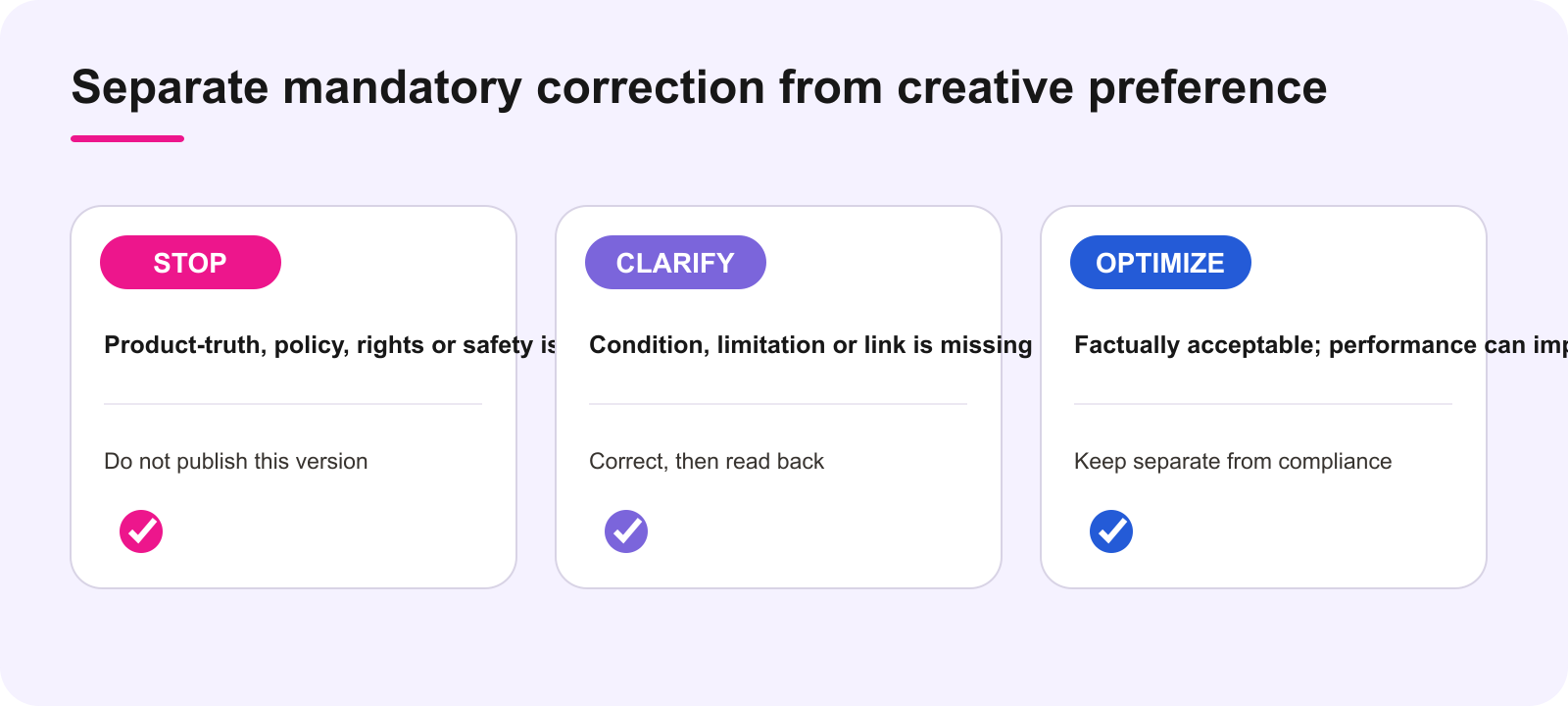
Policy review often fails because the brand mixes mandatory corrections with subjective creative feedback. The creator then receives a long list where “this claim is unsupported” looks no more important than “move the hook three seconds earlier.”
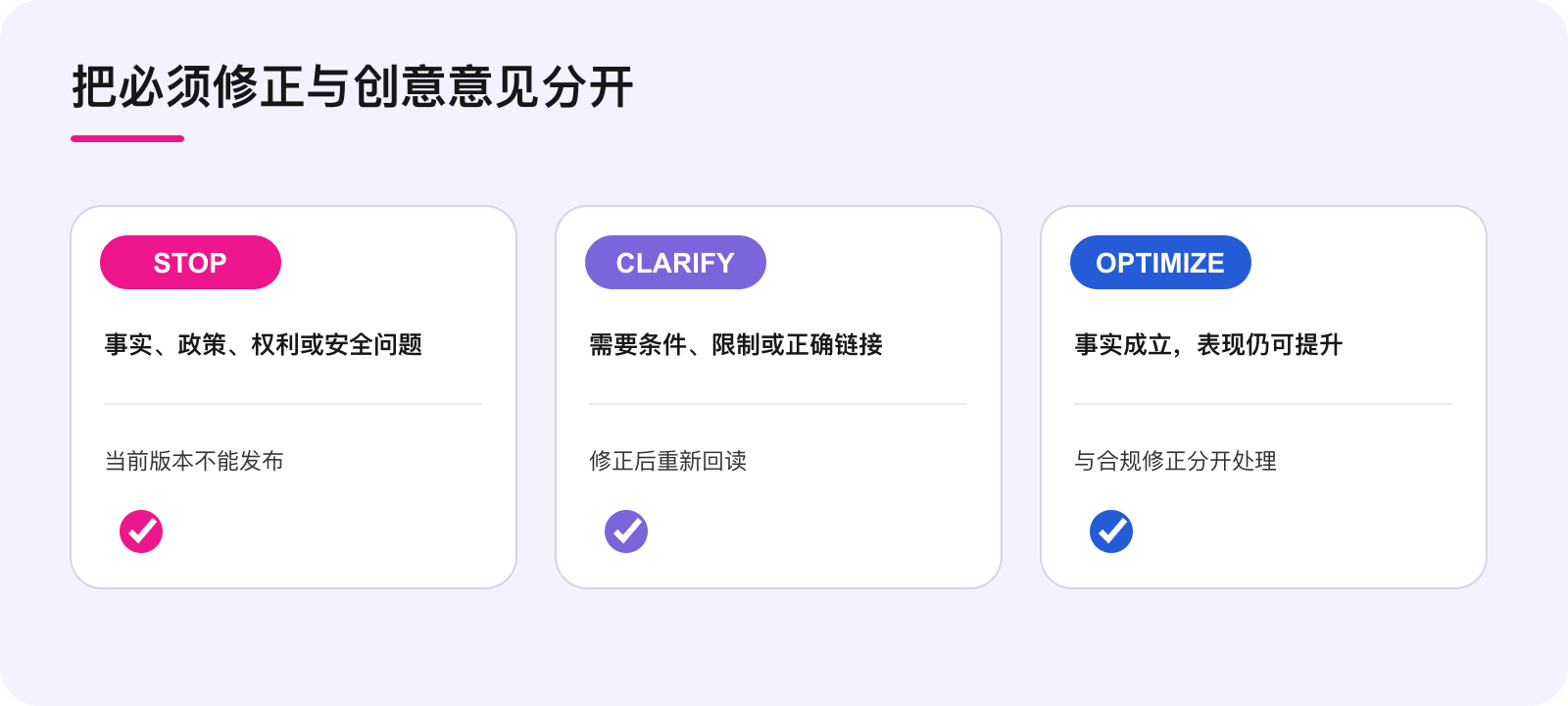
Use three labels:
- Stop: The asset cannot publish in its current form because it creates a policy, product-truth, rights or safety issue.
- Clarify: The content may be usable after a factual condition, limitation, disclosure or linked SKU is made clear.
- Optimize: The content is factually acceptable, but the hook, pacing, framing or CTA could perform better.
This protects the creator relationship. Pure-commission creators should not be forced through a legal memo for every post. Give them the few product truths and boundaries they need to work confidently. Escalate high-risk claims to the right internal owner instead of asking the creator to interpret policy language.
Build a different control for LIVE
A pre-recorded video can be paused before publishing. LIVE content changes by the minute. Hosts answer questions, repeat prices, compare products and improvise use cases. The brand therefore needs a control-room method, not only a pre-approval checklist.
Before the session, give the host:
- the approved product-truth sheet;
- the exact products and variations permitted in the session;
- current offers and their conditions;
- prohibited or unsupported phrases;
- an escalation phrase for questions the host cannot answer;
- the person who can correct a price, link or product-card issue; and
- a stop rule for a repeated or material mismatch.
During the LIVE, one operator should monitor the product shown, linked product card, spoken claim, offer and customer question as one event. If they diverge, repair the earliest broken handoff. Correct the statement clearly, replace the wrong product card, and record the timestamp. Do not keep increasing traffic while the room is creating the wrong expectation.
TikTok Shop's policy also restricts gambling or game-like activity, off-platform redirection, manipulative engagement, charitable-sales claims, shocking material and promotion involving high-risk regulated goods. These risks can enter a LIVE through improvisation even when the planned product demo was safe.
Use an evidence ledger, not a memory test
The smallest useful record is one row per reviewed asset:
| Field | Record |
|---|---|
| Asset | Video draft, post URL, LIVE session or clipped timestamp |
| Product | Exact product and SKU |
| Evidence version | Product-truth sheet, listing snapshot and claim source |
| Decision | Approve, clarify, stop or remove from amplification |
| Reason | Exact mismatch or risk, not “compliance concern” |
| Owner | Brand, creator manager, product, legal, fulfillment or customer service |
| Readback | Corrected file, published post, LIVE correction or removal confirmation |
The ledger matters because enforcement can include content removal, feature restrictions, violation points, commission restrictions or account restrictions. TikTok Shop provides appeal paths, but a brand should not build its operating model around winning an appeal. The first job is to prevent avoidable mismatches and preserve the evidence needed to understand what happened.
A hypothetical review example
Assume a creator records a cordless cleaning tool. The listing includes one device and two attachments. The draft shows four attachments beside the product, adds an AI-generated blue light, says it “kills everything instantly,” and calls the current coupon “the cheapest price anywhere.”
The problem is not one bad sentence. The bundle looks larger, the synthetic light implies an unsupported feature, the performance claim is absolute, and the price comparison is unsupported. The correct review decision is Stop. The brand should replace the bundle shot, remove the synthetic function cue, use supported performance language, and state the actual coupon conditions. After correction, the team should compare the final export and linked SKU again.
That is different from asking the creator to make the video more polished. It is a product-truth repair.
The smallest useful next action
Choose one active hero SKU and create a one-page product-truth record today. Then audit the three highest-distribution creator assets against the five passes above. Do not begin by reviewing every old post. Start where an incorrect expectation would reach the most shoppers or create the most return, policy or trust risk.
The goal is not to make creator content cautious and generic. The goal is to let creators be persuasive without asking the shopper to believe something the product, listing, offer or evidence cannot support.
Source notes
Primary source read in full on September 29, 2026: TikTok Shop U.S. Content Policy, page dated September 2, 2026. The policy applies to U.S. TikTok Shop creator content across videos, LIVEs, images, titles, links, spoken statements, on-screen text, demonstrations and other presentation elements. Platform policies and interfaces may change. Verify the current source and account state before acting.
This page has appeared as a supporting citation in earlier WEM content, including the Voice of Customer system and LIVE operations articles. This draft is a new, narrow operating topic: how a brand reviews creator videos and LIVEs before publication and amplification. It does not repackage the earlier articles' main thesis.
Frequently asked questions
Does a brand need to approve every TikTok Shop creator video before it is posted?
TikTok Shop's Content Policy sets the content requirements, but it does not create a universal brand pre-approval workflow. WEM recommends risk-based review. Review paid or contracted content according to the agreement, and prioritize high-risk categories, claims, time-sensitive prices, AI-assisted visuals and assets the brand may amplify.
Is checking the creator's script enough?
No. The policy covers visual demonstrations, cover images, titles, descriptions, links, voiceovers, text, props, gestures and behavior. Review the shopper's complete impression and the linked product page.
Can creators mention a coupon or sale price?
Yes, when the information is accurate, clear, current and not misleading. Conditions such as selected SKUs, coupon redemption, minimum spend, user eligibility, time limits, shipping, tax, fees or region should be disclosed when they affect availability.
Is all AI-generated TikTok Shop content prohibited?
No. The current policy focuses on misleading or deceptive AIGC, impersonation, fabricated functions, exaggerated effects and other policy violations. AI-assisted visuals still need to match the actual product, listing and reliable evidence.
What should a LIVE host do when a viewer asks a question the brand has not verified?
The host should avoid guessing. Use an agreed escalation phrase, record the question, and route it to the product or compliance owner. A delayed accurate answer is safer than an improvised guarantee.
Who owns creator-content compliance inside a brand?
There should be one review owner, but that person should route issues to the true owner. Product teams own specifications, commercial teams own offers, fulfillment owns delivery facts, and qualified legal or regulatory reviewers should handle legal questions. The creator manager should not be expected to invent missing evidence.