TIKTOK SHOP U.S. · SHOP TAB ELIGIBILITY
Allowed to Sell Does Not Mean Eligible for TikTok Shop Tab Recommendation
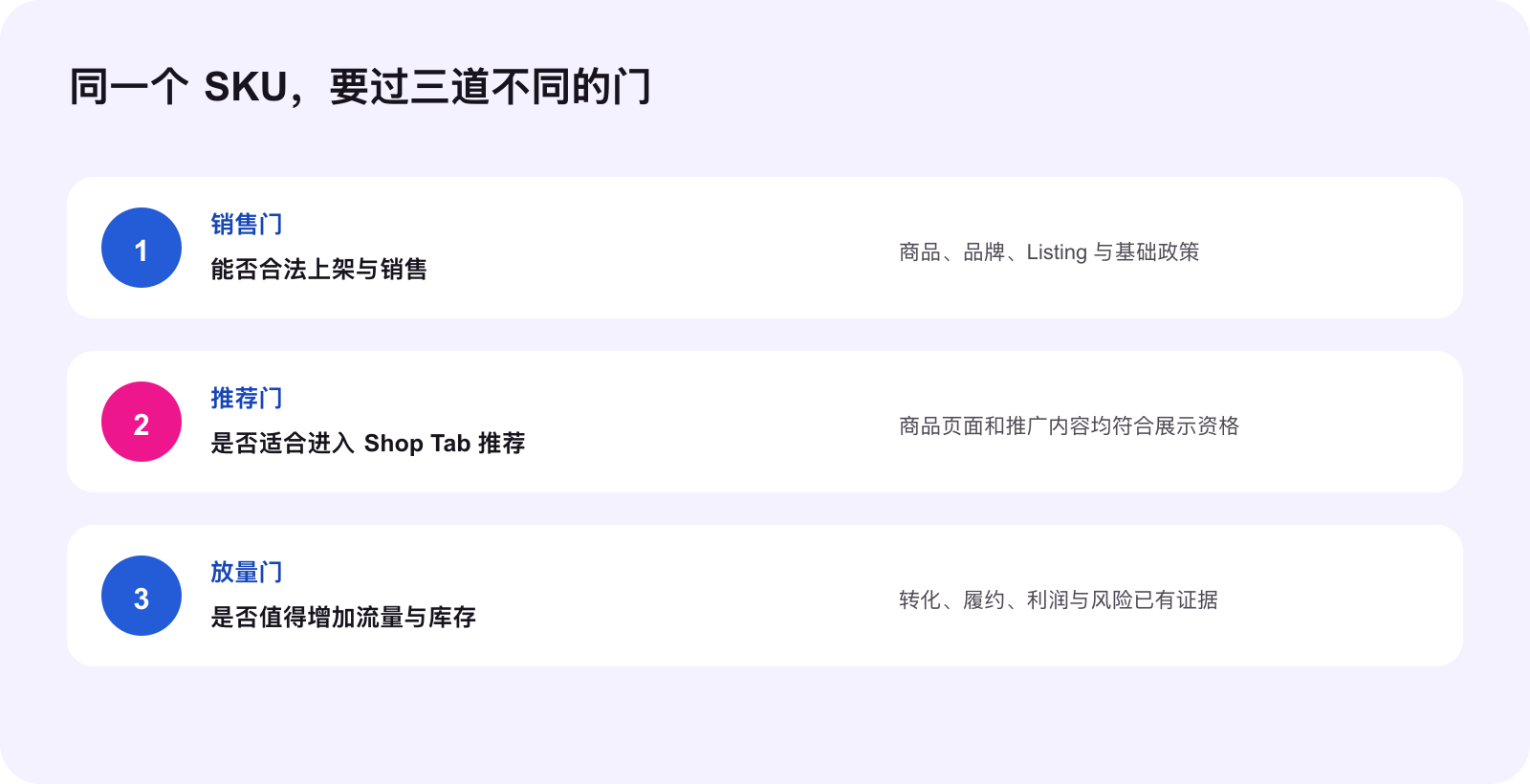
Direct answer: no. A product can clear the basic conditions to be listed and sold without being suitable for recommendation on the TikTok Shop Tab. The current TikTok Shop U.S. eligibility guide separates homepage recommendation from ordinary sale. It also evaluates promotional content, including videos and LIVE covers, not only the product record. Treat sale, recommendation and scale as three different gates.
The distinction matters because each gate answers a different question. The sale gate asks whether the product, seller, brand relationship and listing may operate on TikTok Shop. The recommendation gate asks whether the product page and the content used to promote it are suitable for a broad customer-facing surface. The scale gate is a WE Marketing operating decision: even when the first two gates pass, does the brand have enough conversion, margin, inventory and fulfillment evidence to add traffic responsibly?
Passing one gate is not evidence that the next gate passed. A searchable listing is not proof of homepage eligibility. Recommendation eligibility is not a promise of placement, impressions or sales. Platform permission is not proof that the SKU can absorb more creator volume, paid traffic or inventory. A clean audit keeps those conclusions separate.
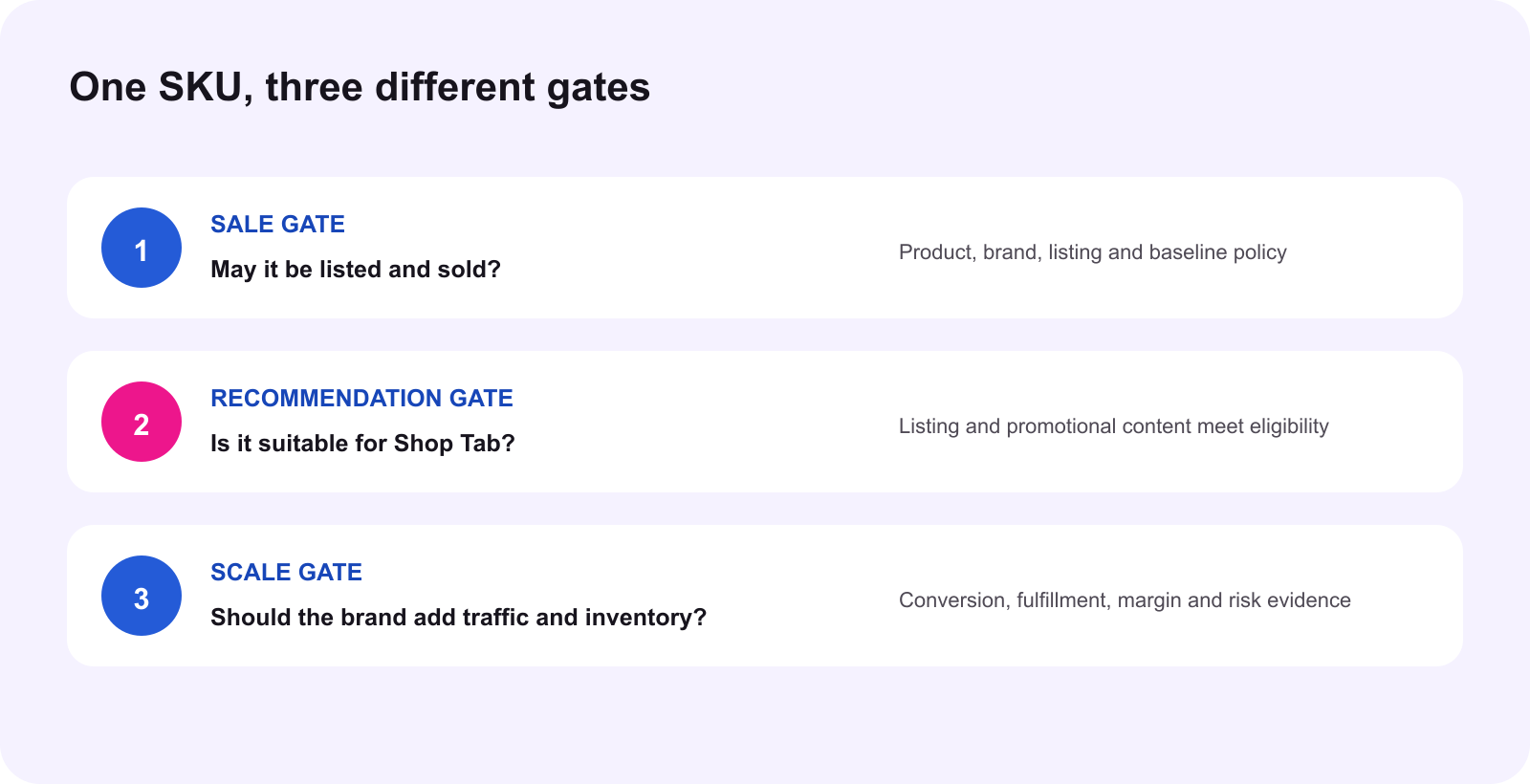
Gate 1: may the product be listed and sold?
Begin with the product itself. Confirm that the item, category, seller permissions, brand relationship, claims, images, title, description, variants and required qualifications comply with the applicable TikTok Shop rules. If a product requires brand authorization, category qualification, safety evidence or another approval, a recommendation review cannot replace it. A weak sale file should stop the release before the team discusses homepage visibility.
The sale gate also requires product truth. The exact item shipped must match the listing. Packaging, quantity, size, material, included accessories, color and variant names should be consistent across the product page, creator brief and fulfillment record. If the content promises something the SKU does not deliver, the risk is not solved by changing a thumbnail. Repair the offer and listing first.
Record the result as more than a green check. Save the seller entity, SKU, listing ID, category, brand route, qualification status, current screenshots, reviewer, review date and next expiry. A product is ready to move to the recommendation gate only when those fields describe the actual item that will be promoted.
Gate 2: is the product and its promotion suitable for Shop Tab?
TikTok Shop describes the Shop Tab as a customer-facing landing page where product recommendations can actively promote items. Its current U.S. guide says listings and promotional content must comply with Shop Tab eligibility as well as the Product Listing Policy and Content Policy to be visible or recommended on the homepage. Noncompliant content may be removed from the Shop Tab or excluded from recommendation even when the underlying product can still be sold.
The review surface is broader than the product detail page. Include the main image, supporting images, title and description, then inspect every video, LIVE cover, text overlay and promotional scene that could represent the SKU. A clean listing paired with an unsuitable LIVE cover is not a clean recommendation package. The same is true when a compliant product is promoted through vulgar, sexually suggestive, graphic or distressing creative.
The guide identifies crude, vulgar and disturbing content as ineligible. Its examples include explicit language, obscene gestures, graphic violence, sexual content, offensive or shock humor, profanity, hidden sexual meaning, bathroom jokes, insulting jokes, harmful stereotypes, exposure of intimate parts, suggestive poses, bodily fluids, decay, threatening uses of blood or weapons and gruesome animal imagery. These examples should become a preflight checklist, not a reason to invent broader prohibitions than the source states.
Sensitive events require a separate review. The guide lists natural disasters, health emergencies, civil unrest, terrorism and mass violence, and explains that products exploiting or endorsing tragedy may be removed or limited. The question is not only whether a product mentions an event. Review the commercial framing, creative treatment and timing. Do not use fear, suffering or an unfolding emergency as a conversion hook.
Political content has another boundary. Paid political advertising is not allowed. The guide also says political products are not eligible for TikTok Shop promotions such as Today’s Deals and New Customer Deals. Keep this promotion restriction separate from any broader question about whether a particular product may remain available for sale.
Search visibility is not Shop Tab recommendation
Teams often infer too much from a successful search test. The official eligibility guide explains that some products not eligible for Shop Tab recommendation may still appear in search. Therefore, a product being discoverable by exact title, shop name or keyword proves only that the route returned the listing at that moment. It does not prove that the homepage may recommend it to a broad audience.
Keep separate readbacks for listing availability, search discovery, Shop Tab eligibility and actual recommendation delivery. The first three are product or platform states. The fourth is an observed distribution outcome. If a seller sees low Shop Tab traffic, do not claim an eligibility problem without evidence. Check current notices, content status and account interfaces, then compare impressions before and after a controlled repair.
Run the recommendation package audit
Create one audit row per SKU and one asset row for every promotional item. For the SKU row, record the listing URL, category, title, main image, claims and policy status. For each asset, record the asset ID, format, creator, linked SKU, first-use date, current version and reviewer. The reviewer should see the actual rendered asset, not only a filename or script.
Check four layers in order. First, product truth: does every statement match the item? Second, visual suitability: does the page or creative contain any crude, vulgar, sexual, graphic, distressing or exploitative element identified by the current guide? Third, context: does the creative use a sensitive event or political promotion in a restricted way? Fourth, route consistency: do the listing, video and LIVE cover present the same product, offer and claim?
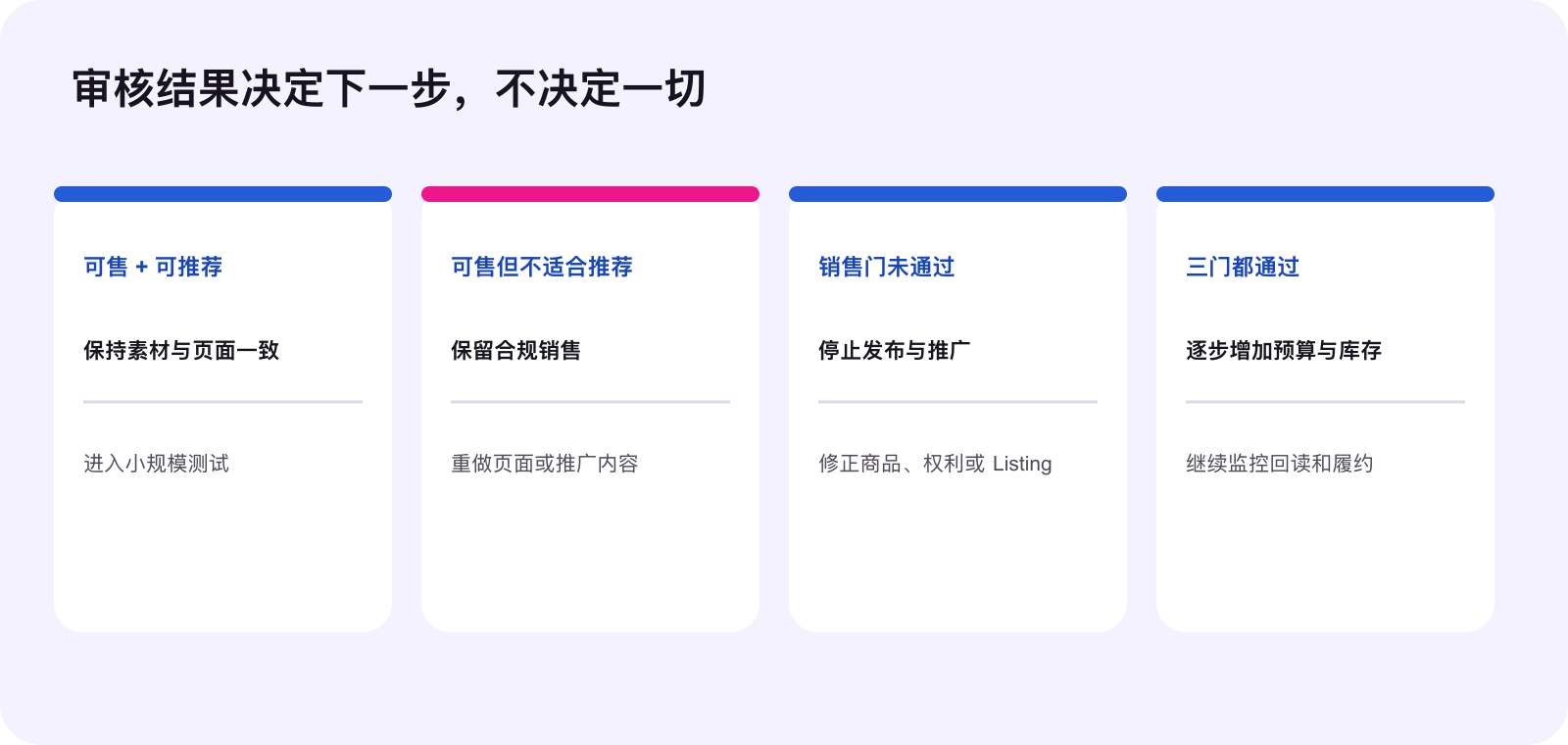
When one asset fails, isolate the failure. Do not automatically delist a compliant product because one thumbnail is unsuitable, and do not leave an unsuitable asset live because the product itself is allowed. Hold or replace the specific promotional asset while confirming whether the listing may remain available. If the sale gate itself fails, stop both sale and promotion until the underlying issue is resolved.
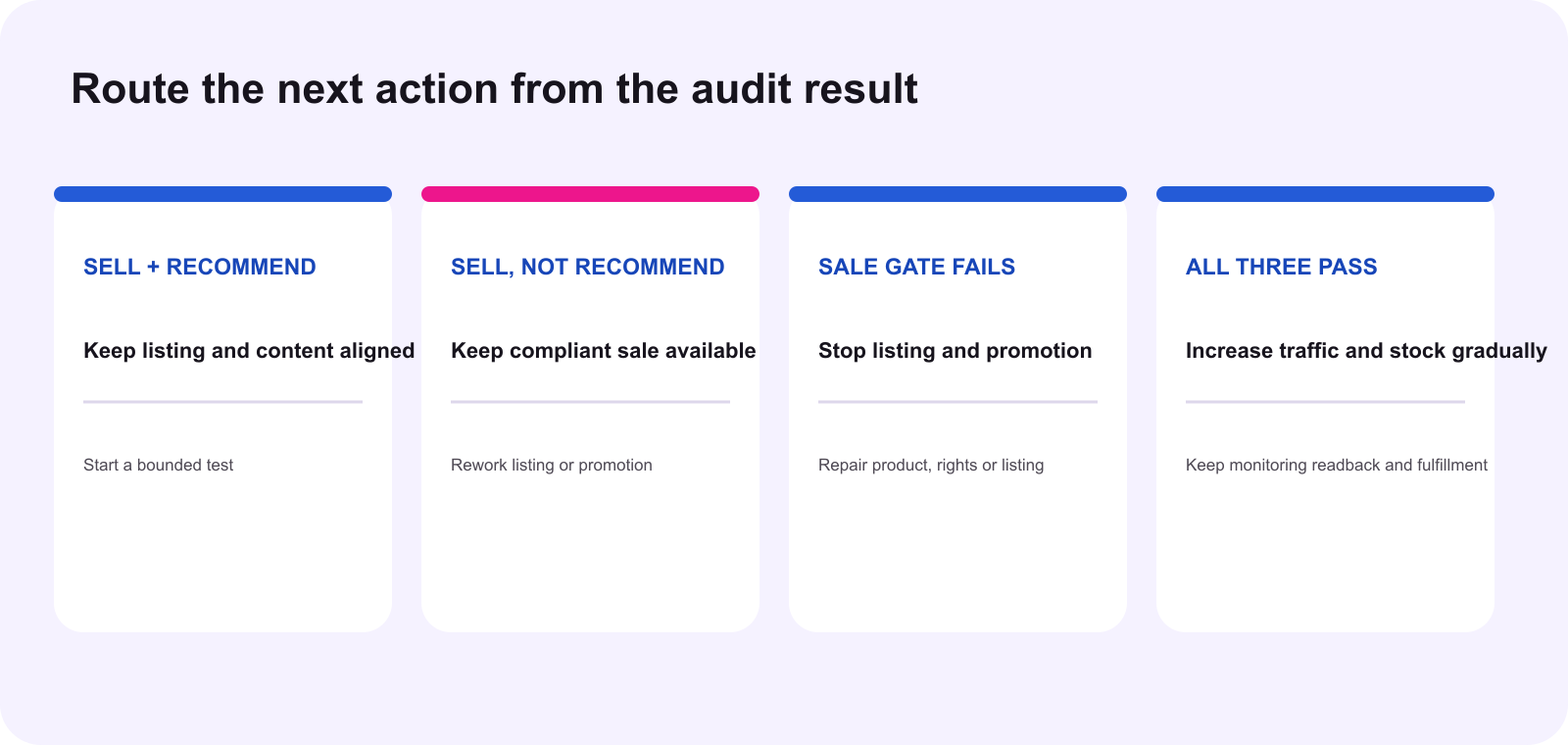
Gate 3: is the SKU ready to scale?
The scale gate is not a TikTok Shop permission and should never be presented as one. It is the brand's operating decision after compliance and recommendation suitability are stable. A SKU may be fully eligible but still be a poor candidate for additional spend because its product page does not convert, inventory is thin, contribution margin is negative, creators cannot explain it or fulfillment creates cancellations and complaints.
Define a bounded test before increasing traffic. Freeze the SKU, price, core offer, product page and fulfillment promise. Choose one traffic source and one creative question. Record impressions, product-page views, add-to-cart, checkout, orders, cancellations, returns, contribution margin and recurring buyer objections. The purpose is to learn whether the buyer path holds, not to manufacture a positive result by changing every variable.
Scale only after the team can name what worked and what remains constrained. Increase traffic or inventory in steps, with a stop condition for policy notices, fulfillment deterioration, rising return reasons, margin loss or content mismatch. Recommendation suitability can change when an asset changes, so a scale plan must preserve version control and repeat the gate review for new creative.
A weekly three-gate ledger
| Gate | Question | Minimum evidence | Owner |
|---|---|---|---|
| Sale | May this exact SKU be listed and sold? | Product truth, category, brand route, qualifications and current listing readback | Catalog or compliance owner |
| Recommendation | Are the listing and promotional assets suitable for Shop Tab? | Rendered asset review, current notice status and versioned approval | Content and shop operations |
| Scale | Can the buyer path, margin and fulfillment absorb more demand? | Bounded test, unit economics, inventory and service signals | Growth and operations |
Review the ledger whenever the SKU, claim, image, video, LIVE cover, price, bundle or sensitive context changes. Preserve the last approved version and the current rendered version so the team can see what actually changed. A submitted edit is not an accepted readback. A green status from last week does not cover a new creative today.
What enforcement can look like
The official guide says enforcement may include Account Health Rating points, listing removal, loss of selling privileges, removal from promotional surfaces and refunds to affected customers. The exact action depends on the issue and current platform decision. Operators should read the specific notice and use the corresponding appeal path when an appeal is available, rather than assuming every restriction has the same remedy.
Keep a case file with the notice, listing and asset versions, timestamps, source evidence, action taken and terminal readback. Do not label an appeal as successful when it has only been submitted. Do not label a product as restored until the relevant listing or promotional surface can be verified in the current account and, where appropriate, through an anonymous public check.
The smallest useful action today
Pick one priority SKU. Write three lines: sale gate, recommendation gate, scale gate. Under the recommendation line, attach the current listing, main image, top video and LIVE cover. Mark each line Pass, Hold or Unknown, cite the evidence and assign one owner. If anything is Unknown, resolve it before increasing traffic. This twenty-minute audit is more useful than treating “active listing” as proof that the whole growth system is ready.
Source notes and execution boundary
This original WE Marketing operating framework draws on the complete current TikTok Shop U.S. Seller University guide Shop Tab Eligibility, published September 24, 2026 and revalidated October 8, 2026. The source also directs sellers to the current Product Listing Policy and Content Policy. The three-gate structure, ledger and scale decision are WEM operating methods. Platform interfaces, eligibility, recommendation logic and enforcement can change. Verify the current U.S. Seller Center and the brand's own inventory, fulfillment and economics before execution. Eligibility does not guarantee recommendation, traffic or sales.
Common questions
If a product is allowed for sale, is it automatically eligible for Shop Tab recommendation?
No. The current TikTok Shop U.S. guide says some products may be allowed for sale but not suitable for homepage placement. Recommendation eligibility is a separate gate.
Can shoppers still find an item that is not recommended on Shop Tab?
The official guide explains that products not eligible for Shop Tab recommendation may still appear in search. Availability in search does not prove homepage recommendation eligibility.
Does Shop Tab eligibility apply only to the product listing?
No. The guide covers product listings and promotional content, including LIVE covers and videos. Operators should review the product page and every asset used to promote it.
Are political products eligible for TikTok Shop promotions?
The current guide says paid political advertising is not allowed and political products are not eligible for TikTok Shop promotions such as Today’s Deals and New Customer Deals.
Does passing the recommendation gate guarantee traffic or sales?
No. Eligibility means the item is suitable to be considered for recommendation. It does not guarantee placement, impressions, conversion or sales.
What is the smallest useful audit to run today?
Choose one priority SKU and review its listing, main image, videos and LIVE cover against the sale and recommendation gates. Record the exact issue, owner and next check date before adding traffic.