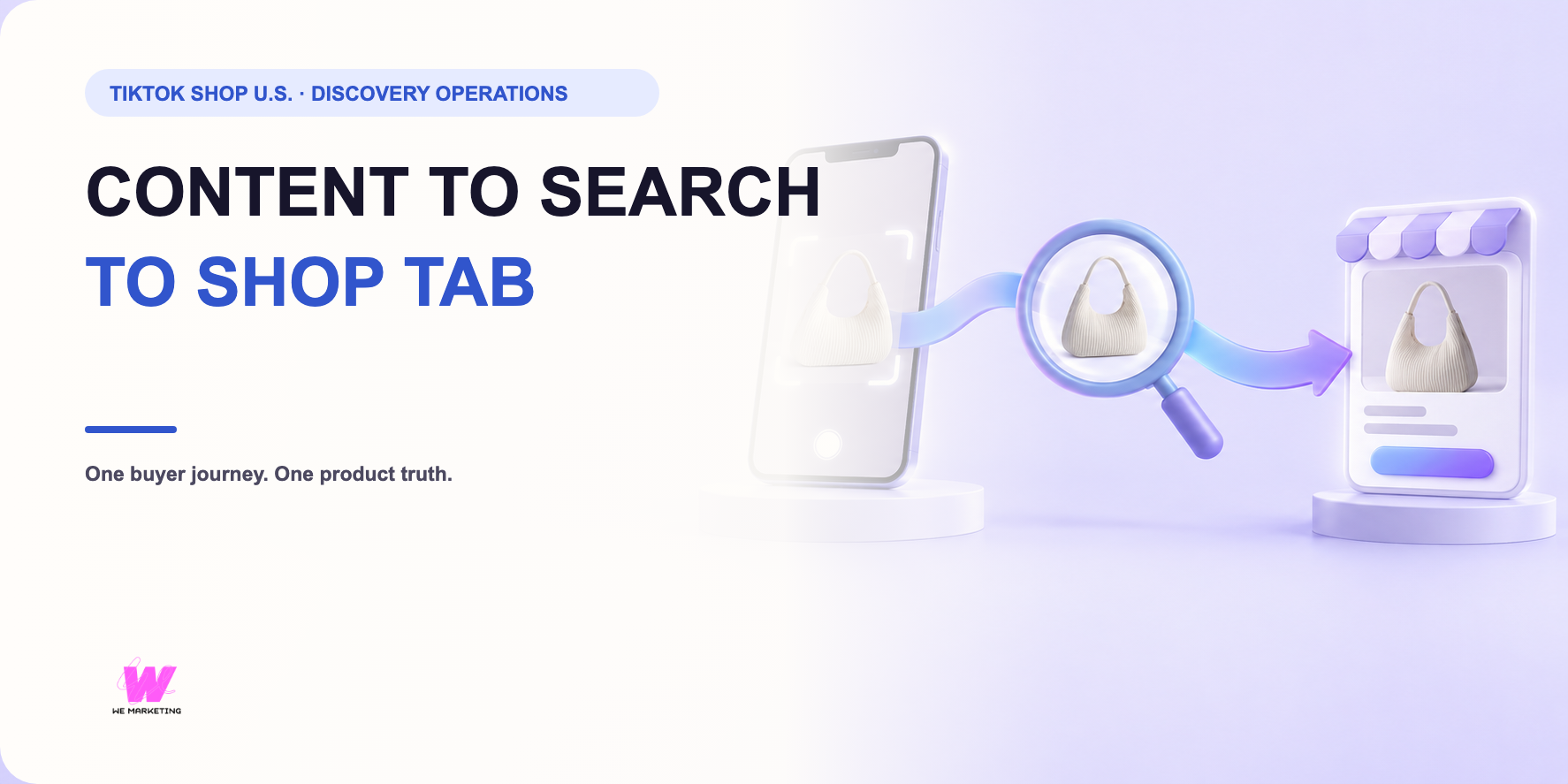
TIKTOK SHOP U.S. · DISCOVERY OPERATIONS
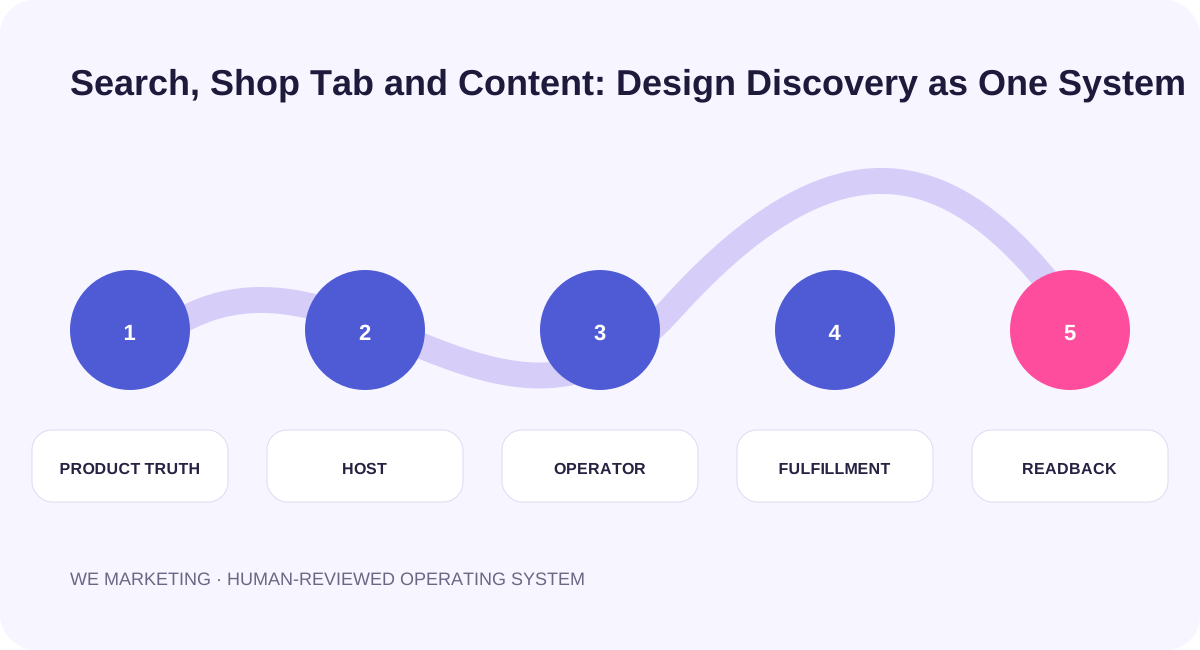
Search, Shop Tab and Content: Design Discovery as One System
WE Marketing Team · Sep 15, 2026 · 15 min read
Direct answer
Treat content, search and Shop Tab as one buyer journey, not three traffic teams. Content makes a product relevant to a real situation; search lets the shopper verify and compare; the product card and Shop Tab must make the same item easy to recognize, trust and buy. If the promise, query, title, images, stock and offer do not agree, more content creates more leakage rather than more demand.
A discovery system is a repeatable handoff from buyer language to product truth. It has a named buyer question, approved content expression, relevant query family, accurate listing, sellable variant, measurement window and an owner who can repair the earliest broken handoff. It is not a promise of ranking or a trick for adding unrelated keywords.
The operating question is never “what can the tool do?” It is “what decision can the team safely make from current evidence, and who owns the readback?”
Why buyer question comes before execution
A broad keyword can attract curiosity while the actual listing fails the buyer need. That is why the first operating move is specific: Choose one concrete question that a shopper asks after seeing a demonstration, such as size, compatibility, material or use case. Translate it into a small family of truthful query terms rather than chasing every trending word. The evidence is equally specific: Comment and search language, the exact product and approved claims. A fast interface cannot repair a wrong classification or an unverified starting point. It can only execute the team's assumption more quickly.
This article therefore treats buyer question and content promise as connected release gates. The team does not advance because a recommendation looks confident or a dashboard tile turns green. It advances when the exact object is known, the current account evidence supports the action and the consequence of being wrong is inside a written guardrail.
The evidence packet for this decision
Build one packet from the evidence families used across this workflow: Comment and search language, the exact product and approved claims. Final creative, creator brief, product link, claim review and variant map. Current U.S. listing fields, Product Optimizer recommendations and search-term evidence. These records answer different questions and should not be collapsed into one score. Platform evidence describes access and observed state. Brand evidence describes product truth, cost, stock, staffing and what the customer can actually receive.
Keep the later-stage records beside them: Live product card, sellable variant, Shop Tab eligibility and shop-page preview. Seller Center Shop Tab and Search Analytics, product-level trends, campaign context and comparable dates. Change log, owner, before-and-after evidence, stock and final listing readback. Mark unavailable facts as unknown, with an owner and resolution date. If the missing fact affects product identity, permission, customer safety, sellable inventory, fulfillment or the economic floor, it is a stop condition. If it only limits confidence in an optimization idea, the team may choose a smaller reversible test.
1. Buyer question
Operating move: Choose one concrete question that a shopper asks after seeing a demonstration, such as size, compatibility, material or use case. Translate it into a small family of truthful query terms rather than chasing every trending word.
Required evidence: Comment and search language, the exact product and approved claims.
Failure mode: A broad keyword can attract curiosity while the actual listing fails the buyer need.
Before closing this gate, assign one owner and one readback time. Save the exact page, asset, product, session or order identifier. If the live state differs from the approved state, stop the sequence, record the exception and repair the earliest broken handoff rather than compensating later with more traffic, discount or content.
2. Content promise
Operating move: Make the video or LIVE show the exact benefit and variant the listing can substantiate. Keep the spoken phrase, caption and product link understandable without forcing shoppers to guess.
Required evidence: Final creative, creator brief, product link, claim review and variant map.
Failure mode: A compelling video can send shoppers to a different color, size, bundle or unsupported promise.
Before closing this gate, assign one owner and one readback time. Save the exact page, asset, product, session or order identifier. If the live state differs from the approved state, stop the sequence, record the exception and repair the earliest broken handoff rather than compensating later with more traffic, discount or content.
3. Search match
Operating move: Use accurate category, brand, product type, attributes and relevant search terms. Write a readable title and use optional backend search terms or highlights only where available and true.
Required evidence: Current U.S. listing fields, Product Optimizer recommendations and search-term evidence.
Failure mode: Keyword stuffing, irrelevant synonyms and unverified AI suggestions can damage trust or violate listing rules.
Before closing this gate, assign one owner and one readback time. Save the exact page, asset, product, session or order identifier. If the live state differs from the approved state, stop the sequence, record the exception and repair the earliest broken handoff rather than compensating later with more traffic, discount or content.
4. Shop Tab landing
Operating move: Check the first image, product detail, reviews, price, shipping promise, stock and shop-page navigation from a shopper view. Listed products can enter Shop Tab automatically, but recommendation placement is not guaranteed.
Required evidence: Live product card, sellable variant, Shop Tab eligibility and shop-page preview.
Failure mode: A product can be listed yet fail recommendation suitability, stock or buyer comprehension.
Before closing this gate, assign one owner and one readback time. Save the exact page, asset, product, session or order identifier. If the live state differs from the approved state, stop the sequence, record the exception and repair the earliest broken handoff rather than compensating later with more traffic, discount or content.
5. Measurement boundary
Operating move: Compare the same SKU and a defined period across content, search, Shop Tab and product-card signals. Separate channel attribution from a shopper journey and do not sum overlapping GMV.
Required evidence: Seller Center Shop Tab and Search Analytics, product-level trends, campaign context and comparable dates.
Failure mode: A rise in search after content is a useful hypothesis, not proof that every search order came from that video.
Before closing this gate, assign one owner and one readback time. Save the exact page, asset, product, session or order identifier. If the live state differs from the approved state, stop the sequence, record the exception and repair the earliest broken handoff rather than compensating later with more traffic, discount or content.
6. Repair and repeat
Operating move: Fix the earliest broken handoff, change one controllable variable where practical and read the live state back before scaling. Keep operations and fulfillment able to honor the demand created.
Required evidence: Change log, owner, before-and-after evidence, stock and final listing readback.
Failure mode: More creator content or paid traffic multiplies a weak product card and creates avoidable service issues.
Before closing this gate, assign one owner and one readback time. Save the exact page, asset, product, session or order identifier. If the live state differs from the approved state, stop the sequence, record the exception and repair the earliest broken handoff rather than compensating later with more traffic, discount or content.
Tradeoffs and stop rules for measurement boundary
The central tradeoff is between search match and measurement boundary. Moving early may capture demand or learning, but it also exposes the failure mode already named in the workflow: A rise in search after content is a useful hypothesis, not proof that every search order came from that video. Waiting for perfect information may waste a time-bound opportunity. The practical answer is not maximum speed or maximum caution. It is the smallest release whose downside the owner can observe and stop.
Write stop rules from the actual failure modes: A broad keyword can attract curiosity while the actual listing fails the buyer need. A compelling video can send shoppers to a different color, size, bundle or unsupported promise. Keyword stuffing, irrelevant synonyms and unverified AI suggestions can damage trust or violate listing rules. A product can be listed yet fail recommendation suitability, stock or buyer comprehension. A rise in search after content is a useful hypothesis, not proof that every search order came from that video. More creator content or paid traffic multiplies a weak product card and creates avoidable service issues. Convert the relevant conditions into observable thresholds and give one person authority to pause. The rule should also name the safe state after a stop, such as hold the product, end paid support, remove the item from the session, repair the listing or reconcile affected orders.
Hypothetical operating example
A hypothetical home-organization brand posts a useful demonstration of a compact shelf. Comments repeatedly ask whether it fits a particular cabinet depth. The team does not insert that phrase into every listing. It first confirms the exact dimensions and which variation qualifies, updates the relevant product attributes and image, then uses one accurate phrase in the next video caption and the matching listing. It records the publication time, checks that the product remains sellable and compares search impressions, product-card clicks and orders across comparable periods. If impressions grow but clicks do not, the next repair is the search result image or title; if clicks grow but orders do not, it inspects price, variation and delivery rather than making another video.
This example is illustrative, not a WEM client result. The point is the decision sequence: classify the object, gather current evidence, separate hard gates from optimization choices, release the smallest defensible action and verify the named live state. If the conditions change materially, the team starts a new comparison rather than forcing the result into the old test.
Review the six gates as one sequence
The review order is Buyer question, Content promise, Search match, Shop Tab landing, Measurement boundary, Repair and repeat. Keep one active row for each unresolved gate and connect it to the exact product, event, campaign or decision. A row is pending when its required evidence is missing, blocked when a named condition prevents safe work, released when the approved action is visibly live and verified only after repair and repeat closes the consequence.
The weekly decision must be topic-specific. Close the row as repeat when the same controlled conditions should run again, repair when an earlier gate failed, expand when comparable evidence supports more exposure, monitor when no action is currently justified or stop when the risk or economics no longer support the path. A draft, upload, submission or recommendation cannot close this sequence.
Smallest useful next action
Pick one existing video and one linked SKU. Write the buyer question in the shopper’s words, verify the exact variation and claim, read the live search result and product card, then record the first mismatch and assign one owner to repair it this week.
Source notes
This original WEM discovery framework draws on the complete official U.S.-applicable Chinese cross-border manual, 商城&搜索场实操手册 (May 26, 2026), and current U.S. Seller University guidance on Shop Tab, Shop Tab & Search Analytics, Search terms and Product highlights, and Shop Tab eligibility, revalidated September 17, 2026. The manual's historical aggregate statistics and campaign-specific thresholds are not forecasts or universal eligibility rules. WEM adds the buyer-question handoff, named ownership and controlled measurement. Verify current U.S. Seller Center fields, policy, account access and product state before execution.
Frequently asked questions
What is the first decision to make?
Treat content, search and Shop Tab as one buyer journey, not three traffic teams. Content makes a product relevant to a real situation; search lets the shopper verify and compare; the product card and Shop Tab must make the same item easy to recognize, trust and buy. If the promise, query, title, images, stock and offer do not agree, more content creates more leakage rather than more demand.
Can a platform recommendation replace human approval?
No. Treat recommendations as hypotheses or navigation help. Verify the current native record, product truth, economics, policy and operating context before any consequential action.
What should the team record as unknown?
Any unavailable qualification, metric, inventory, cost, claim, policy or customer fact should be marked unknown with an owner and resolution date. Unknown is not zero and is not approval.
How many variables should change at once?
Change one controllable variable where practical. If safety, compliance or inventory requires a larger correction, protect the business first and label the period non-comparable.
When is the work complete?
Only after the intended live state is visible, the named record is read back, exceptions are reconciled and the next decision is recorded. Submission or a green-looking dashboard is not terminal evidence.
What is the smallest useful action today?
Pick one existing video and one linked SKU. Write the buyer question in the shopper’s words, verify the exact variation and claim, read the live search result and product card, then record the first mismatch and assign one owner to repair it this week.