TIKTOK SHOP U.S. · CUSTOMER DATA
Can TikTok Shop Customer Data Be Used for Email or SMS Marketing?
Direct answer: do not treat a TikTok Shop purchase, order record, buyer message, shipping detail or customer-service interaction as blanket permission to add someone to an email or SMS marketing program. The current U.S. Seller Terms define a narrow permitted purpose for TikTok Shop Data. Direct marketing requires the user's prior consent in accordance with applicable law, and the platform's own messaging functionality cannot be used for marketing or promotional purposes.
This is a data-use decision, not an export-format decision. A CSV can be technically available and still be inappropriate for a campaign. Before a customer record reaches a marketing platform, the team must be able to explain where the data came from, why it is being used, what consent covers that channel and purpose, how the evidence can be read back, and who can stop the use when consent is withdrawn or the purpose changes.
Start with the current Seller Terms boundary
Section 4.2(18) of the current TikTok Shop U.S. Seller Terms describes TikTok Shop Data as information made available by TT Commerce & Global Services or received from it or its users, including when users interact with products or communicate directly with a seller. It requires sellers to handle that data consistently with the Seller Terms, their privacy notices and applicable data-protection requirements.
The section says TikTok Shop Data may be used to process and fulfill an order and, where necessary, handle refunds, returns, cancellations, inquiries, complaints, disputes or claims relating to an order. It calls this the Permitted Purpose. It then prohibits other purposes, including selling or trading TikTok Shop Data and using it for direct marketing by email or another direct-communication method unless the user has given prior consent that meets applicable law.
The terms also say TikTok Platform messaging functionality may not be used for marketing or promotional purposes. They restrict selling or sharing user data without authorization, require appropriate security measures and place boundaries on transfers and access. Those are source facts. The decision system below is WEM operating guidance, not a substitute for privacy counsel.
Operating rule: an order proves a transaction. It does not, by itself, prove channel-specific marketing consent.
Separate order operations from marketing activation
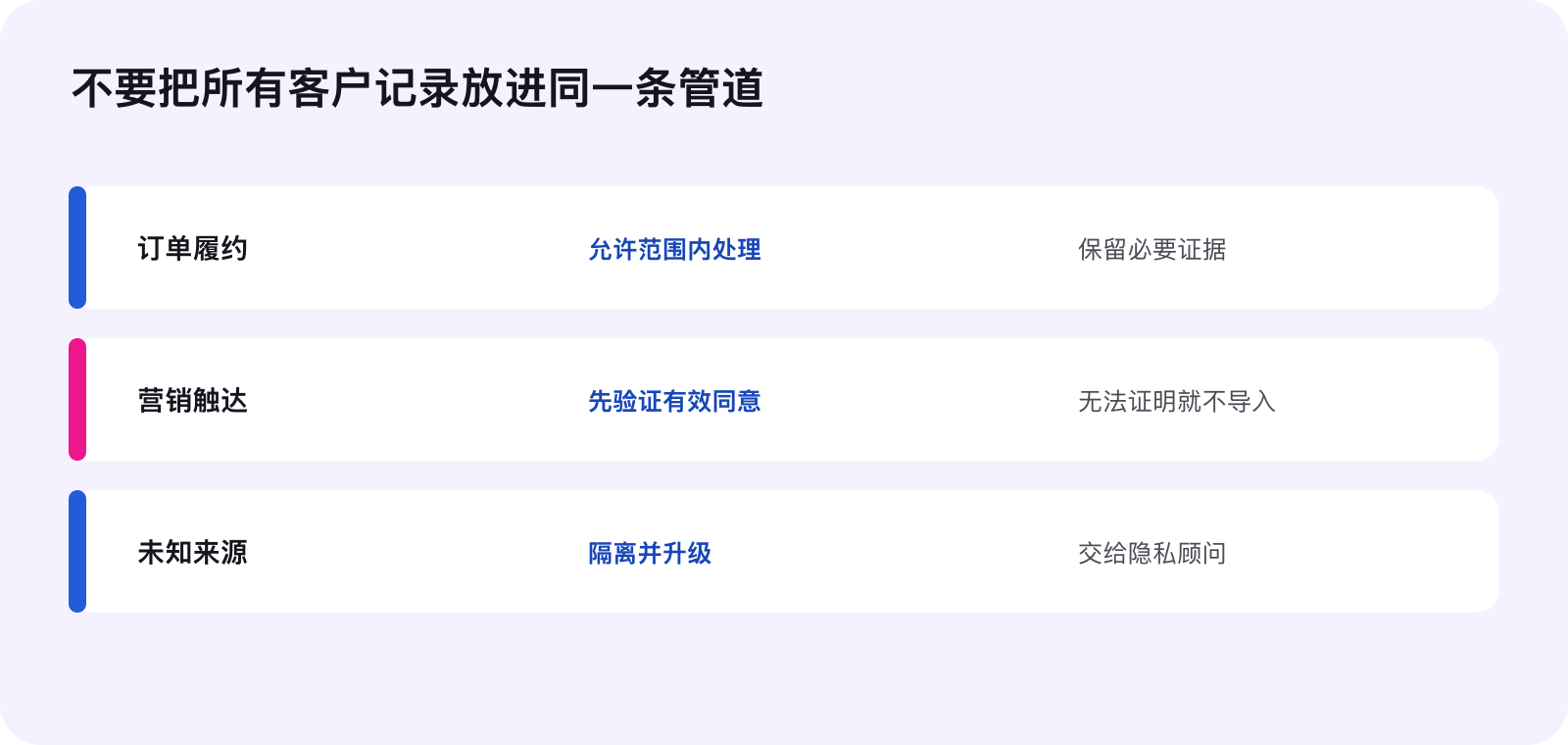
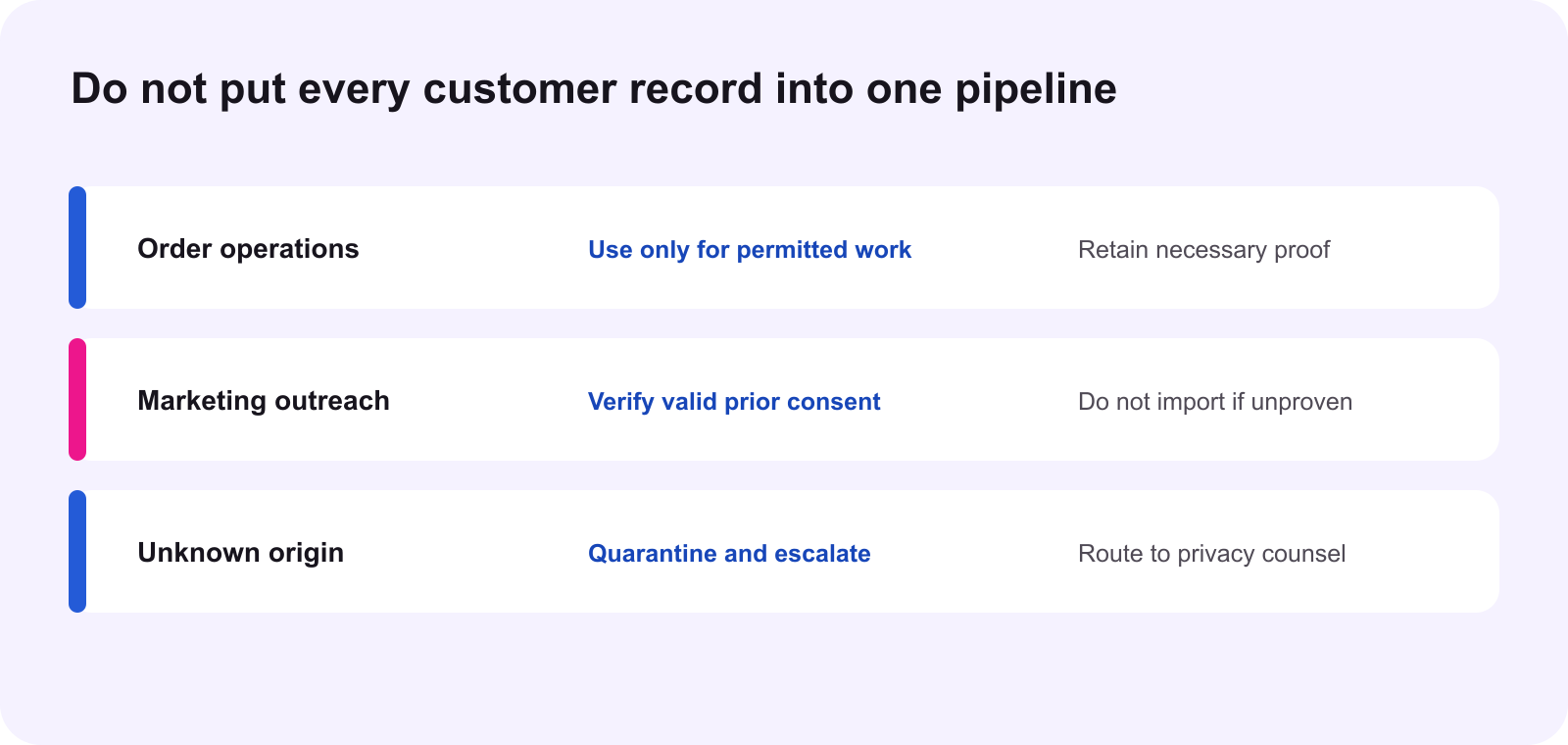
Build two lanes. The order-operations lane contains the minimum information needed for fulfillment, support and order-related resolution. The marketing lane contains only records that have passed a separate consent and purpose gate. Do not allow convenience, a broad CRM label or a shared spreadsheet to merge these lanes.
In the order lane, define the operational reason for each field, the teams that need it, the systems that receive it and the closure condition. A shipping address can be necessary to fulfill an order. That necessity does not automatically make the address, phone number or email available for a promotion. A support conversation can be necessary to resolve a complaint. It does not become a marketing lead simply because the customer expressed interest in a product.
In the marketing lane, the record needs an independent basis for the planned outreach. The evidence must match the channel. Email permission does not automatically prove SMS permission. A consent captured for one brand, purpose, jurisdiction or campaign should not be silently expanded. When scope is ambiguous, pause the import and route the question to privacy counsel.
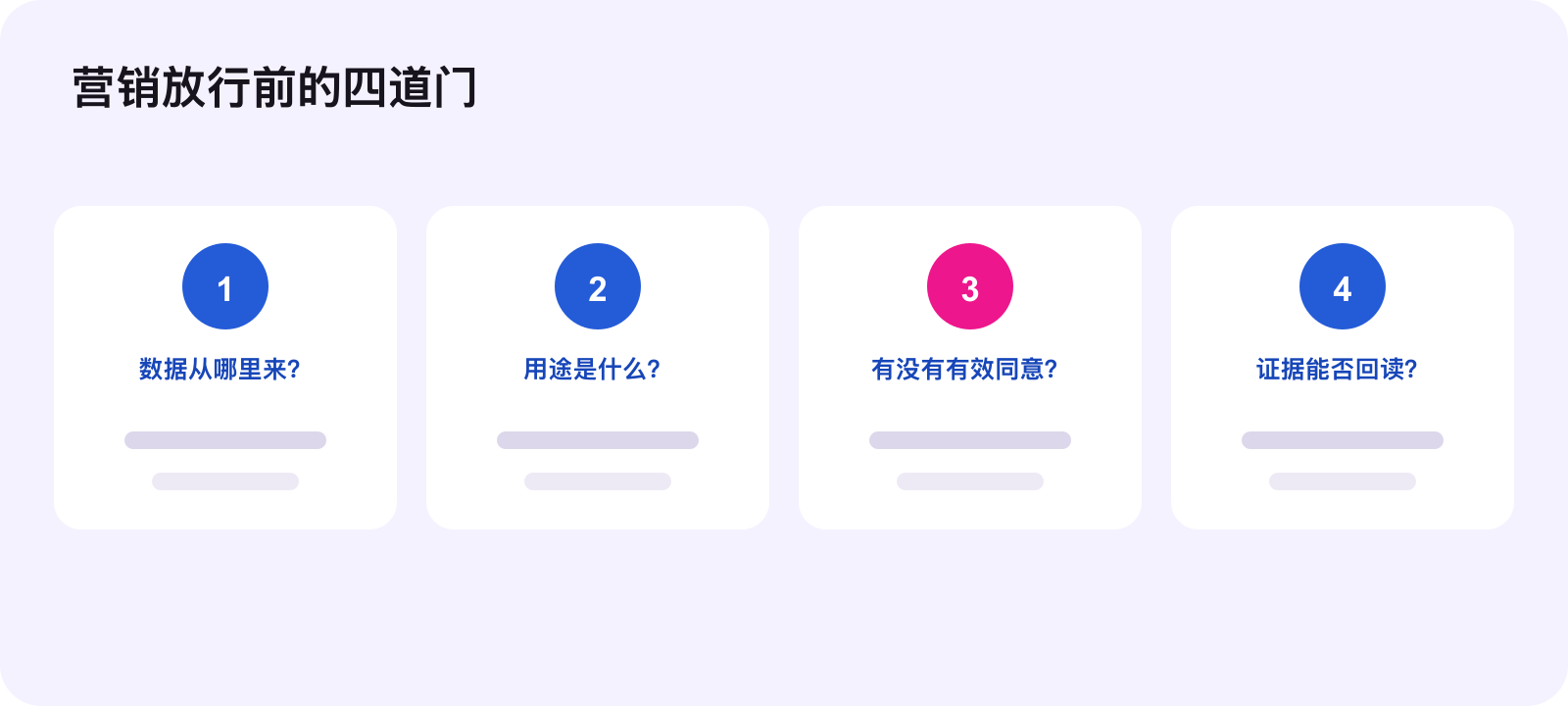
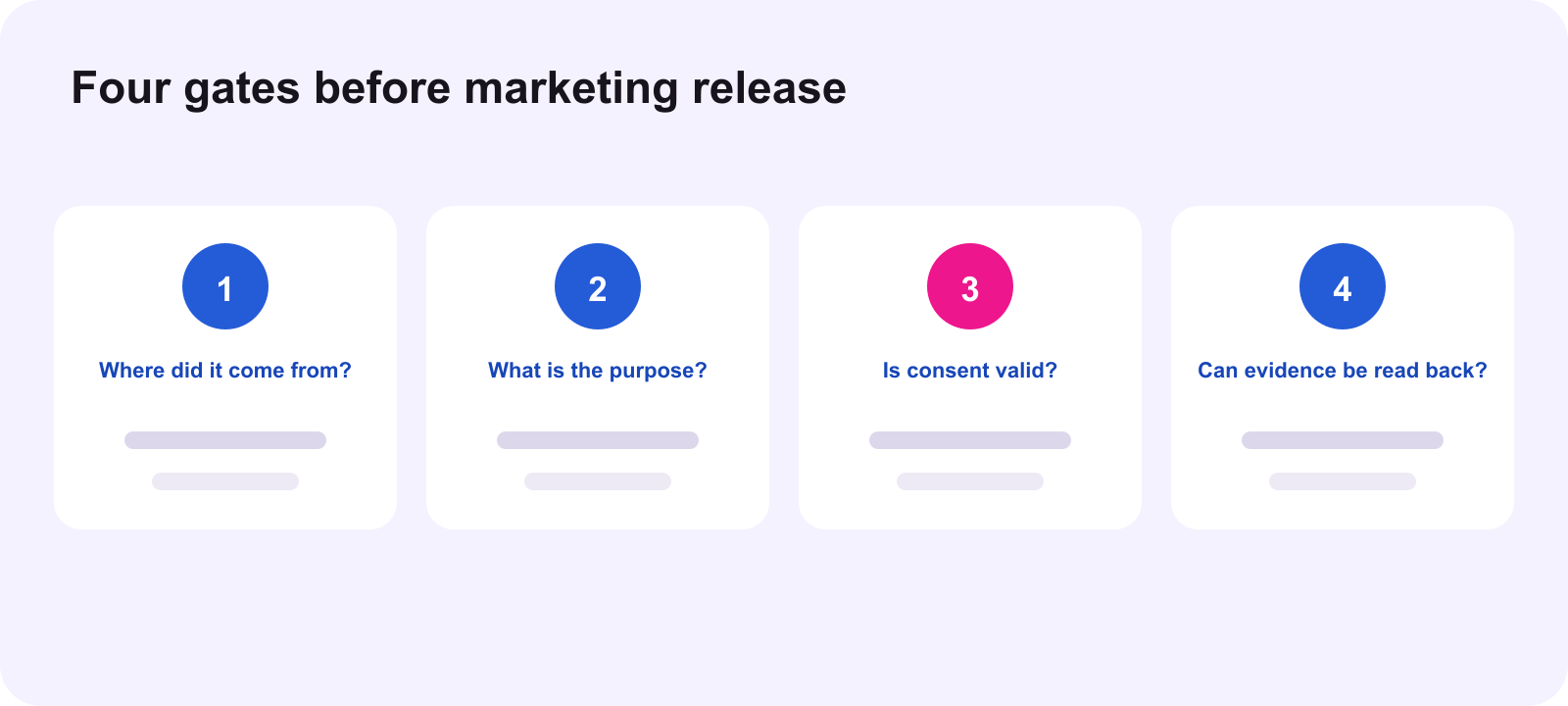
Use four gates before any record enters a campaign
Gate 1: source. Name the collection surface and system of record. Was the information supplied for a TikTok Shop order, an independent brand-site signup, a loyalty enrollment, an event form or another documented surface? Preserve the source rather than flattening everything into “customer.” If the source is unknown, the record is not ready.
Gate 2: purpose. Write the intended action in plain language: send a shipping update, answer an order inquiry, deliver a requested receipt, send a promotional email, or send an SMS offer. “CRM use” is too vague. The team should be able to compare one named purpose with the source boundary and consent record.
Gate 3: consent and legal review. For direct marketing, identify the exact language the user saw, the affirmative action, date and time, channel, brand, jurisdiction, policy version and any required disclosures. Then have qualified privacy counsel determine whether the evidence and proposed use satisfy applicable requirements. Operators should not invent a legal conclusion from a checked box or platform field.
Gate 4: readback. Confirm that the destination platform received only eligible records, that suppressions and withdrawals remain active, and that a reviewer can reproduce why a record was included. The import count is not enough. Sample records across sources and verify consent evidence, channel, status and campaign eligibility.
Build a field-level decision table
| Field or record | Order purpose | Marketing decision | Required evidence |
|---|---|---|---|
| Email or phone from an order | May support necessary order work | Do not assume marketing eligibility | Separate prior consent matching the channel and use |
| Brand-site signup linked to the same person | Not needed to prove the order | Assess under the signup's own terms | Collection surface, language, time, status and identity match |
| Buyer message or support transcript | May support inquiry or complaint handling | Do not convert conversation into promotion | A separate, documented marketing consent if outreach is proposed |
| Suppression or withdrawal | May not be campaign content | Must control future activation | Current status, effective time and destination readback |
The table is a routing device, not a claim that every listed field is always available or lawful to process. Data fields, interfaces, jurisdictions and business arrangements differ. Inventory what the current account actually exposes, minimize collection and have the responsible privacy owner approve the final rule.
Do not solve a consent gap with data matching
A team may already have a separate email subscriber who later buys through TikTok Shop. The safe question is not “can we recognize the same person?” It is “what documented consent applies to the planned message, and can we prove the match without repurposing restricted data?” Identity resolution does not create permission. It can also introduce mistaken matches, wider access and new retention obligations.
If counsel approves a match process, define the minimum fields, matching confidence, authorized owner, destination, retention, correction path and audit evidence. Keep TikTok Shop order data from becoming the silent master list. A marketing system should record why a person is eligible, not merely that a customer identifier exists somewhere.
Control vendors, exports and destinations
Before sending records to an email service provider, SMS platform, CDP, spreadsheet, agency or analytics tool, document the purpose, fields, authorized users, location, transfer path, retention period and deletion process. Confirm that the vendor is needed for the approved purpose and that its access is limited accordingly. Do not use an agency handoff as a shortcut around the seller's own responsibility.
Keep exports versioned and access-controlled. Avoid personal downloads and uncontrolled shared links. Record who exported the file, when, from which source, for which purpose and where it was placed. When the purpose ends, close the access and preserve evidence of deletion or return where required. The offboarding control should cover both the platform authorization and every downstream copy.
Run a consent-led campaign release
- Write one campaign purpose and channel.
- Identify the approved source populations and exclude TikTok Shop order-only records.
- Apply suppression, withdrawal, age, geography and other counsel-approved rules.
- Reconcile the eligible count before and after import.
- Sample records and read back source, consent, channel and current status.
- Approve the campaign only after the privacy owner and campaign owner sign their separate gates.
- After send, retain the decision record, destination result and any new withdrawal evidence.
Do not let a deadline collapse these controls into a single “uploaded” status. Prepared, imported, approved, sent and verified are different states. If evidence is missing, keep the population excluded and record the unknown rather than treating it as consent.
Operational example: the retention team asks for all buyers
Imagine a retention team asks operations to export all TikTok Shop buyers into the email and SMS stack before a launch. Operations should not deliver a general buyer file. Instead, it creates a source inventory and splits the population: order-only records, people with a separate brand-site email consent, people with separately documented SMS consent, withdrawn contacts and unknown-source records.
The privacy owner reviews the consent language and matching method. The marketing owner defines the exact campaign and channel. Only the approved population moves, and the destination readback confirms that suppressions survived the import. Unknown and order-only records remain outside the campaign. If counsel cannot confirm the use, the team pauses rather than converting commercial urgency into an unsupported privacy decision.
The smallest useful next action
Open the next planned email or SMS audience today and add four columns: data source, named purpose, consent evidence, release owner. Sample ten records. If any record is present only because it came from a TikTok Shop order, remove it from the marketing audience until a qualified reviewer confirms a separate valid basis. Preserve the exclusion and review result as evidence.
Source notes and execution boundary
This original WE Marketing framework draws on the current TikTok Shop U.S. Seller Terms of Service, especially Section 4.2(18), revalidated October 5, 2026. The source defines the order-related Permitted Purpose, restricts other uses of TikTok Shop Data, requires prior consent meeting Applicable Law for direct marketing, and prohibits using TikTok Platform messaging for marketing or promotional purposes. Interfaces, terms and laws can change. Verify the current source and account, minimize data use, and involve qualified privacy counsel before legal, consent, retention or cross-border decisions. This article is operational guidance, not legal advice.
Common questions
Can we add every TikTok Shop buyer to our email list?
No. A purchase or order record is not blanket consent for direct marketing. Verify a separate lawful consent basis and the exact scope before importing or messaging.
Can we use TikTok Shop data to send SMS promotions?
Only when the user has provided prior consent that meets applicable law and the planned use fits that consent. Route legal sufficiency to qualified privacy counsel.
Can we send promotions through TikTok Shop messaging?
The current U.S. Seller Terms say TikTok Platform messaging functionality must not be used for marketing or promotional purposes.
What proof should we keep for marketing consent?
Keep the consent language, collection surface, timestamp, user or record identifier, channel, source, policy version, withdrawal state and a reproducible readback.
What should we do with records whose source is unclear?
Quarantine them from campaigns. Identify the source and permitted purpose; if consent cannot be proved, do not treat the records as marketable.
Is this legal advice?
No. This is an operating-control framework. Ask qualified privacy counsel to assess applicable laws, consent language, retention and cross-border processing.