TIKTOK SHOP U.S. · PAYMENT OPERATIONS
A Seven-Day TikTok Shop Chargeback Evidence Pack
Direct answer: do not begin a chargeback appeal by hunting for random screenshots. Open one case file, capture the live reply-by date, name one accountable owner, identify the disputed fact and assemble only the evidence that proves or disproves that fact. Submit before the deadline, then read back the files, status, timestamp and final financial outcome. The seven-day window is a control clock, not a promise that missing order history can be recreated later.
The current TikTok Shop U.S. Chargeback Policy says a chargeback begins when a customer disputes a transaction through a financial institution or card issuer. Reasons can include non-receipt, a product that differs from the listing, damage, billing errors, duplicate charges or an allegedly unauthorized purchase. That makes a payment chargeback different from an ordinary return request. The evidence must answer the financial dispute, not simply repeat the customer-service history.
Start with the live notification and exact clock
The current policy says sellers generally must respond in Seller Center within seven calendar days of the chargeback notification. It also says the specific reply-by date appears in the notification. Capture both the notification time and that visible date because the displayed deadline is the operating truth for the case. Do not calculate a private deadline and assume it matches the platform.
Create an internal deadline before the external deadline. Use day zero to save the case and assign ownership, days one through four to complete evidence, day five for an independent review and day six for submission plus readback. Keep day seven as emergency buffer only. If the team waits until the last day, a permissions problem, large file, unclear image or missing logistics record becomes an unrecoverable failure.

Write the fact to prove before collecting files
A useful packet begins with one sentence: “For this reason code, the decision depends on whether…” A non-receipt dispute may depend on whether delivery can be linked to the cardholder’s order and location. A not-as-described dispute may depend on what the listing and selected SKU promised when the order was placed. A damaged-product dispute may depend on condition at packing, handoff and delivery. A duplicate-charge dispute requires transaction records, not a warehouse video.
This sentence prevents evidence dumping. The reviewer can reject a file that does not answer the disputed fact, even when the file looks professional. It also exposes the true gap early. If nobody can name the fact, the team is not ready to decide whether an appeal is supportable.
Separate required information from supporting material
The current policy lists three required information groups: the status of the transaction, a description of the product and proof that the item was received by the cardholder. It also identifies additional materials that may be included, such as order confirmation emails, records of changes, refunds or cancellation, tracking numbers, product images and customer messages.
Required does not mean a generic screenshot is sufficient. A transaction status should identify the correct transaction. A product description should reflect the ordered product and selected variant. Proof of receipt should connect the order, shipment and recipient in a way an external reviewer can understand. Supporting files should fill a named evidentiary gap, not create a longer attachment list.
Build a six-part chargeback packet
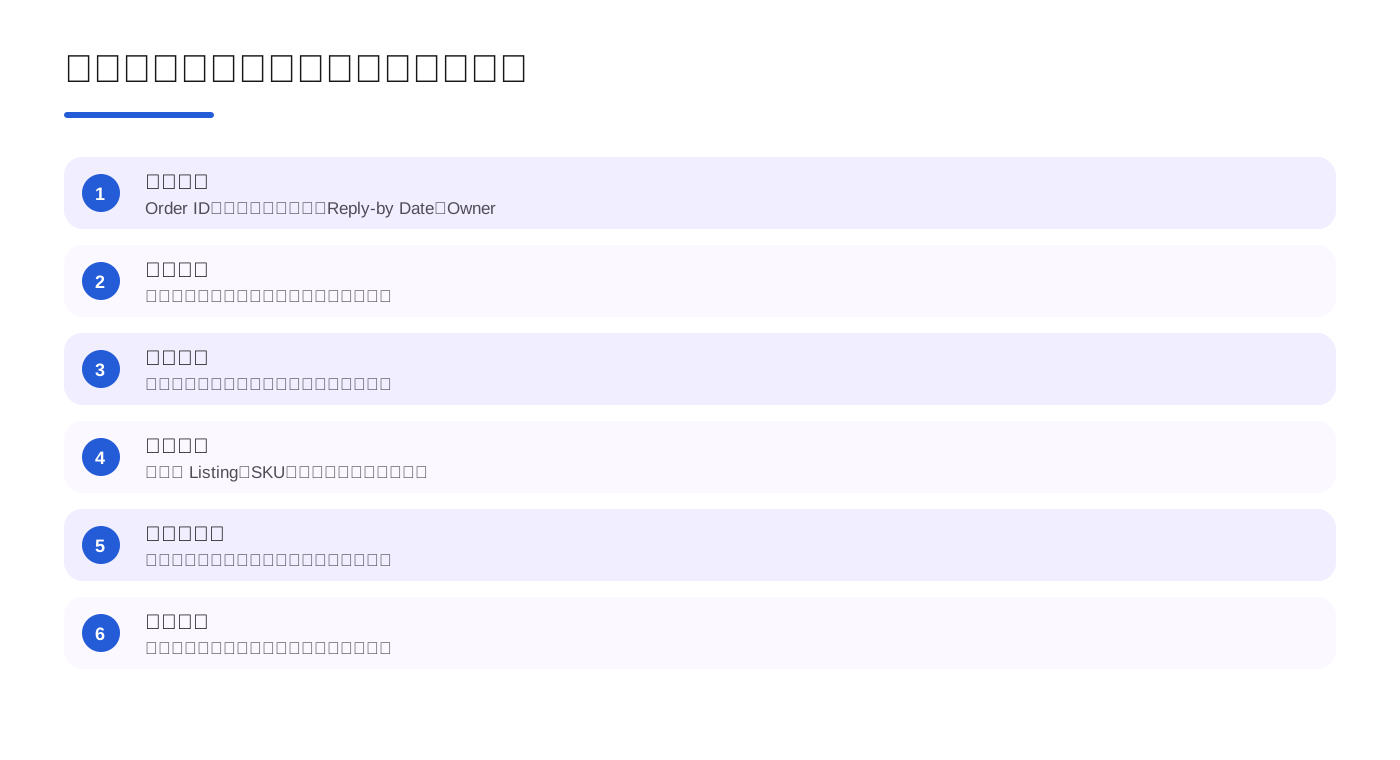
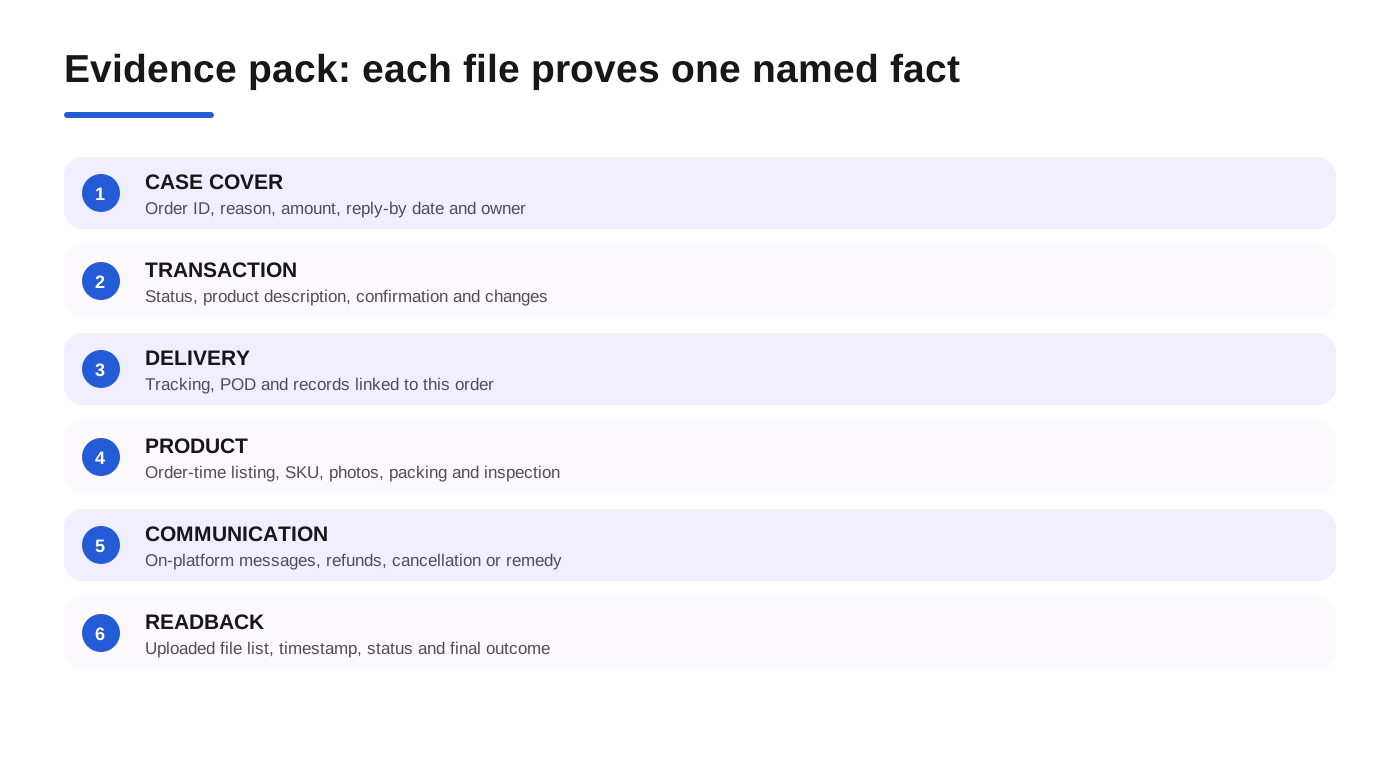
1. Case cover. Record Order ID, chargeback reference, reason, disputed amount, notification time, visible reply-by date, current status and owner. 2. Transaction record. Preserve order confirmation, payment and refund state, changes and cancellation history. 3. Product truth. Save the order-time listing, selected SKU, specifications and relevant claims. 4. Fulfillment and delivery. Connect packing, label, tracking, handoff and proof of delivery to the same order. 5. Communication and remedy. Include relevant on-platform messages and any replacement, refund or agreement. 6. Submission readback. Preserve exactly what was uploaded and what Seller Center displayed afterward.
The packet should read in chronological order. Give files stable names such as 01-case-cover, 02-order-confirmation and 03-proof-of-delivery, followed by the order identifier and capture date. A reviewer should not need local tribal knowledge to understand which image belongs to which fact.
Use reason-specific proof
For “order not received,” focus on order-linked tracking, proof of delivery, delivery location and recipient evidence. For “not as described,” preserve the version of the listing and SKU information that applied at purchase, plus product and packing records. For damage, show condition, protective packaging and the relevant handoff sequence. For unauthorized purchase or billing issues, prioritize transaction facts and follow the live platform request rather than inventing a warehouse-based defense.
The policy says documents forwarded to TikTok Shop may be presented to the financial institution. Assume an external reviewer has no context. Remove internal chatter, unsupported conclusions and unrelated customer data. Keep explanations factual, short and attached to the relevant file.
Resolve contradictions before submission
A packet can contain individually valid files that tell conflicting stories. The listing may show one specification while the invoice shows another. The tracking event may say delivered while the customer message says the package went to a different location. A packing video may show the product but not the shipping label. An issued refund may overlap the disputed amount.
Assign a second reviewer who did not assemble the packet. They should check identifiers, dates, amounts, product descriptions, visible addresses, refund state and whether every conclusion is supported. Record unresolved contradictions on the case cover. Hiding them does not remove them from the financial institution’s review.
Understand representment and decision ownership
After a seller submits an appeal, TikTok Shop reviews the information and prepares supporting documentation, sometimes called representment, for the financial institution. The current policy explains that the financial institution controls the outcome. This means a submitted appeal is not a win, and a TikTok Shop receipt is not the final financial result.
Keep two owners visible: the internal packet owner and the business owner for the outcome. The packet owner is responsible for completeness, submission and readback. The business owner is responsible for settlement impact, fee treatment, root-cause repair and any customer or inventory follow-up. Without this separation, an operational submission can disappear before Finance sees the result.
Read back the terminal state
Immediately after submission, save the chargeback reference, uploaded filenames, submission timestamp, visible status and any confirmation. Reopen the case from the normal queue to prove that the material is attached to the intended dispute. If the interface still shows missing information or allows edits, the owner should not mark the case complete.
The current policy says chargeback appeals can take up to 90 days from the initial notification and that TikTok Shop informs sellers of the outcome in Seller Center. Maintain a follow-up date and a final-state field. Record won, lost, auto-contested, withdrawn or other exact platform wording, along with amount, fees and posting date. Never overwrite the original submission record.
Prepare evidence during normal order operations
The fastest seven-day response is built before any dispute. Keep accurate listing snapshots, order and transaction events, packing evidence, shipping labels, tracking, delivery proof and on-platform customer communications under a shared retention rule. Capture identifiers in the image or adjacent ledger so files remain connected after export.
Review lost cases by reason, SKU, carrier, warehouse, missing evidence field and owner. A pattern of non-receipt losses may require stronger delivery proof. Not-as-described losses may require listing repair. Damage disputes may require packaging changes. Duplicate-charge cases may require Finance reconciliation. The appeal packet protects one case; the learning loop prevents the next one.
A hypothetical operating example
This is an operational example, not a client result. A seller receives a non-receipt chargeback with a reply-by date seven days away. The assigned owner saves the order and tracking record, but the delivery photo lacks a visible label. On day two, Logistics obtains carrier proof that links the tracking number to the delivery location. A second reviewer confirms the order, amount and absence of an earlier refund. The owner submits on day six, reopens the case, saves the uploaded file list and schedules outcome review. The evidence packet is complete even though the financial institution’s decision is still pending.
Smallest useful next action
Create one reusable chargeback folder today with six sections: case cover, transaction, product truth, fulfillment and delivery, communication and remedy, and submission readback. Add fields for reply-by date, owner, disputed fact, contradiction review and final financial outcome. Test the template against five completed cases. If an independent reviewer cannot understand one case in ten minutes, simplify the index and repair the missing evidence source before adding automation.
Source notes
This original WEM operating framework draws on the complete current TikTok Shop U.S. Seller University Chargeback Policy, dated September 23, 2026, and the After-Sales Evidence Guide for Appeals and Disputes, revalidated October 19, 2026. Timers, eligible paths, fees, required documents, interfaces and auto-contest rules may change. Read the live notification and current U.S. policy before execution.
Common questions
How long does a TikTok Shop seller have to appeal a chargeback?
The current U.S. Chargeback Policy says sellers generally must respond in Seller Center within seven calendar days of the chargeback notification. Use the specific reply-by date shown in the live notification as the operational deadline.
What information is required in a chargeback appeal?
The current policy lists transaction status, a product description and proof that the item was received by the cardholder. The exact case may require additional material, so read the live request before submitting.
Does uploading more files create a stronger appeal?
No. Every document may be presented to the financial institution, so each file should be relevant, legible, order-linked and tied to a named fact. Contradictory or unrelated files can weaken the packet.
Who decides the final chargeback outcome?
TikTok Shop reviews the seller submission and prepares representment, but the financial institution decides the chargeback outcome. The seller should read the result back in Seller Center and record any financial effect.
Should a seller wait for a chargeback before collecting evidence?
No. Delivery, transaction, listing, packing and customer-communication evidence should be retained during normal order operations. The seven-day window is for assembling and validating the packet, not recreating missing history.
What is the smallest useful next action?
Create one folder template with a case cover, required-fact checklist, evidence index, independent review field, submission receipt and final outcome. Test it against five recent chargebacks before automating anything.