TIKTOK SHOP U.S. · BFCM CREATOR OPERATIONS
A TikTok Shop BFCM Creator Brief That Creators Can Actually Follow
Direct answer: a useful BFCM creator brief is an execution control, not a mood board and not a long brand deck. It tells the creator which exact SKU is being promoted, what is true about it, what offer is active, what must be demonstrated, which claims have evidence, what must not be said or shown, and who resolves an unknown before publication.
The current TikTok Shop U.S. Content Policy applies across LIVEs, videos, cover images, titles, descriptions, spoken statements, on-screen text, backgrounds, props and product demonstrations. The current 2026 BFCM seller and creator guides also connect campaign readiness to accurate listings, compliant content, product quality and continuing account or performance signals. A brief therefore has to connect product truth, campaign truth and creative execution in one controlled handoff.
Most weak briefs fail in one of two directions. Some are too vague: “make it engaging,” “mention the discount,” or “show the benefits.” Others are too long: twenty slides of positioning with no exact variant, current price, required shot or escalation owner. Both force the creator to guess. During BFCM, when prices, inventory and deadlines can move quickly, guessing becomes a version-control problem.
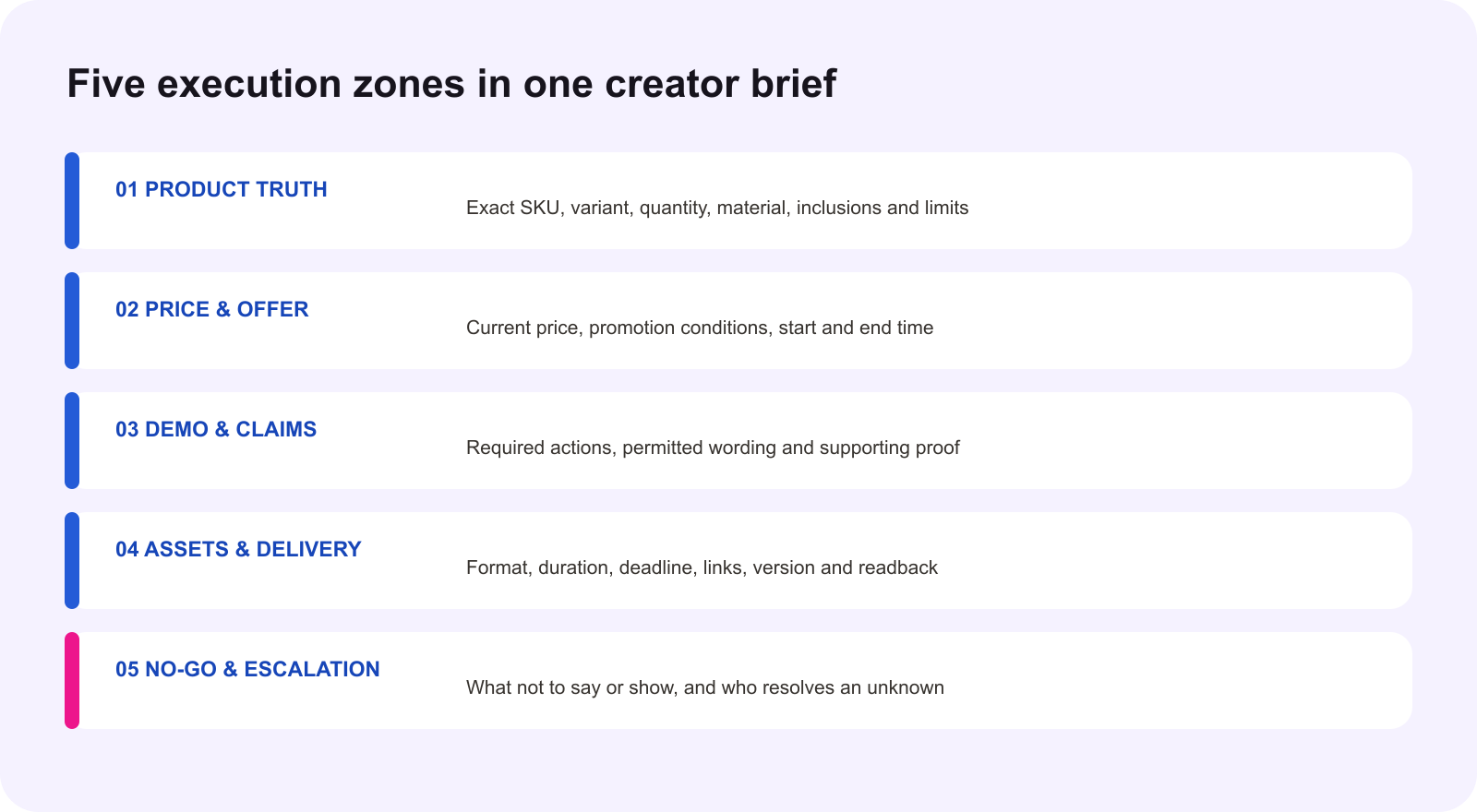
Start with the exact product truth
Name the exact SKU and variant before describing the creative angle. Include the product title, seller SKU, listing URL, color, size, quantity, material, included accessories and any important use limitation. If creators may choose among variants, show which facts are shared and which differ. A generic product family description is not enough when the shipped item, packaging or quantity can vary.
Add two visual references: the current product detail page and a clean image of the exact item the creator will receive. Mark what must remain visible in the demonstration. If installation, charging, preparation or compatibility matters, state the required setup. If a product needs qualification, warning language or age restrictions, link the current approved wording instead of paraphrasing from memory.
The Content Policy requires promotional content to remain consistent with the product and its reliable evidence. That means the brief cannot “upgrade” an ordinary function into an instant result, change size or material through staging, hide the real quantity, or imply accessories that are not included. Product truth is the floor for every hook, shot and claim that follows.
Make price and promotion language executable
Do not write “mention the BFCM deal.” Write the current regular price, campaign price if active, coupon or bundle condition, eligible audience, start time, end time and the screen or product card the shopper should use. Identify which values are fixed and which must be checked immediately before recording or going LIVE. If a strike-through price depends on an active promotion, say that clearly.
Separate a platform-visible fact from a marketing interpretation. A product card displaying a price is a current interface observation. “Lowest,” “cheapest,” “best price” or a comparison with another seller is a claim that needs its own proof and policy review. The current Content Policy lists unsupported best-price and vague price-comparison language among misleading examples. When evidence is missing, remove the superlative rather than softening it with an asterisk.
Every price block needs a version and effective timestamp. If the offer changes, the brand issues a new block and withdraws the old one. Creators should confirm the displayed product-card price before publishing, but that readback does not authorize them to invent a broader promise. Record who checked the price and when.
Translate benefits into observable demonstrations
A creator can execute a shot more reliably than an adjective. Replace “show that it is premium” with a specific action: open the packaging, display the included pieces, compare dimensions to a known reference, show the texture under ordinary light, demonstrate one supported function, or explain the correct setup. Each requested demonstration should answer one buyer question.
For every demonstration, include the allowed conclusion and the proof behind it. A material claim may point to packaging or specification evidence. A compatibility claim may point to the verified model list. A performance claim may require test documentation and additional review. If the available evidence only supports a narrow statement, keep the creator wording narrow.
Avoid staging that changes the product story. The current policy addresses misleading backgrounds, demonstrations, functions and effects. Lighting, edits and props may improve clarity, but they should not fabricate size, quantity, speed, repair, cleaning, beauty or health outcomes. Before-and-after structure needs special caution because editing and uncontrolled conditions can imply a result the evidence does not support.
Give the creator a claims library, not a guessing test
Use three columns: approved wording, required evidence and prohibited expansion. For example, an approved specification can be quoted exactly; its evidence is the current product record; the prohibited expansion is any performance guarantee beyond that specification. This format lets a creator understand both the usable fact and the boundary around it.
Include pronunciation, required disclosures and brand-name rules where relevant. If the product uses licensed marks, supply the approved assets and scope. Do not tell creators to pull logos or comparison imagery from search. The brief should link only to controlled files, and each file should have a version or date.
Keep the library short enough to use. Three verified claims are more valuable than fifteen vague talking points. The goal is not to eliminate a creator's voice. It is to prevent the creative idea from changing the underlying product, offer or proof.
Write no-go zones as concrete examples
“Follow policy” is not an operational instruction. Translate the relevant boundaries into examples for this SKU. Do not make unsupported lowest-price claims. Do not promise instant or guaranteed outcomes. Do not alter the item, quantity, material or included accessories. Do not show unrelated products as if they are part of the offer. Do not use a brand, logo, song or asset without confirmed rights.
Add format-specific boundaries. For a short video, identify risky text overlays and edited effects. For LIVE, define what the host should do when a buyer asks about a missing fact or a price changes. For cover images, confirm that the item and offer match the linked product. The current policy evaluates all these content elements, so a clean spoken script does not cure a misleading visual.
The BFCM creator guide notes that creator participation is evaluated through current campaign eligibility, quality, compliance and performance signals. Do not turn that into a guarantee or freeze a volatile threshold in the brief. Link to the current campaign page, ask the creator or merchant to check the visible status, and treat a saved screenshot as a dated observation.
Build a real question and escalation path
A useful brief makes uncertainty safe. Name one product owner, one offer owner and one policy reviewer. Tell the creator what to send: the exact buyer question, screenshot, product link and draft timestamp. Set a response cutoff. If the answer does not arrive, the creator should omit the claim or hold publication, not improvise.
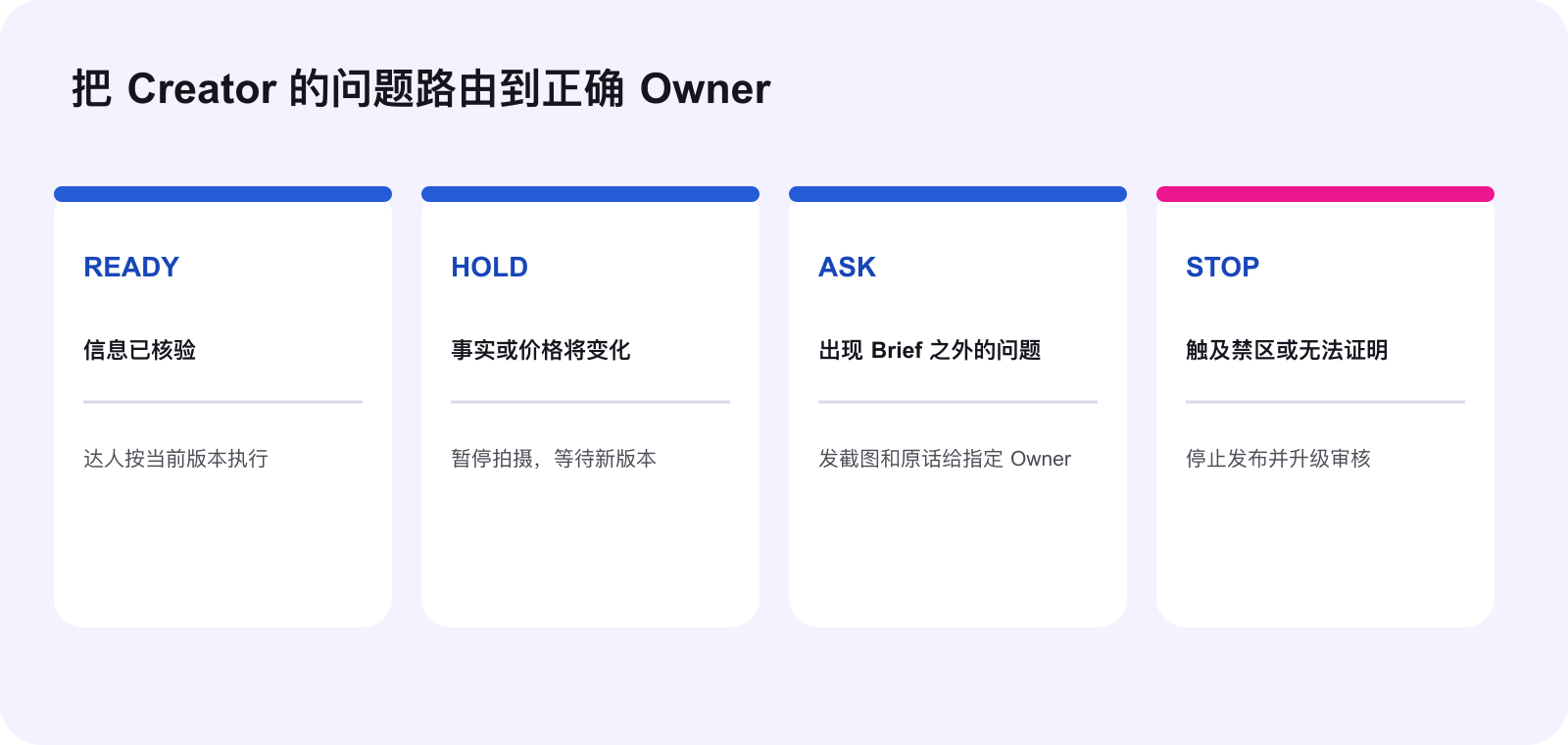
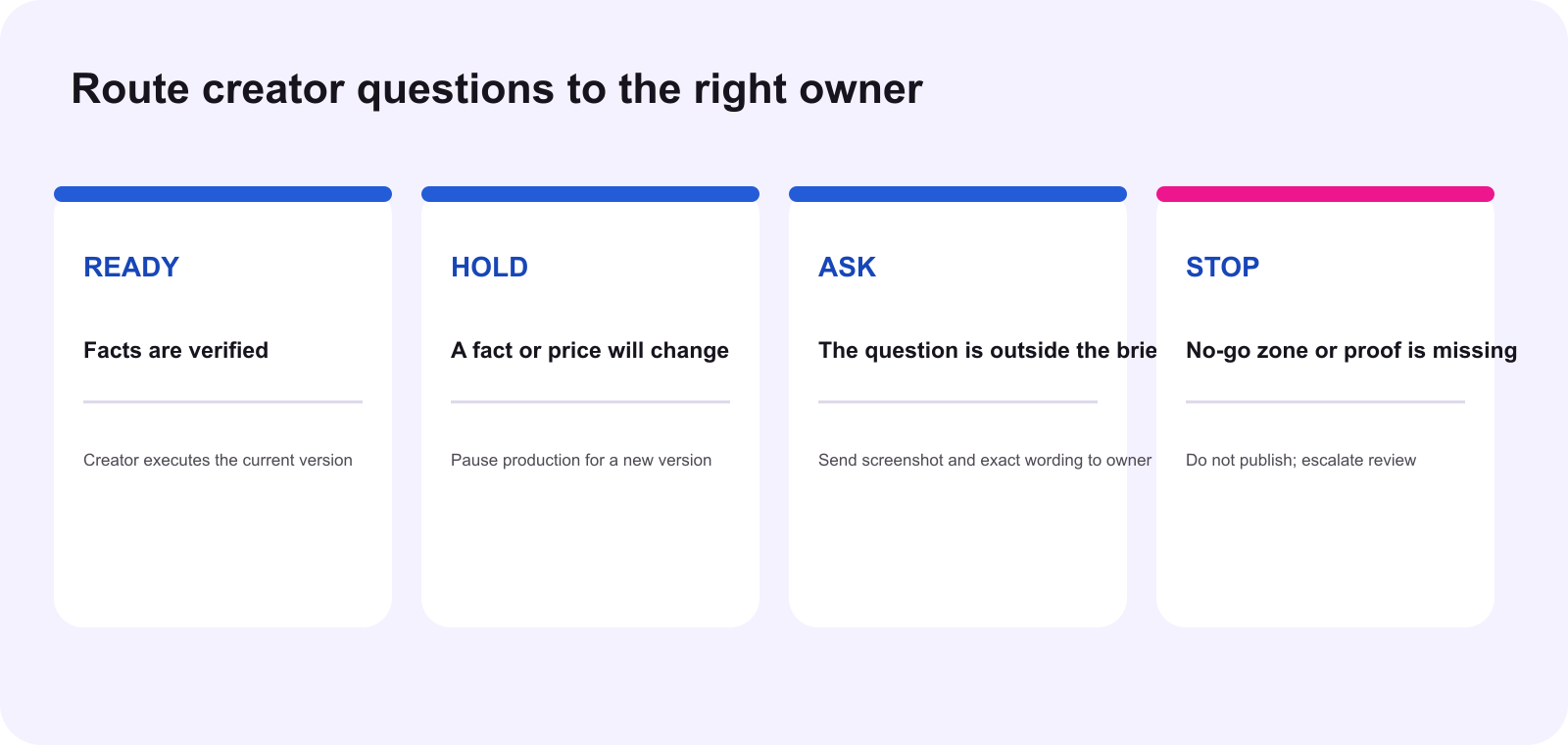
Use four states. READY means the fact and asset are verified for the current version. HOLD means a known change is pending. ASK means the issue is outside the brief and needs an owner. STOP means the content touches a no-go zone or lacks required proof. These states make the handoff faster because they tell the creator what action follows the label.
Use one page, plus an evidence appendix
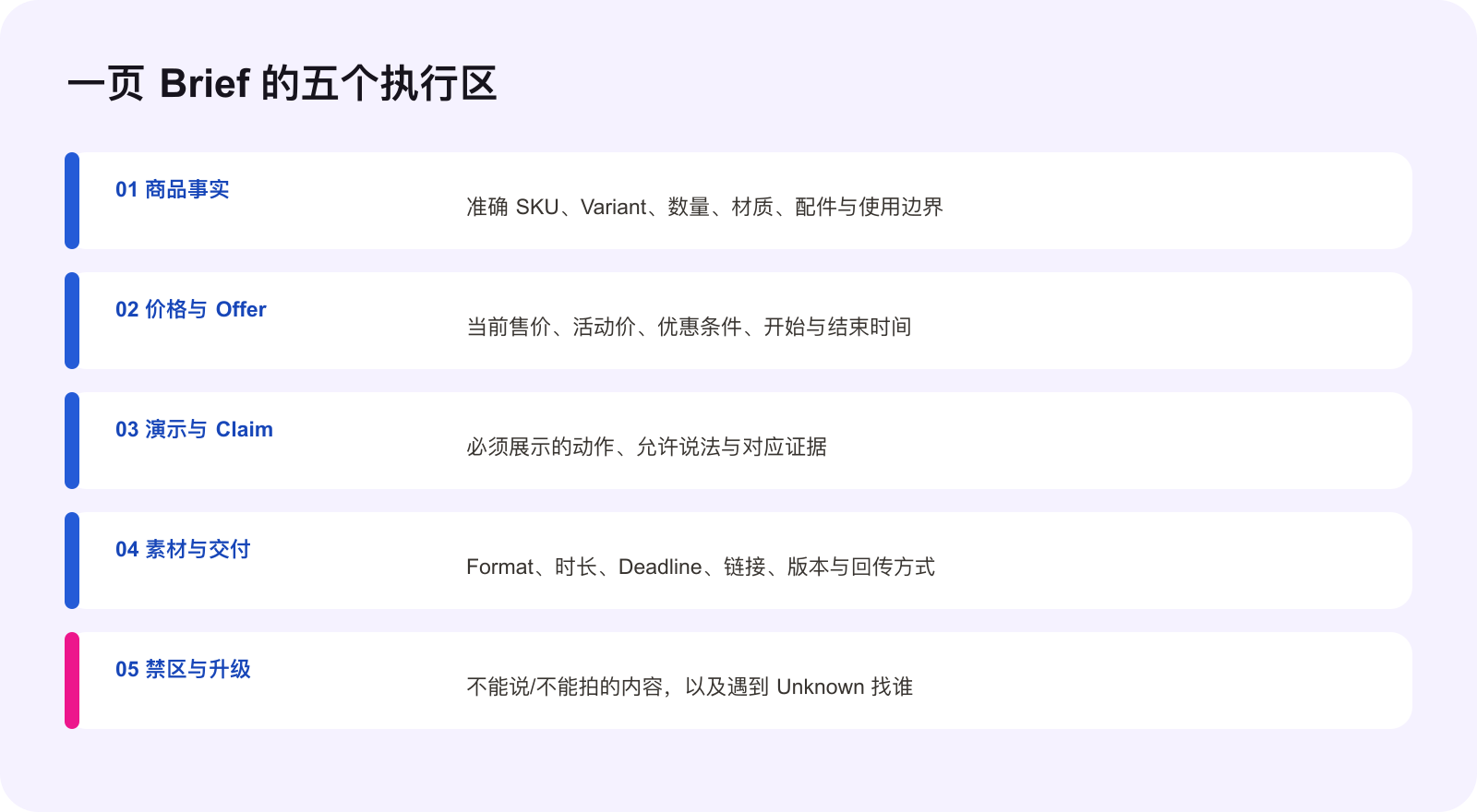
The creator-facing page should contain the execution essentials: product, audience question, offer, required demonstration, three approved claims, no-go examples, deliverable, deadline, links, owner and version. Put certificates, test records, complete specifications, campaign screenshots and legal approvals in an appendix. Link each claim to the exact appendix item.
This separation keeps the brief usable without hiding evidence. Creators can see the operating instructions immediately, while reviewers can trace every claim. The evidence appendix should retain source, date, owner and expiry where applicable. A folder of unnamed screenshots is not an evidence system.
Run a preflight before the first creator records
Have someone who did not write the brief try to execute it. Can they identify the exact item, current offer, required shot, permitted claims and stop conditions without asking what the author meant? Open every link. Compare the price with the current product card. Confirm the shipped sample. Review the final cover, caption and on-screen text, not only the script.
Then send the same version to a small first group and log the questions they ask. Repeated questions are not creator failure; they reveal missing instructions or weak product truth. Repair the brief once, issue a new version and make the change visible. Do not send silent edits that leave creators working from different facts.
The smallest useful action today
Choose one priority BFCM SKU. Write five blocks on one page: product truth, price and offer, required demonstration, proof links, and no-go zones with an owner. Add version 2026-10-09 v1. Ask one operator to execute it cold. Fix every question that requires guessing before the brief reaches a creator.
Source notes and execution boundary
This original WEM operating framework draws on the complete current TikTok Shop U.S. Content Policy, revalidated October 9, 2026; the 2026 BFCM Seller Campaign Guide, dated September 20, 2026; and the current 2026 BFCM Creator Campaign Guide. The one-page brief, five-zone structure, version control and escalation states are WEM operating methods. Platform eligibility, campaign dates, prices, thresholds, account status and interfaces can change. Verify the current U.S. Seller Center or creator tools, product card and approved brand evidence before execution.
Common questions
Should a BFCM creator brief contain a complete word-for-word script?
Usually no. Give creators the verified product facts, required demonstrations, approved claims, evidence links, offer conditions and no-go zones. A rigid script can hide confusion instead of resolving it.
Can the brief say a product has the lowest price on TikTok Shop?
Only when the brand has current, supportable evidence and the exact claim is allowed. The current Content Policy identifies unsupported lowest, cheapest and best-price claims as misleading examples.
What should happen when the campaign price changes after the brief is sent?
Issue a new version with an effective timestamp, withdraw the old price card and require readback before the creator records or posts. Never rely on an untracked chat correction.
Does an approved product listing make every creator claim safe?
No. The current policy applies to spoken statements, on-screen text, titles, demonstrations, images and other content elements. Each claim still needs to match the product and reliable evidence.
How should a creator handle a buyer question that is not in the brief?
Do not improvise. Save the buyer wording, send it to the named product or policy owner, and add the verified answer to the next controlled brief version.
What is the smallest useful action today?
Choose one BFCM priority SKU and replace its long briefing deck with a one-page execution sheet: facts, offer, required demo, proof, no-go zones, owner and version.