TIKTOK SHOP U.S. · BFCM PRICING
TikTok Shop BFCM Better Price Rewards: Model the Reward After Margin, Returns and Fees
Direct answer: choose the price tier after you model the full SKU outcome
Better Price Rewards should be treated as a price-and-economics decision, not a benefit to chase in isolation. The current TikTok Shop guide says one BFCM registration flow assigns a product to the matching benefit tier according to its registered price. Entry price unlocks standard benefits, a lower price can unlock Flash Sale and Premium Offers, and the lowest price can unlock additional TikTok Shop subsidies. Those are access outcomes, not evidence that a SKU is profitable.
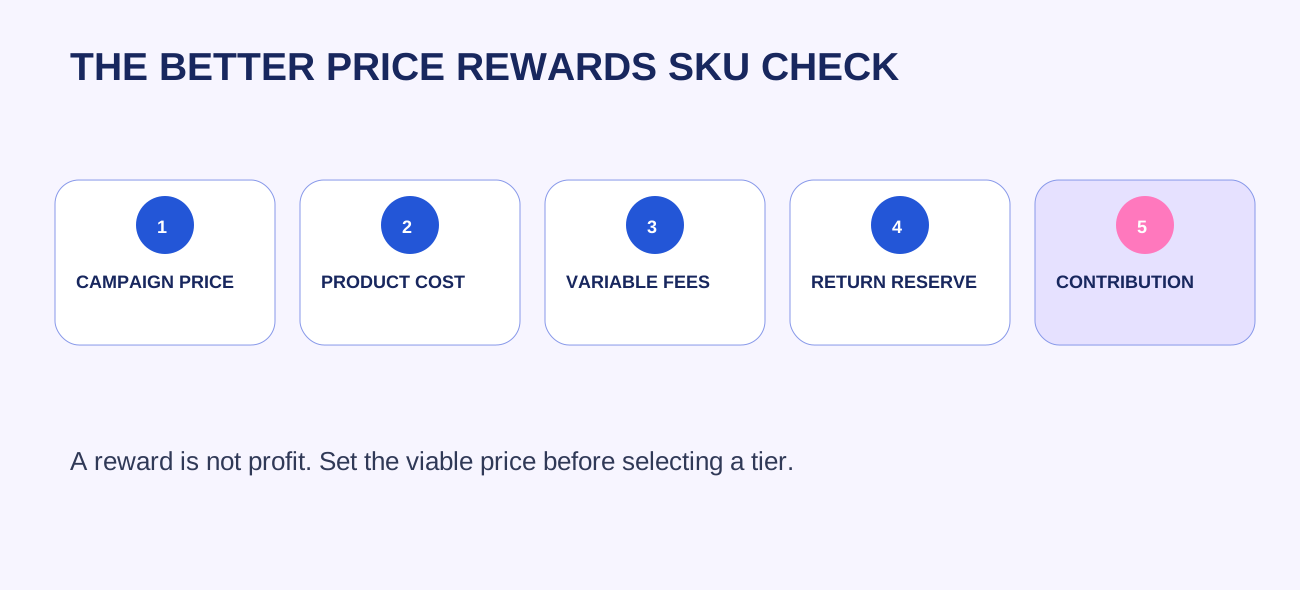
Start with a SKU contribution sheet. Put the proposed campaign price at the top, then subtract product cost, seller-funded discount, fulfillment, payment and program fees, creator commission where applicable, expected returns and a reasonable support reserve. Only then compare the result with the benefit tier and decide whether the lower price has a job worth funding.
1. Register by SKU, not by a campaign average
The guide describes product-level registration. Different products and SKUs can use different discount tiers, and the system evaluates benefits according to the registered price. That means one hero SKU can merit an aggressive demand test while a low-margin accessory may need a different tier or no campaign enrollment. Inventory reservation is not supported, so price selection also needs an operational stock and service check.
Build one row per sellable SKU and variation. Record current sell price, proposed campaign price, minimum contribution threshold, on-hand availability, return profile, promised ship window and owner. A blended store average hides precisely the SKU differences that the campaign registration flow preserves.
2. Calculate the floor before looking at the recommendation
Recommended or pre-filled tier prices can speed registration, but they do not know your current landed cost, creator mix, fulfillment exception rate or return exposure. A price can meet a campaign threshold and still fail the seller’s own contribution rule. Use the recommendation as an input to test, never as an automatic economic approval.
A practical floor is: campaign net revenue minus product and packaging cost, variable fulfillment, expected return and cancellation cost, paid and creator acquisition allocations, applicable fees and the minimum contribution you need to retain. Keep assumptions visible. If a return rate or fee is unknown, mark it pending rather than treating it as zero.
3. Keep benefit language separate from money language
The official guide names tiered benefits. It does not turn a feature, Flash Sale channel, Premium Offers placement or additional subsidy into guaranteed incremental revenue. The seller still has to read current eligibility, price thresholds and actual account results in Seller Center. Operational planning should use “may unlock” for campaign access and reserve “earned” for amounts visible in the relevant records.
Before external copy goes live, check the linked product page and shopping path. Do not promise a price, subsidy or deal that a shopper cannot actually receive. Save the page capture, tier selected, registration timestamp and source link with the SKU decision so a later change can be diagnosed rather than guessed.
4. Build a returns-aware reward model
A lower campaign price can increase conversion while also changing the value of each return, cancellation or customer-service touch. If returns arrive after the BFCM decision window, an early sales report can make the lower tier look better than its mature contribution. Use a conservative return reserve based on the closest relevant SKU or category history, then refresh it as cohorts mature.
Review gross orders and retained orders separately. Watch delivery exceptions, rating or quality signals and reasons for return. If the low tier grows units but pushes return cost or service load beyond the operating boundary, that is an adjustment signal, not a reason to call the tier successful.
5. Treat fees and subsidies as separate lines
A campaign price is not the entire commercial picture. Keep seller-funded markdowns, platform support when shown, program and transaction fees, creator commissions, paid traffic and logistics on separate lines. This prevents a visible shopper discount from being confused with a seller charge, and it prevents a subsidy from being counted twice as both revenue and reduced cost.
Reconcile a small order sample after registration becomes active. Compare the product page, campaign record and settlement or transaction records that are available for those orders. Use the same order ID across sources. The first reconciliation does not need to be perfect; it needs to surface which cost fields are confirmed, which are estimates and when each will be reviewed.
6. Use the three tiers as scenarios, not a winner-take-all ladder
The entry, lower and lowest price positions are useful scenarios. For each, estimate units, net revenue, contribution per order, total contribution, operational load and the benefit that may be unlocked. A lower tier should win only if the expected commercial result and capacity boundary are better, not merely because the benefit sounds more visible.
Choose an explicit rule before results arrive: keep a SKU at its tier when contribution and service measures stay inside threshold; adjust when conversion improves but contribution or returns deteriorate; exit when both economics and demand signal are weak. Assign a date to re-read prices because campaign criteria and availability can change.
7. Use registration controls deliberately
The current guide supports online registration, online bulk registration and Excel upload. Bulk methods are convenient, but they can repeat a weak assumption across many SKUs. Use a controlled first batch for uncertain price points, then preserve the input file, selected rows and confirmation readback.
The guide also notes that if SKU price tiers differ, the lowest tier can apply across all SKUs in that registration context. Treat that message as a prompt to check variation-level consequences before submitting, not as a technical detail to skip. When a custom price is used, confirm it meets the current campaign threshold before approval.
8. The smallest next action: one SKU, three rows, one decision
Take a single BFCM candidate SKU and model the entry, lower and lowest price positions in three rows. For each row, state the price, all variable costs, return reserve, expected contribution and current benefit shown by Seller Center. Then write one action: register, revise price, restrict inventory, or hold.
This WEM framework is an operating method, not financial advice or a guarantee of campaign eligibility. The official source was fully read October 23, 2026. Price tiers, subsidies, eligibility, benefits and interface details are volatile: verify the live Seller Center view and the completed registration readback before execution.
Source notes
This WEM operating framework draws on the complete current TikTok Shop U.S. 2026 BFCM Better Price Rewards Registration Guide, read and revalidated October 23, 2026. Price tiers, eligibility, subsidies, campaign benefits, interface paths and registration requirements can change; verify the current Seller Center view and completed registration readback before acting. Contribution, returns reserve and decision rules are WEM operational design.
Related WEM guides
Frequently asked questions
Does the lowest price automatically make a SKU the best BFCM choice?
No. It may unlock additional subsidies, but the SKU still needs to meet its contribution, return and capacity rules.
Can different SKUs use different Better Price Rewards tiers?
Yes. The current guide describes product-level registration and different tiers by SKU.
Can inventory be reserved through this registration?
No. The current guide states that inventory reservation is not supported.
What should be checked before choosing a custom price?
Confirm it meets the live campaign threshold and passes your own SKU contribution model.
Why separate a visible discount from seller cost?
A shopper-facing discount and the seller’s actual charges or support can be different records.
What is the smallest useful next action?
Model one SKU at each price tier and record one register, revise, restrict or hold decision.