TIKTOK SHOP U.S. · BFCM PREP
TikTok Shop BFCM LIVE Planning: Give Every Session a Job
Adding LIVE hours to a Black Friday calendar is easy. Giving each session a reason to exist takes more thought. If the product order, host explanation, offer, and audience are still unclear, a longer session gives the team more time to repeat the same confusion.
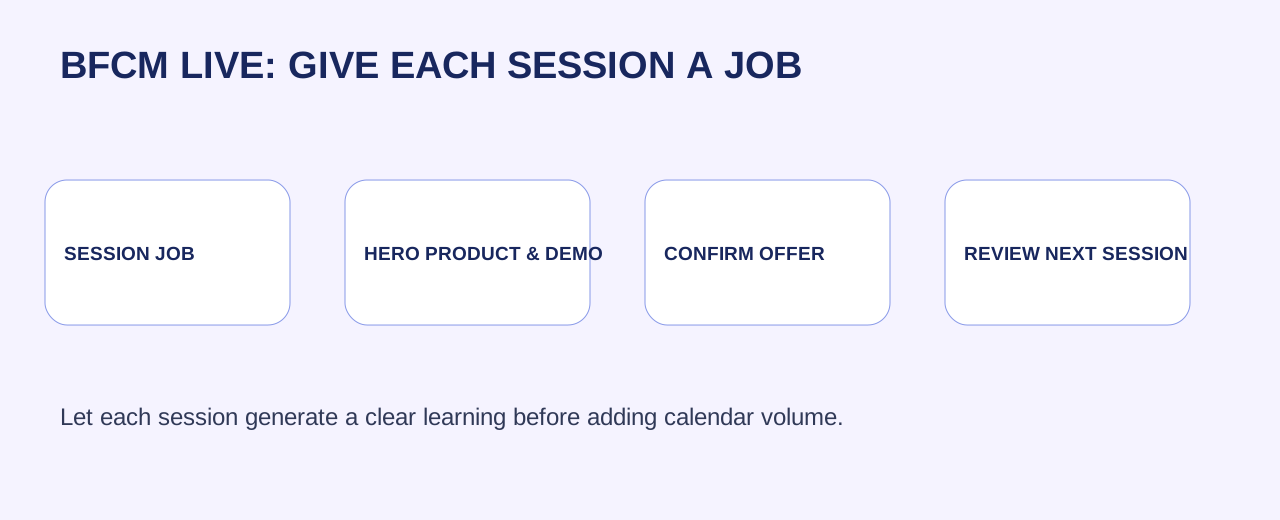
A useful TikTok Shop BFCM LIVE plan assigns each session a specific job: explain a hero product, answer purchase objections, test an offer, or serve a peak shopping moment. Connect the session to short videos before it and useful clips afterward. Expand the formats that show a workable buyer response.
TikTok Shop's 2026 seller materials place seller LIVE and creator LIVE within the wider holiday content plan. Its public U.S. campaign guide lists November 11–30, 2026, as the BFCM sale period. Use that window to organize the calendar, then verify the current program and account-specific conditions. TikTok Shop campaign guide
Define the session before booking more hours
A LIVE event plan connects a session's audience, product mix, host, demonstration, offer, inventory, and follow-up. The point is to make a live buying decision easier while producing information the team can use in the next session.
For an unfamiliar product, a session may need to slow down and show how it works. For an established hero product, viewers may need help choosing the right variant or understanding the event offer. A giftable product may need an explanation of what arrives and who would enjoy it.
Those sessions should not automatically use the same script. Choose the job first. Then select the host, products, and format that can do that job. A strong short-video creator is worth reviewing for LIVE, but short-video performance does not establish hosting ability by itself.
Build a product sequence a buyer can follow
I would begin with a product the host can explain clearly and the team can fulfill. Give that product enough attention for viewers to understand its use. Then introduce related items only when the relationship makes sense to a shopper.
For example, a lead-in product may make the first purchase easier. An adjacent item can add value when the host can show why the customer would use both. A bundle needs an understandable benefit and accurate included quantities. Do not turn the session into a tour of every SKU simply because the shop has a large catalog.
The product sequence should also respect variants. If a host spends most of the session explaining combinations that the shopper cannot find on the product page, the content and purchase path are working against each other.
These are operating choices, not participation tiers or promised outcomes.
WE Marketing case: education needed several content layers
WE Marketing's published wellness case describes work across creator seeding, paid support, LIVE, and top-GMV creator collaborations for a product that required education. The case is a historical example of several layers operating together. WE Marketing wellness case
It does not isolate LIVE's incremental contribution, and it does not show that every brand needs the same scale or channel mix. The transferable decision is to give an education-heavy product more than one place to become understandable.
For BFCM, I would use short videos to introduce the central problem, LIVE to demonstrate and respond to questions, and the product page to hold accurate details. Each surface has a different job. The same product story should remain recognizable as the shopper moves between them.
Use short video to make the LIVE invitation specific
“We are going live” gives a viewer a time. It may not give them a reason to join. A useful teaser tells the viewer what they can learn or see: how the product fits into a routine, which option is right for them, or what the confirmed event offer includes.
Make the preview accurate. If the demonstration needs a particular accessory, show it and explain whether it is included. If an offer applies only to selected products or a limited time, keep those conditions visible. Do not advertise an offer before the team confirms how it appears to shoppers.
After the session, review which questions or demonstrations were useful enough to become short content. A clip should stand on its own. Give it enough context to be understandable without the full broadcast, and check that any time-sensitive price is still accurate before reuse.
Test the host and the format together
LIVE performance depends partly on whether the host can hold a useful conversation about the product. A polished presenter who cannot demonstrate or answer practical questions may struggle. A good demonstrator can also need help with sequencing and transitions.
Test a limited session with a clear question. Can the host explain the product without reading the manual? Do viewers understand the difference between options? Does an objection keep returning after the demonstration? Use those observations to revise the next session.
Keep the commercial agreement separate from the experiment. Confirm deliverables, scheduling, fees or commission, content reuse, and cancellation arrangements where applicable. Do not turn a provisional creator conversation into a confirmed peak-week slot in the internal calendar.
Choose interaction that fits the product
An auction can make sense for a product whose uniqueness, scarcity, or deal logic creates a natural reason to bid. It is a poor default when the buyer mainly needs time to understand an everyday product. Similarly, a giveaway can create activity without telling the team whether viewers want the hero SKU.
The 2026 campaign training materials describe several LIVE activations, including invitation-based formats. That does not mean every seller can join every format. Review the current registration details, availability, and required commitments before planning around platform support.
The team should be able to explain why a mechanic belongs in this session. If the answer is only that it might make the room busier, decide which buyer behavior would make that activity useful and how you will observe it.
Read the session as a sequence of decisions
Look at reach and viewing behavior alongside product interest, questions, orders, and contribution economics. When available, review the product and timing associated with an order rather than treating all session activity as one result.
Compare sessions with care. A different host, stronger offer, longer duration, or better inventory can change the result. Mark those differences in the session record. A higher GMV session is useful evidence, but it does not prove that the new script alone caused the increase.
Give each review one next decision: keep the demonstration, shorten the explanation, remove an unclear item, change the host-product match, or test an offer with better economics. A review that only says “go live more” leaves the important work unresolved.
Let inventory and customer experience set the scale
Before increasing frequency or paid support, confirm available inventory, variants, fulfillment capacity, and support coverage. A host needs a clear update when an item or offer changes. The product page needs to reflect the same reality.
If a product cannot be fulfilled reliably, remove it from the growth plan until the issue is resolved. The public BFCM guide requires campaign products to be buyable, in stock, and ready to ship. It also describes continued performance monitoring during the campaign. TikTok Shop campaign product requirements
Paid amplification is another decision, not the automatic next step after hosting. Confirm content rights and account setup, then test only with a budget the product economics can support. We discuss the wider channel role in our LIVE strategy guide.
Build the next useful session
In late October, I would put existing proof to work. Choose one hero SKU, one host, and one buying question. Confirm the offer and inventory. Publish a specific teaser, run the session, and record the questions that still remain.
If the session helps shoppers understand the product, repeat and improve that format. If the team cannot explain what it learned, expanding the calendar is premature. A smaller calendar with clear ownership and useful review gives a brand a stronger basis for the peak period.
Frequently asked questions
How should a seller plan TikTok Shop BFCM LIVE sessions?
Start with the job of each session, then connect audience, hero product, host, demonstration, offer, inventory, and follow-up. Use short videos to explain why viewers should join. Review buyer questions and commercial signals before expanding frequency or duration.
Should every brand run LIVE auctions for Black Friday?
No. Consider an auction when uniqueness, scarcity, or a clear deal gives viewers a reason to bid. A product that mainly needs education may be better served by a demonstration-led format. Check current feature access and applicable rules before committing.
Are Super LIVE or Key LIVE opportunities available to every seller?
The supplied 2026 campaign materials describe invitation-based participation for selected LIVE formats. Availability and commitments need to be checked in the current campaign interface or with the relevant platform contact. Do not build the calendar around unconfirmed support.
Can strong short videos prove that a creator will perform well on LIVE?
They provide a reason to review the creator, but they do not prove hosting ability. LIVE requires real-time explanation, product sequencing, and responses to questions. A limited test can help the brand evaluate those capabilities before a larger commitment.
What should a brand measure after a LIVE?
Review viewing behavior, product interest, repeated questions, orders, and product economics together. Note changes in host, offer, duration, and inventory before comparing sessions. Use the review to choose one concrete improvement for the next session.
What is the smallest useful next step for a BFCM LIVE plan?
Choose one hero product, one host, one buying question and one confirmed offer or inventory check. Run the session, record recurring questions, then make one specific change for the next session.
Related WEM guides
Source notes
Source review: September 30, 2026. Inputs include the supplied TikTok Shop 2026 Seller Success Guide and campaign training materials, the public U.S. BFCM campaign guide, and the historical WE Marketing wellness case. Session design and measurement recommendations are Wendy Lin's operating judgment. Revalidate program access and date-specific offers before execution.
Bring your hero product, current LIVE clips, and event plan to a WE Marketing consultation if you need help deciding what the next session should do.