TIKTOK SHOP U.S. · BFCM PREP
TikTok Shop BFCM 2026: Build a Creator Content Runway Before the Sale
If your Black Friday plan starts with a large creator invitation list, I would look at what happens after the invitation. A list gives you people to contact. It does not tell you which creators understand the product, which samples will become useful content, or which videos deserve another round of support.
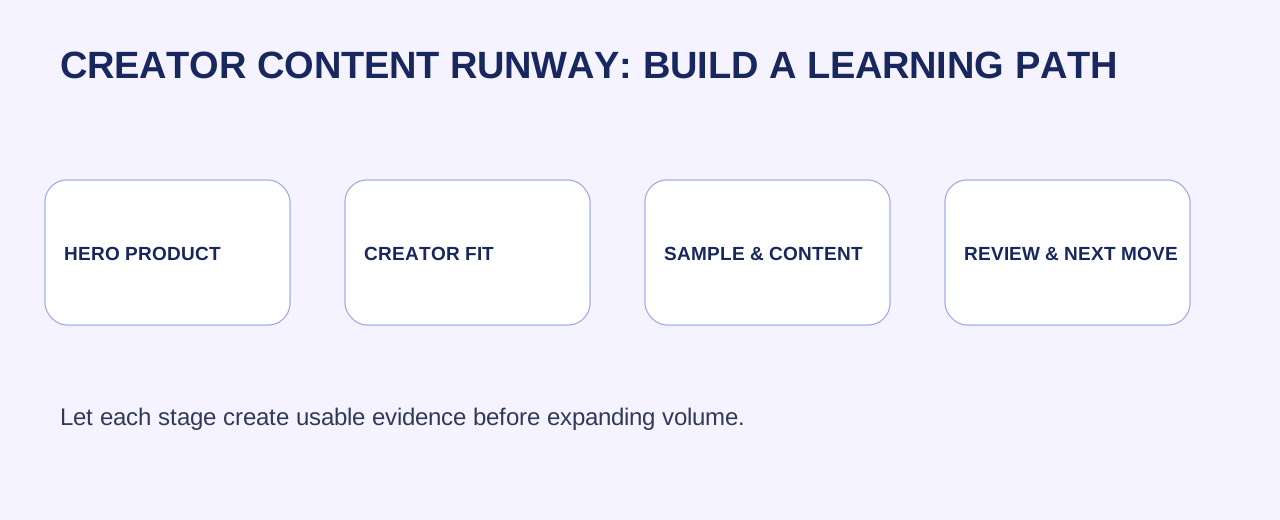
For TikTok Shop BFCM, build the creator runway around a small group of hero products. Match creators to the buying decision, get products into their hands, review the content and customer response, and keep budget available for follow-through. Invitation volume becomes useful when the rest of that path works.
TikTok Shop's published U.S. seller guide lists November 11–30, 2026, as the BFCM campaign window. That is the sale window, not the amount of time every product needs to earn trust. Check the current campaign page before committing dates. TikTok Shop seller campaign guide
What is a creator content runway?
A creator content runway is the preparation period that connects product selection, creator fit, samples, useful content, shopper feedback, and amplification before a sales event. Its length depends on the product's explanation needs, creator availability, shipping time, and the evidence the brand already has.
For a product shoppers can understand from a quick demonstration, the first content may answer most of the buying question. For skincare, wellness, or a higher-priced product, shoppers may need to understand the use case, the brand, and the limits of what the product can do. A discount can help someone finish a decision. It cannot always do the work of starting that decision.
This is why I would start earlier with high-consideration products. I would also avoid giving every brand the same fixed lead time. A brand with working content and established creator relationships is in a different position from a brand sending its first samples.
Give each hero product a clear job
Before asking how many creators to recruit, decide what each product needs to prove. One product might be the easiest first purchase. Another might make a good gift. A third might need a comparison that explains why it costs more.
For a smaller operation, I would usually concentrate on one to three hero products first. This is an operating starting point, not a TikTok Shop requirement. Concentration keeps samples, creator attention, inventory, and learning pointed at the same questions. It also makes it easier to tell whether a weak response comes from the product, the audience, the offer, or the explanation.
Write down the viewer, the problem, the observable demonstration, and the reason to buy now. If the team cannot explain those four things simply, a creator is unlikely to fix the confusion by reading a longer product manual.
Match the creator to the buying decision
Follower count does not tell you whether a person can explain your product. I want to see relevant commerce content, a believable audience fit, and a format that makes the product understandable. A creator should either want the product personally or see a credible way to sell it to their audience.
For an application product, review the creator's actual demonstrations. For a product that needs spoken education, listen to how they explain unfamiliar ideas. For fashion, look at fit, styling, and the situations the audience recognizes. A strong account in an unrelated category can still be the wrong match.
These are screening questions. They do not guarantee orders. Keep enough flexibility to test creators outside the obvious niche when the buyer and use case still fit.
WE Marketing case: a beauty relaunch needed a clearer story
In WE Marketing's published beauty relaunch case, the brand had strong reviews but stalled sales. The work included restructuring the hero-product strategy, refreshing the creator mix, and aligning content around one problem-solution story. The displayed dashboards show $312K GMV in February 2025 and $982K in March 2025. WE Marketing beauty case
That is a historical engagement, not a BFCM 2026 forecast. The before-and-after figures do not isolate the contribution of any single change. The practical lesson I would carry into holiday planning is narrower: a brand can have a good product and still make creators work too hard to find a useful story.
Before increasing sample volume, listen to the first content. If every creator is explaining a different reason to buy, the brand may be spreading its learning across too many messages. Keep natural creator delivery, but make the product's central use case clear enough to recognize across the content.
Track the stages that actually need intervention
An accepted sample request and a published video are different stages. So are a video with views and a video with useful product interest. If the team only counts invitations or shipments, it cannot see where work has stopped.
Use a simple record for each relationship: product, creator fit, invitation response, sample decision, shipping status, content status, observed questions, and next action. Do not put a posting date into the plan until it is agreed where the collaboration requires one. Paid deliverables and commission-based collaborations have different commitments.
If a creator receives the sample and does not post, the next action should be useful. Ask whether the product was understandable, send a short demonstration reference, or offer an angle that fits their content. Repeating the same reminder cannot repair weak original fit.
Keep the brief easy to use
A good brief gives the creator a way into the product. It names the viewer's problem, shows the product accurately, and offers two or three angles. Include what must be correct and what the creator can express in their own way.
For a gifting angle, show the actual packaging and included items. For an everyday-use angle, show the real routine. For a comparison, identify details the brand can support. If a claim requires qualification, keep that qualification next to the claim rather than buried in a separate document.
We have a separate creator brief guide. This article's focus is the relationship and learning runway around the brief, not making the document longer.
Leave money and time for the second decision
Affiliate is not free marketing. Samples, shipping, selection, follow-up, content support, and paid testing all take resources. A brand that spends its entire preparation budget on samples can end up with content and no room to learn what deserves amplification.
I would reserve budget for controlled tests and repeat work with creators who show useful signal. Read views alongside product interest, orders, customer questions, and product economics. A promising organic video may deserve a test; an expensive amplification plan still needs a reason.
Permission to use creator content also needs to be clear. Commission and content usage are separate commercial questions. Confirm the applicable rights before putting an asset into paid use. Do not assume the first collaboration covers every later channel or duration.
If you are starting in late October
By late October, a long preparation runway is shorter. Separate the people and products that are already ready from the ones that still need explanation. Start with creators who have the product, existing relationships, accurate published assets, and inventory you can support.
For a new high-consideration SKU, narrow the job. Test whether people understand the use case and whether the first questions can be answered clearly. It may be better to build a useful foundation through the holiday period than to make an unsupported peak-week commitment.
The smallest next action is to choose one hero product and review its creator pipeline from response through content. Identify the stage with the most unresolved work. Assign one owner and a next action. More outreach can follow once you know what it is meant to fix.
Frequently asked questions
When should TikTok Shop sellers begin BFCM creator outreach?
Begin when the product, sample supply, and offer are clear enough to support a useful collaboration. Products that require trust or explanation usually need more preparation than a quick demonstration product. Work backward from sample delivery, content production, review, and testing rather than using one lead time for every brand.
How many creators should a brand recruit for Black Friday?
There is no universal useful count. Start with the product's sample capacity, relevant creator supply, and the team's ability to follow through. A large invitation list cannot replace fit, content support, or inventory. Expand when the first group gives the team enough evidence to make a better next selection.
Should a brand prioritize high-follower creators?
Prioritize the ability to reach the right buyer and explain the product. Review commerce history, actual content, category fit, and audience context. A large following can be useful, but it does not establish that the creator is the right person for a particular buying decision.
What if samples are delivered but creators have not posted?
Separate unclear product understanding, weak original fit, and missing follow-up. Offer a simple next action or useful reference. Review the collaboration's actual commitments before treating a delay as a missed deliverable. Use the learning to improve future selection.
Can a past WE Marketing case predict BFCM results?
No. A historical case shows a particular starting condition and execution scope. Product strength, offers, creator activity, paid support, inventory, and timing can all affect results. Use the case to improve operating decisions rather than forecast the same GMV for another brand.
What should a brand do before expanding creator volume?
Review the hero product pipeline from creator response through useful content, identify the stage with the most unresolved work, and assign one owner and next action.
Related WEM guides
Source notes
This article uses TikTok Shop's 2026 Seller Success Guide and campaign training materials supplied for this series, reviewed September 30, 2026; the public U.S. BFCM seller campaign guide; and the historical WE Marketing case study. Campaign timing is a platform fact. Creator selection, concentrated hero products, and budget sequencing are Wendy Lin's operating recommendations. Check current campaign dates and account-specific availability before execution.
If your creator pipeline is busy but the product story is still unclear, bring the hero SKU, sample status, and current content to a WE Marketing consultation. That gives us something concrete to diagnose.