TIKTOK SHOP U.S. · MERCHANT CONTENT SYSTEM
Build a Merchant Content System That Can Actually Compound
WE Marketing Team · Sep 12, 2026 · 15 min read
Direct answer
Merchant content compounds only when every asset leaves behind a reusable answer, approved product truth and one next decision. A daily posting quota creates volume; a connected brief, production, publishing and readback system creates a library that gets easier to operate and more useful to buyers.
A compounding merchant-content system is an owned operating loop. It starts with a named buyer question and exact product truth, produces one clear proof asset, publishes only after link and claim checks, reads buyer and order signals, and stores the answer or correction for the next brief.
The operating question is never “what can the tool do?” It is “what decision can the team safely make from current evidence, and who owns the readback?”
Why question ledger comes before execution
A broad daily content calendar produces posts without preserving what buyers needed answered. That is why the first operating move is specific: Capture repeated buyer questions and choose one narrow question per asset. The evidence is equally specific: Comments, customer-service notes, search terms, product-page questions and an owner. A fast interface cannot repair a wrong classification or an unverified starting point. It can only execute the team's assumption more quickly.
This article therefore treats question ledger and product truth as connected release gates. The team does not advance because a recommendation looks confident or a dashboard tile turns green. It advances when the exact object is known, the current account evidence supports the action and the consequence of being wrong is inside a written guardrail.
The evidence packet for this decision
Build one packet from the evidence families used across this workflow: Comments, customer-service notes, search terms, product-page questions and an owner. Current product page, physical sample, approved claims, inventory and destination link. Versioned brief, filming checklist, approved product link and clear production owner. These records answer different questions and should not be collapsed into one score. Platform evidence describes access and observed state. Brand evidence describes product truth, cost, stock, staffing and what the customer can actually receive.
Keep the later-stage records beside them: Final media, sound and caption review, product match, disclosure and policy check. Live post URL, product page, account notices, comments, orders and named reviewer. Content ledger, version, buyer question, observed signal, decision and next owner. Mark unavailable facts as unknown, with an owner and resolution date. If the missing fact affects product identity, permission, customer safety, sellable inventory, fulfillment or the economic floor, it is a stop condition. If it only limits confidence in an optimization idea, the team may choose a smaller reversible test.
1. Question ledger
Operating move: Capture repeated buyer questions and choose one narrow question per asset.
Required evidence: Comments, customer-service notes, search terms, product-page questions and an owner.
Failure mode: A broad daily content calendar produces posts without preserving what buyers needed answered.
Before closing this gate, assign one owner and one readback time. Save the exact page, asset, product, session or order identifier. If the live state differs from the approved state, stop the sequence, record the exception and repair the earliest broken handoff rather than compensating later with more traffic, discount or content.
2. Product truth
Operating move: Freeze the exact product, variation, included units, approved facts and claim boundaries before writing.
Required evidence: Current product page, physical sample, approved claims, inventory and destination link.
Failure mode: A reusable script becomes harmful when the product, proof or linked listing drifts.
Before closing this gate, assign one owner and one readback time. Save the exact page, asset, product, session or order identifier. If the live state differs from the approved state, stop the sequence, record the exception and repair the earliest broken handoff rather than compensating later with more traffic, discount or content.
3. Reusable brief
Operating move: Create a short brief with the buyer moment, first proof, spoken promise, visual proof and required call to action.
Required evidence: Versioned brief, filming checklist, approved product link and clear production owner.
Failure mode: A creator or employee can make a polished asset that cannot be reused or compared.
Before closing this gate, assign one owner and one readback time. Save the exact page, asset, product, session or order identifier. If the live state differs from the approved state, stop the sequence, record the exception and repair the earliest broken handoff rather than compensating later with more traffic, discount or content.
4. Controlled production
Operating move: Film or build one original, dynamic demonstration that directly supports the product promise.
Required evidence: Final media, sound and caption review, product match, disclosure and policy check.
Failure mode: Static, copied or irrelevant content can lose buyer trust and create enforcement risk.
Before closing this gate, assign one owner and one readback time. Save the exact page, asset, product, session or order identifier. If the live state differs from the approved state, stop the sequence, record the exception and repair the earliest broken handoff rather than compensating later with more traffic, discount or content.
5. Publish and readback
Operating move: Verify the live caption, product anchor, destination, early questions, clicks, orders and service exceptions.
Required evidence: Live post URL, product page, account notices, comments, orders and named reviewer.
Failure mode: Views alone hide whether the asset answered the question or created a broken buying path.
Before closing this gate, assign one owner and one readback time. Save the exact page, asset, product, session or order identifier. If the live state differs from the approved state, stop the sequence, record the exception and repair the earliest broken handoff rather than compensating later with more traffic, discount or content.
6. Library decision
Operating move: Store the winning answer, required correction and next test so the next brief starts from evidence.
Required evidence: Content ledger, version, buyer question, observed signal, decision and next owner.
Failure mode: Content volume compounds only when each release leaves a trustworthy reusable record.
Before closing this gate, assign one owner and one readback time. Save the exact page, asset, product, session or order identifier. If the live state differs from the approved state, stop the sequence, record the exception and repair the earliest broken handoff rather than compensating later with more traffic, discount or content.
Tradeoffs and stop rules for publish and readback
The central tradeoff is between reusable brief and publish and readback. Moving early may capture demand or learning, but it also exposes the failure mode already named in the workflow: Views alone hide whether the asset answered the question or created a broken buying path. Waiting for perfect information may waste a time-bound opportunity. The practical answer is not maximum speed or maximum caution. It is the smallest release whose downside the owner can observe and stop.
Write stop rules from the actual failure modes: A broad daily content calendar produces posts without preserving what buyers needed answered. A reusable script becomes harmful when the product, proof or linked listing drifts. A creator or employee can make a polished asset that cannot be reused or compared. Static, copied or irrelevant content can lose buyer trust and create enforcement risk. Views alone hide whether the asset answered the question or created a broken buying path. Content volume compounds only when each release leaves a trustworthy reusable record. Convert the relevant conditions into observable thresholds and give one person authority to pause. The rule should also name the safe state after a stop, such as hold the product, end paid support, remove the item from the session, repair the listing or reconcile affected orders.
Hypothetical operating example
A hypothetical beauty brand has one hair tool with three attachments. Video proves the basic use case, an eligible photo post compares the included pieces, and LIVE answers recurring fit and routine questions. The formats are different because each removes a different buyer barrier, not because the calendar requires three channels.
This example is illustrative, not a WEM client result. The point is the decision sequence: classify the object, gather current evidence, separate hard gates from optimization choices, release the smallest defensible action and verify the named live state. If the conditions change materially, the team starts a new comparison rather than forcing the result into the old test.
Review the six gates as one sequence
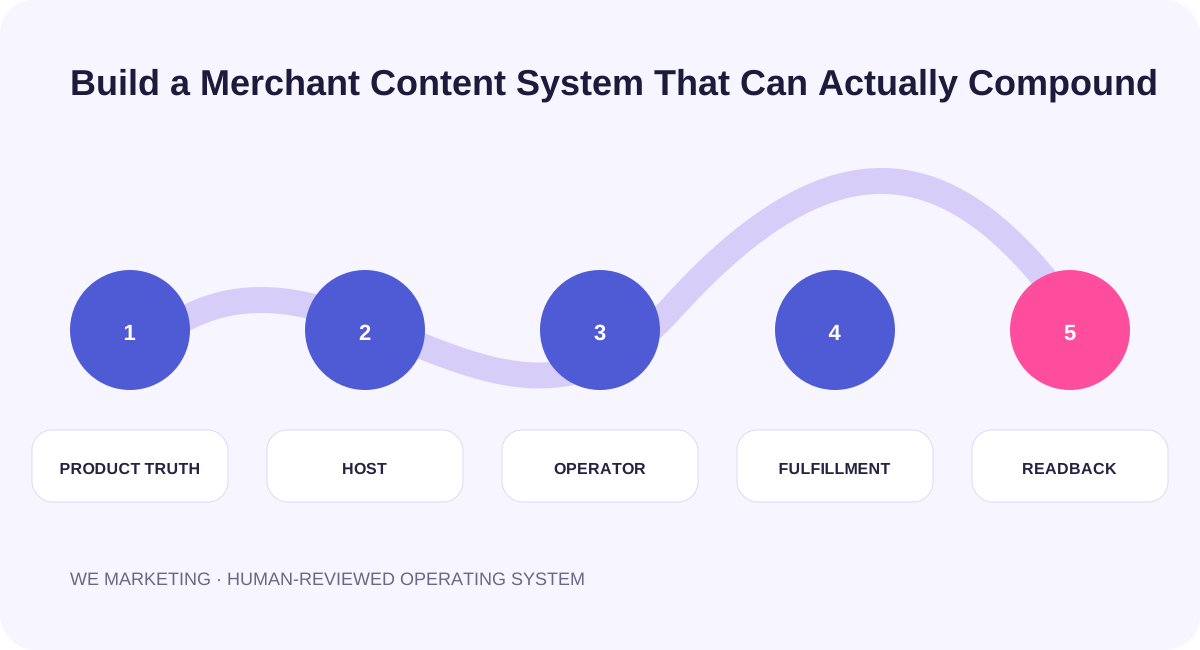
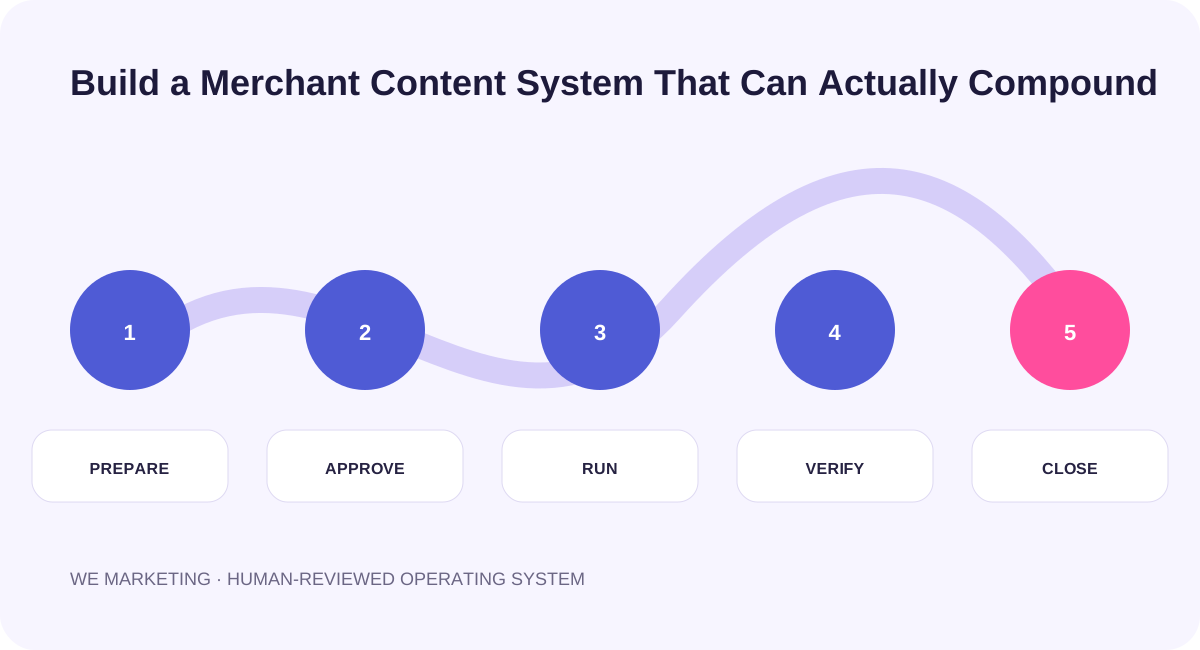
The review order is Question ledger, Product truth, Reusable brief, Controlled production, Publish and readback, Library decision. Keep one active row for each unresolved gate and connect it to the exact product, event, campaign or decision. A row is pending when its required evidence is missing, blocked when a named condition prevents safe work, released when the approved action is visibly live and verified only after library decision closes the consequence.
The weekly decision must be topic-specific. Close the row as repeat when the same controlled conditions should run again, repair when an earlier gate failed, expand when comparable evidence supports more exposure, monitor when no action is currently justified or stop when the risk or economics no longer support the path. A draft, upload, submission or recommendation cannot close this sequence.
Smallest useful next action
Choose one SKU and three unresolved buyer questions. Mark each question as motion, comparison or interaction. Assign the least costly truthful format, define one signal and one stop condition, and verify the live result before producing the next asset.
Source notes
This original WEM operating framework draws on complete current TikTok Shop U.S. Seller University material revalidated September 9, 2026: official source 1, official source 2, official source 3, official source 4, official source 5. The official material establishes the current platform capabilities, eligibility, policy or measurement context used here. WEM adds the decision gates, ownership, economics, stop rules and readback discipline. Interface paths, availability, thresholds, attribution and policies can change. Verify the current U.S. Seller Center, the exact account state and qualified legal or compliance guidance where required before execution.
Frequently asked questions
What is the first decision to make?
Merchant content compounds only when every asset leaves behind a reusable answer, approved product truth and one next decision. A daily posting quota creates volume; a connected brief, production, publishing and readback system creates a library that gets easier to operate and more useful to buyers.
Can a platform recommendation replace human approval?
No. Treat recommendations as hypotheses or navigation help. Verify the current native record, product truth, economics, policy and operating context before any consequential action.
What should the team record as unknown?
Any unavailable qualification, metric, inventory, cost, claim, policy or customer fact should be marked unknown with an owner and resolution date. Unknown is not zero and is not approval.
How many variables should change at once?
Change one controllable variable where practical. If safety, compliance or inventory requires a larger correction, protect the business first and label the period non-comparable.
When is the work complete?
Only after the intended live state is visible, the named record is read back, exceptions are reconciled and the next decision is recorded. Submission or a green-looking dashboard is not terminal evidence.
What is the smallest useful action today?
Choose one SKU and three unresolved buyer questions. Mark each question as motion, comparison or interaction. Assign the least costly truthful format, define one signal and one stop condition, and verify the live result before producing the next asset.