TIKTOK SHOP U.S. · LIVE AUCTION
Temporary Listings Are a Test Tool, Not Your Catalog
WE Marketing Team · Sep 6, 2026 · 15 min read
Direct answer: temporary means one controlled session
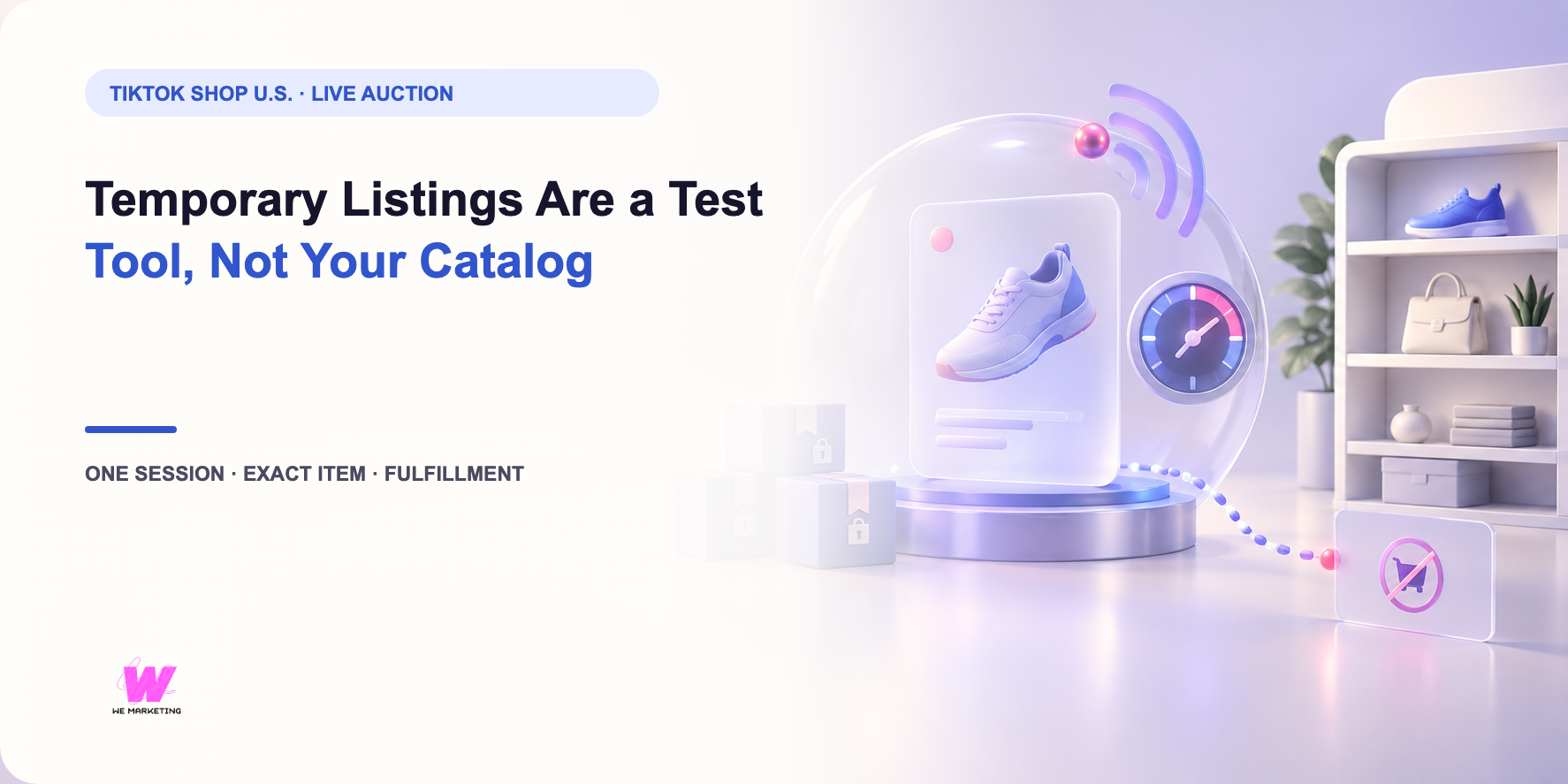
A Temporary Listing is a session-bound tool for eligible TikTok Shop LIVE Auction use, not a shortcut around catalog governance. TikTok Shop's current U.S. guidance says it does not sync to the shop or Shopify, is removed when the LIVE ends and must be created again if the same product appears in a future session. The seller still owns the accuracy of the item, category, condition, images and what is actually delivered.
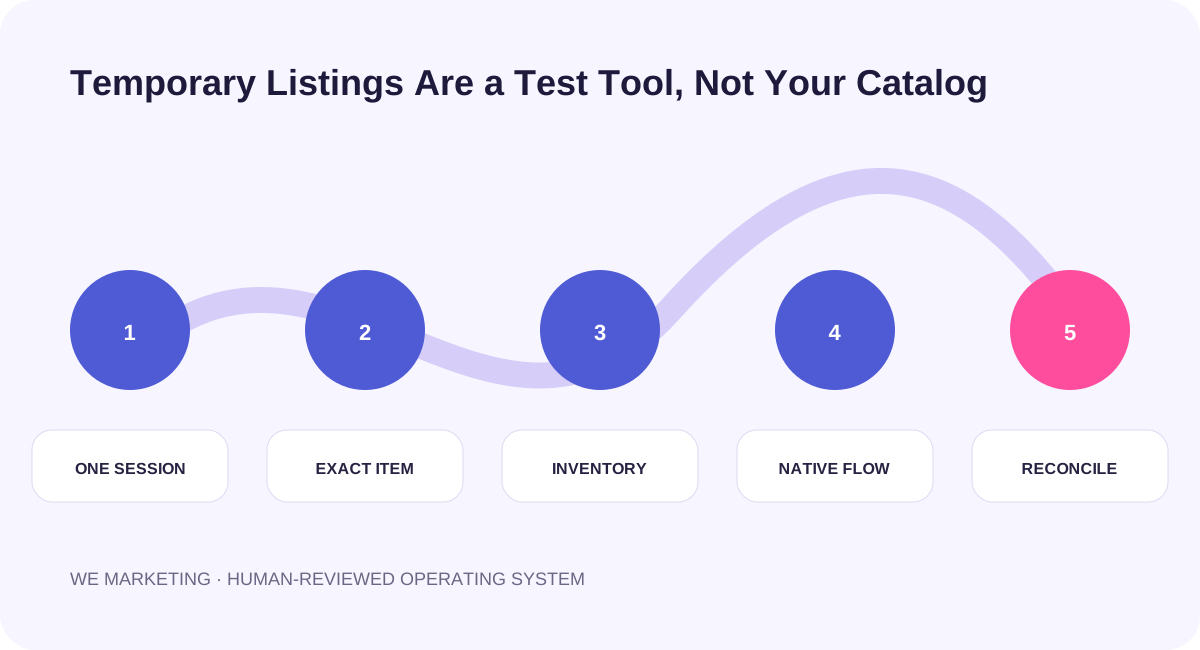
Use the tool only when one named session has one eligible item, one reserved inventory pool, one approved description, one test question and one reconciliation owner. The temporary record can help a team test event mechanics or demand without building a permanent page first. It cannot make an uncertain product identity, unsupported category or uncontrolled stock safe.
Confirm access, category and format before creating the item
Open the current U.S. LIVE Auction Requirements and the actual account. Confirm that the category and format are allowed, that the seller and creator meet their respective current access conditions, and that the native LIVE Auction feature is available. Older materials may call the tool Countdown Bidding. TikTok Shop states that auction activity outside its permitted feature is not allowed. Do not recreate an auction through comments, direct messages or improvised bid collection.
Temporary Listing access has its own current conditions in the official guidance. Those conditions and surfaces may change. Save the evidence, market and timestamp rather than copying an older threshold into a permanent internal rule. If access is missing, the decision is blocked. The team should not change the product category to make the button appear.
Feature access is not the same as product approval. After confirming the account can use the tool, the team must still verify that the exact item is permitted and accurately represented. Keep these two decisions in separate fields so a green account-level state is not mistaken for item-level clearance.
Build an exact item record that survives live pressure
Before the session, confirm and record the product title, brand, category, subcategory, condition, variation, included quantity and final images. Photograph any unique condition or distinguishing feature. The item shown and described during the LIVE must match the Temporary Listing. A fast interface does not reduce the seller's responsibility for truthful product information.
Give the host and operator the same item identifier. When several similar items sit on the table, use a physical label or position map that cannot be confused with the buyer-facing product title. The operator should be able to point from the listing to the exact item and from the order back to that item after the event.
If the host discovers a material difference, damage, missing part or uncertain condition, pause later auction rounds for that item and handle the current exception through the platform's process. Do not imply that a seller may cancel a valid winning result at will. Correct the record before deciding whether the item can safely return in a later event.
Ring-fence inventory outside the permanent catalog
Allocate a separate sellable quantity to the temporary event. Subtract units reserved elsewhere, damaged stock, open replacements and the buffer needed for fulfillment accuracy. If the item is unique, the reserved quantity is usually one. If it is a repeated SKU, the owner still needs a session-specific cap and a method that prevents simultaneous sale through another channel.
Write the stock stop before the first countdown. The operator should know when to remove the item, how to handle an ambiguous order and who decides whether an additional unit can be released. A Temporary Listing disappearing after the session does not restore inventory automatically inside the brand's other records.
After the LIVE, reconcile every paid, canceled and unsold unit. Return unsold inventory to its correct state only after verifying condition and reservation. Keep fulfillment exceptions attached to the event record. Temporary should describe the listing lifecycle, not the quality of the inventory controls.
Give the session one question worth answering
Name the purpose before creating the listing. The test might ask whether qualified viewers understand one item's condition, whether the format can support accurate item-to-order matching, whether a narrow audience values the item at the planned opening conditions, or whether the host and operator can execute the native flow without confusion. Choose one primary question.
Define the evidence that will answer it. Bids alone may show activity but not a healthy customer experience or acceptable economics. Include completed orders, cancellation or dispute signals, inventory accuracy, repeated buyer questions, operator errors and the cost of preparing and fulfilling the event. A positive decision needs the whole path, not only an exciting moment.
Do not turn one event into a test of category, host, price, traffic, item quality and fulfillment at once. Some conditions will inevitably move, but the team should know which decision is primary and record the rest. Without that discipline, a temporary listing becomes a one-night anecdote rather than a useful experiment.
Operate only through the native LIVE Auction flow
Rehearse the sequence: identify the exact item, show the evidence, explain condition and included unit, verify the correct Temporary Listing, start the native LIVE Auction feature, monitor the item and close the result. Older materials may call this Countdown Bidding. The moderator should remove misleading comments and surface product questions without inventing urgency or collecting unofficial bids.
Use a written stop rule for identity mismatch, inventory uncertainty, prohibited behavior, a platform warning, unclear winning-order state or any product fact the host cannot verify. Give one operator authority to stop. Continuing because the room feels energetic can turn a small uncertainty into multiple customer and policy problems.
Save the platform result and the exact order relationship before moving to the next item. If the feature state is unclear, pause rather than guessing who won. The buyer should not carry the cost of an operating ambiguity created inside the room.
Decide what happens when the LIVE ends
TikTok Shop says the Temporary Listing is removed after the LIVE and does not sync to the store or Shopify. Therefore the post-session checklist must preserve the evidence the disappearing record no longer provides: item identity, order result, price, buyer-facing description, inventory disposition, fulfillment owner and open exception. Store only what the team is permitted to retain.
A successful test does not automatically justify a permanent catalog listing. Ask whether the item can be supplied consistently, whether product information and evidence can be maintained, whether the economics remain acceptable outside the event and whether customers need a durable page. A temporary listing can reveal interest while the correct permanent decision remains no.
If the same product will appear in another session, create a new Temporary Listing as required and repeat the accuracy check. Do not clone yesterday's description without verifying current condition, quantity and image. The new session is a new release decision, not a continuation of an expired record.
Hypothetical collectibles test
A hypothetical collectibles seller plans one eligible LIVE Auction item. The team confirms current access and category, photographs the item's condition, reserves a single unit and writes one question: can viewers understand and value this exact item through the planned native flow? The host and operator rehearse the item identifier and stop rule before the session.
During the LIVE, the host shows the exact photographed item and the operator starts the native LIVE Auction feature from the matching Temporary Listing. When a buyer asks whether an accessory is included, the host answers from the approved item record instead of guessing. The team saves the result and reconciles the order after the session.
The event receives interest, but the seller does not immediately create a permanent catalog page. The team first reviews preparation cost, buyer questions, fulfillment and whether equivalent items can be represented consistently. The test answered a bounded question without pretending the temporary tool had created a repeatable catalog system.
Smallest useful next action
Before the next eligible auction, create a one-page test card with current access proof, the exact item and condition, reserved units, approved description and images, one test question, a live stop rule and the post-LIVE reconciliation owner. If any of those fields is missing, do not create the Temporary Listing yet.
Source notes
This original WEM operating framework draws on complete current TikTok Shop U.S. Seller University material revalidated September 9, 2026: official source 1, official source 2, official source 3. The official material establishes the current platform capabilities, eligibility, policy or measurement context used here. WEM adds the decision gates, ownership, economics, stop rules and readback discipline. Interface paths, availability, thresholds, attribution and policies can change. Verify the current U.S. Seller Center, the exact account state and qualified legal or compliance guidance where required before execution.
Frequently asked questions
How long does a Temporary Listing last?
TikTok Shop's current U.S. guidance says it is removed after the LIVE session ends. If the same product appears in a future LIVE, create a new Temporary Listing.
Does a Temporary Listing sync to the shop or Shopify?
No. Current official guidance says it does not sync to TikTok Shop stores or Shopify.
Can any category use Temporary Listings for auction?
No. Confirm current permitted categories, formats, account access and item eligibility before creating one.
Who owns inventory for a temporary item?
The seller still owns inventory accuracy. Reserve a session-specific quantity, prevent double sale and reconcile sold, canceled and unsold units after the LIVE.
Can the host collect bids in comments?
Auction activity must use TikTok Shop's permitted native LIVE Auction feature. Older materials may call it Countdown Bidding. Do not improvise off-feature bidding.
Does a strong test mean we should create a permanent listing?
Not automatically. Review supply, product information, evidence, economics, fulfillment and the need for a durable page before making that separate decision.