TIKTOK SHOP U.S. · AUCTION ECONOMICS
TikTok Shop LIVE Auction Economics: Design the Event Before Chasing Bids
WE Marketing Team · Sep 8, 2026 · 15 min read
Design a viable event before asking for higher bids
A LIVE Auction can produce an exciting room and still lose money. Before choosing an opening bid or booking a longer broadcast, calculate what each completed order contributes and what the whole event costs to run. Bid count and gross sales describe activity. They do not tell you whether the seller can repeat the event without exhausting margin, inventory, or the team.
Start with one approved product group, an explicit inventory allocation, and a realistic staffing plan. Decide whether the event is intended to generate contribution, release suitable inventory, or buy a specific piece of learning. Each objective can support a different budget. None makes unsupported products, unclear item descriptions, or improvised auction mechanics acceptable.
Permission comes before the spreadsheet
TikTok Shop currently limits auctions to expressly permitted categories and formats and requires its native LIVE Auction feature. Check the current requirements and the exact account access before assigning revenue to an auction plan. A product being available through a normal listing does not by itself establish that the proposed auction format is available for it.
Treat that check as a boundary around the economic model. If the planned format is unavailable, compare an eligible alternative or a conventional LIVE demonstration instead of assuming the team can recreate bidding in comments. The rest of this article is an operator's planning framework, not a statement that any particular seller, product, or format has qualified.
Define revenue once so costs are not counted twice
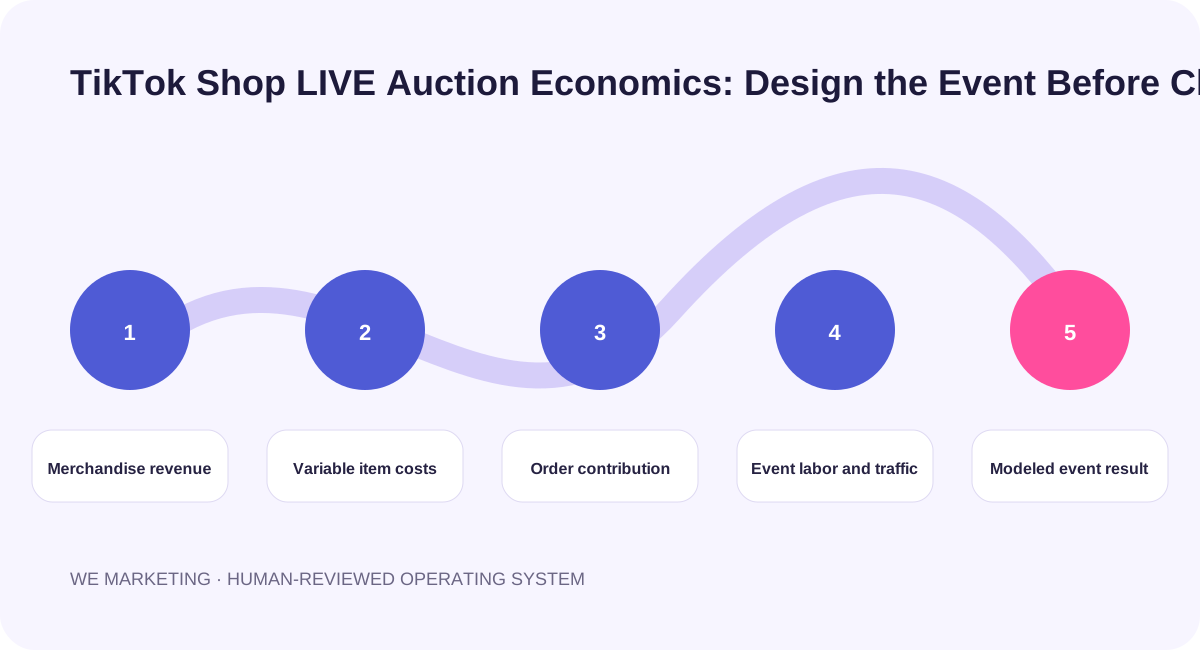
Use a consistent merchandise-revenue basis for the model. State how seller-funded discounts and refunds are treated, and keep pass-through taxes outside the revenue used to evaluate contribution. Do not switch halfway from the winning bid to a settlement deposit. The latter may already have fees or adjustments deducted, so subtracting those amounts again would distort the result.
Under that revenue line, show landed product cost, the actual applicable platform and payment charges, creator commission, packaging, seller-funded shipping, and other costs that vary with an order. Use the current account terms and agreement for each fee. A generic percentage from a different category, campaign, or creator arrangement is not a reliable input.
Decide where expected aftersales losses belong. You can model them through reduced expected revenue and unrecoverable costs, or through a clearly defined allowance. Do not count the same expected refund in both places. Label assumptions and distinguish them from confirmed costs so the owner can see what would change the launch decision.
Separate a profitable item from a profitable show
An item can leave a positive contribution while the event loses money. Add the cost of preparing and running the show: host time, camera and room preparation, item photography, listing work, moderation, order matching, reconciliation, and customer support. A founder working late still uses capacity even when no invoice arrives that evening.
Separate costs incurred only if this event happens from shared costs already committed. That distinction helps decide whether to run a small additional test. For a recurring program, also show a reasonable allocation of shared labor and equipment so an apparently profitable experiment does not hide a business that requires permanent unpaid work.
Use the actual amount of work the assortment creates. Twenty identical sealed items can require a different preparation and packing process from twenty individually described collectibles. Counting only the minutes spent on camera understates the cost of a show that depends on careful condition checks and exact item-to-order matching.
A hypothetical three-case model
The following numbers are invented for illustration, not WEM client results, platform fee rates, or recommended prices. Assume one item per completed order. Each item has $24 of landed cost and an estimated $12 of other variable costs, for $36 in total. For simplicity, hold that total constant in this example; a real model must recalculate percentage-based charges as price changes.
Assume the event costs $400 in preparation and operating time plus $100 in paid support, for $500 of event costs. In the downside case, twelve orders produce average net merchandise revenue of $50 each. Contribution before event costs is 12 × ($50 − $36), or $168. After the $500 event cost, the modeled result is a $332 loss.
In the base case, twenty orders average $60 each. Contribution before event costs is $480, leaving a $20 loss. In the upside case, twenty-eight orders average $65 each. Contribution is $812 before event costs and $312 afterward. All three cases can generate orders and an active room, but only one covers the assumed event cost.
At the base-case contribution of $24 per order, covering $500 requires at least twenty-one completed orders. At twenty orders, the average revenue would need to reach $61 under these simplified cost assumptions. Neither figure is a forecast. They show what the plan demands, so the team can judge whether its inventory, audience evidence, and capacity make that demand credible.
Choose the opening conditions before the commitment
A low opening bid can attract attention, but the seller must be willing to accept the outcomes the permitted setup can produce. Model the unattractive outcome before starting. Do not assume an active audience will always push the final price above cost, especially when the room is new or the item needs more explanation than the schedule allows.
An internal contribution floor is a planning rule, not a promise that the interface supports a reserve-price feature. Verify the actual configuration options. If the available setup cannot protect the business within the intended test budget, change the eligible assortment, redesign the event, or do not start that item.
Set operating limits for future activity: how many additional items may be offered, whether further paid support is allowed, and who can stop launching subsequent rounds. These limits do not authorize canceling a valid completed sale merely because its price disappointed the seller. Keep customer obligations and the live order state separate from the decision to run another round.
Inventory is an exposure limit, not just a unit count
Reserve the exact units the team can identify, demonstrate, and fulfill. Keep those units from being promised elsewhere at the same time. For individually described items, preserve the connection among the item identifier, condition evidence, auction result, and packing instruction. One mistaken substitution can consume far more time than the original sale contributed.
Model unsold units as well as sold ones. An unsold item may remain available inventory rather than becoming a total loss, but preparation time has already been spent and handling may create additional risk. Write its next destination: another eligible event, a standard listing where appropriate, or a separate inventory review. Do not turn uncertain recovery value into cash in the model.
Constrain volume by the slowest real step. If the team can present many items but cannot reliably match and pack the resulting orders, a longer show increases exposure. First remove the bottleneck or limit the assortment. More bidding activity is not useful when the back office cannot preserve the product promise.
Paid support needs its own learning question
A well-designed event with limited distribution can deserve controlled paid support. Decide what the spend should reveal: whether a clear item presentation attracts more relevant viewers, whether those viewers stay, or whether the event produces enough contribution to justify repeating. Allocate a bounded amount and keep a record of the window in which it ran.
TikTok's LIVE GMV Max attribution includes paid and organic conversions within the selected LIVE. Its reported return therefore does not establish that advertising independently caused every included sale. Keep the campaign report, the event's full economics, and the estimate of additional demand from spend as separate views.
For a first test, you may learn more from a focused assortment and a smaller budget than from extending the entire show. For a room with promising evidence, refusing all paid testing until every metric is perfect can also prevent learning. The decision should follow the hypothesis, product economics, and affordable downside, not a universal rule to always spend or never spend.
Final sale does not mean zero service cost
Current auction rules distinguish a change of mind from valid problems such as missing, damaged, or misdescribed items. Do not interpret final-sale messaging as permission to set expected aftersales losses to zero. Verify the current rules for the exact format and category, especially when evaluating a Surprise Set rather than a straightforward identified-item auction.
For planning, use your own relevant evidence about damage, description disputes, payment or cancellation exceptions, and support effort. Where no history exists, show a conservative assumption and the effect of changing it. Record unresolved cases separately after the show so the apparent result is not treated as fully settled while material consequences remain open.
Preventable ambiguity is an economic cost. Clear condition photographs, accurate package descriptions, reliable order matching, and suitable protective packaging consume time, but skipping them can create a larger loss. Evaluate preparation as part of delivering the product honestly, not as optional polish that can always be cut to rescue the budget.
Name the learning before allowing a learning loss
A first event may be worth running even when the base case does not cover every preparation hour. That can be a reasonable investment if the team agrees on the amount it is willing to lose and the decision the event will inform. Examples include measuring item-preparation time or testing whether the audience understands a particular eligible assortment.
Avoid giving learning an invented dollar value that makes any result appear profitable. Keep commercial contribution and learning observations on separate lines. Record what changed in the team's understanding, which future decision it supports, and what uncertainty remains. We learned that auctions are exciting is not enough to approve the same loss indefinitely.
Choose a follow-up that fits the evidence. Better-than-expected demand with poor fulfillment accuracy calls for operational repair before more volume. Strong item contribution with excessive preparation cost calls for a simpler repeatable process. Weak buyer interest despite a clear presentation may call for a different product or a different selling format.
Close the event with a decision the team can repeat
After the show, replace assumptions with actual completed-order revenue, known charges, staff time, and unresolved aftersales exposure. Reconcile inventory and record the difference between the live report and the current operating result. Mark the result provisional when meaningful costs or customer issues are still unresolved.
Before scheduling another event, answer three questions: did the item contribution support the work, could the team fulfill accurately, and did the test resolve its named uncertainty? Then decide whether to repeat at the same scale, change one part of the design, expand within verified capacity, or stop. The useful output is a better next event, supported by numbers the team can explain.
Source notes
This original WEM operating framework draws on complete current TikTok Shop U.S. Seller University material revalidated September 9, 2026: official source 1, official source 2, official source 3, official source 4, official source 5. The official material establishes the current platform capabilities, eligibility, policy or measurement context used here. WEM adds the decision gates, ownership, economics, stop rules and readback discipline. Interface paths, availability, thresholds, attribution and policies can change. Verify the current U.S. Seller Center, the exact account state and qualified legal or compliance guidance where required before execution.
Frequently asked questions
Can positive auction GMV still mean a loss?
Yes. Subtract the relevant item costs, charges, fulfillment costs, and aftersales exposure, then the cost of running the event. Positive sales or positive item contribution does not guarantee that the entire show covers its costs.
Should every auction start at a very low price?
No universal opening price fits every item or room. Evaluate the outcomes the permitted setup can produce before starting. Do not assume that bidders will always raise the price enough to protect the seller's contribution.
Is an internal margin floor the same as a platform reserve price?
No. A planning threshold does not prove that a matching feature exists in the current interface. Confirm the available setup and decide whether to offer the item before launching the round. A disappointing valid sale is not a reason to undo the commitment.
Does final-sale messaging remove all refund exposure?
No. Valid product and delivery problems can still create aftersales obligations. Check the current policy for the exact category and format rather than assuming all auction products have identical treatment.
How should we budget for a first event that is mainly a test?
Set a maximum affordable loss and a specific question before the event. Keep commercial contribution separate from learning observations. Continue only when the result supports a useful next decision, not merely because the room felt exciting.
Why not judge the event only by LIVE GMV Max ROI?
The campaign attribution includes paid and organic conversions within the selected LIVE. The report is useful, but it is not the same as event profit or proof of advertising's incremental effect. Review those questions separately.