TIKTOK SHOP U.S. · AUCTION READINESS
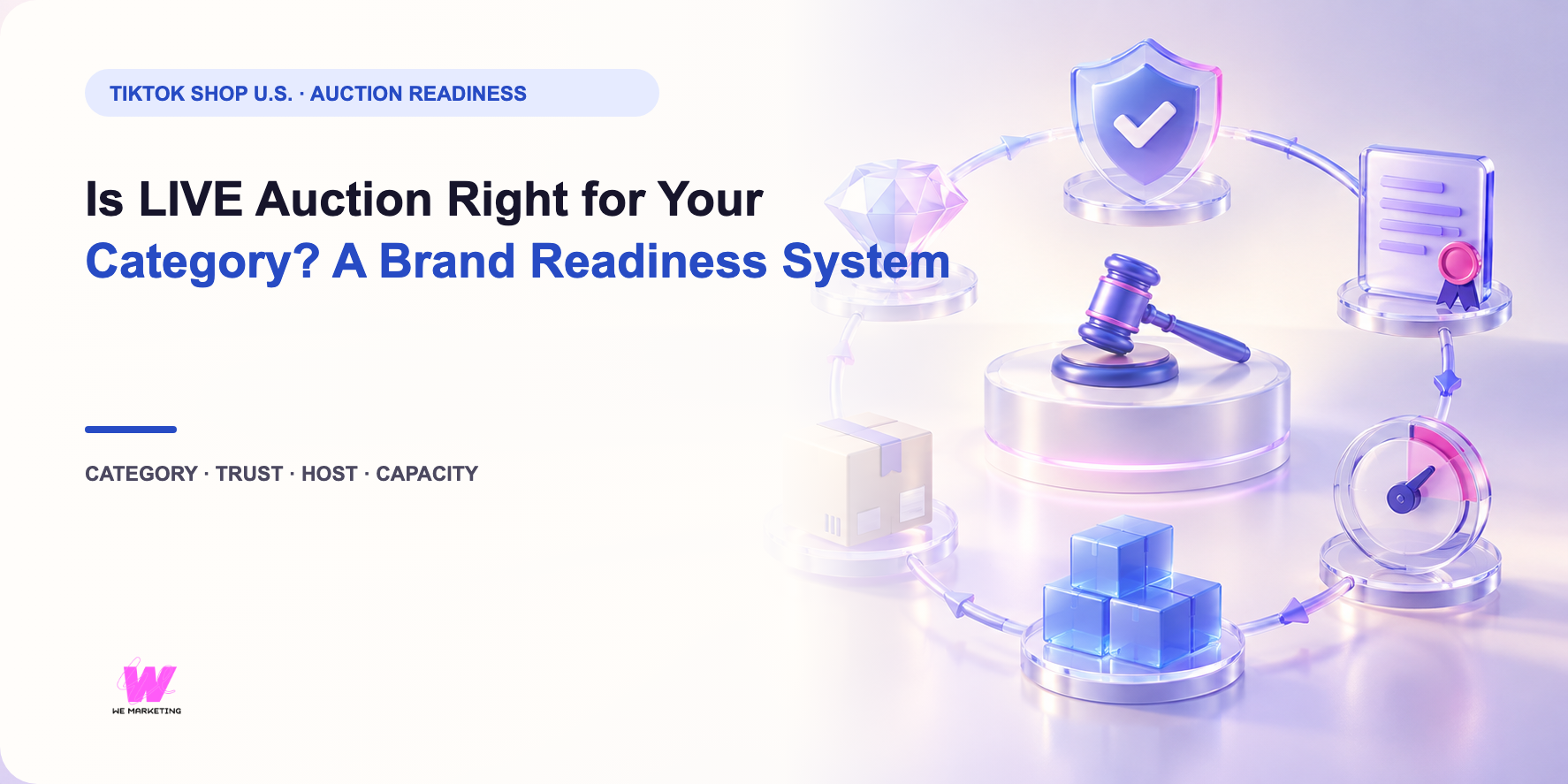
Is LIVE Auction Right for Your Category? A Brand Readiness System
WE Marketing Team · Sep 7, 2026 · 15 min read
Direct answer: permission is necessary, readiness is broader
LIVE Auction is right only for categories and formats TikTok Shop currently permits and only when the brand can prove item identity, condition, inventory, host accuracy and fulfillment. TikTok Shop's current U.S. LIVE Auction Requirements define seller and creator access separately and require use of the native LIVE Auction feature. A permitted category opens the door; it does not prove the brand is ready to walk through it.
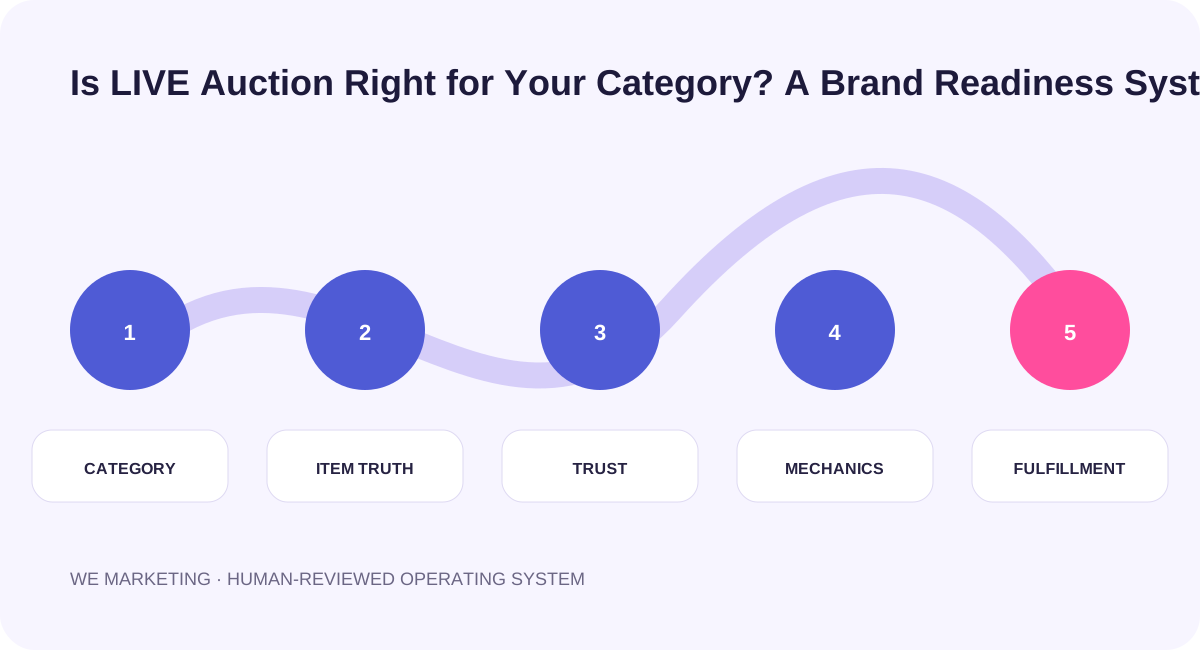
Entertainment value cannot compensate for an unsupported item or an ambiguous operating process. Before planning the show, test six readiness areas: platform permission, item explainability, trust evidence, auction mechanics, inventory and fulfillment, and repeatable ownership. A zero in permission, product truth or fulfillment is a stop, even when the audience appears interested.
Gate 1: verify the current permitted path
Open the latest U.S. LIVE Auction Requirements, not only an older best-practices article. Confirm that the exact category and format are allowed, the shop meets seller conditions, the host meets creator conditions and the native LIVE Auction feature is available in the account. Older materials may call the feature Countdown Bidding. Keep the latest official name and current account state in the release record.
Do not generalize permission from another marketplace, creator or category. An auction format that is familiar elsewhere can still be unsupported on TikTok Shop. If the access or product pathway is unavailable, record the exact blocker and stop. Changing the category, collecting bids in comments or moving the transaction outside the native feature is not a readiness solution.
The requirements may change, so store the source URL, market and validation date. A permanent internal threshold copied from an older article can become a new compliance problem. Operators should check the exact seller and creator state again on event day.
Gate 2: make the exact item explainable in seconds
The host must identify the offered item, condition, variation, quantity and included parts quickly and truthfully. For a unique or condition-sensitive item, create standardized close-up images and a short item card. The buyer should not need to infer whether the displayed object, listing and eventual shipment are the same unit.
Ask a person outside the event team to review the card. Can they distinguish this item from similar units on the table? Do they understand which imperfections, accessories and packaging are included? If the answer depends on the host's memory, the process is not ready. Move the facts into a shared record before adding energy or scarcity.
Some products are difficult to explain under time pressure. Complex customization, subjective condition or unclear provenance can create disputes even when the category is permitted. That does not automatically prohibit the item, but it raises the evidence and staffing required. Readiness is about whether this team can represent this item accurately in this format.
Gate 3: establish trust before asking for a bid
Collect the relevant provenance, authenticity, condition, safety and category-specific records before the event. Match each document or photograph to the exact item identifier. Approve the host's wording and remove guarantees that the evidence cannot support. A live audience should see useful proof, not a promise that substitutes for proof.
Trust also depends on explaining the rules clearly. Buyers need to understand the item, what the auction action means and how the native flow works. Do not use false countdowns, unofficial bids or claims that pressure a shopper through uncertainty. High energy can help attention; it should never hide product facts or create a different transaction than the platform provides.
The current requirements describe winning bids as final sale while still protecting buyers when an item has a valid problem. A final-sale policy is not permission to send the wrong item, conceal a defect or ignore a legitimate issue. Include customer-service and evidence ownership in the readiness review.
Gate 4: rehearse the native LIVE Auction mechanics
Run a dry rehearsal from item selection through the LIVE Auction feature, winner state, order confirmation and transition to the next item. Assign the host, operator and moderator different duties. The host explains and demonstrates, the operator verifies the listing and native flow, and the moderator surfaces product questions and watches for confusing or prohibited behavior.
Write a stop rule for missing access, identity mismatch, uncertain condition, inventory error, unclear winner state or a platform warning. The operator must be able to stop without negotiating in front of the audience. A process that works only when nothing unusual happens is not ready for a live event.
Keep a backup plan that protects the buyer rather than improvising another auction channel. The safe alternative may be to skip the item, continue with a non-auction product segment or end the event. It should not be to collect names manually and decide the winner later.
Gate 5: ring-fence inventory and fulfillment
Reserve the exact auction units outside ordinary sellable inventory and prevent another channel from selling them during the event. Unique items need a one-to-one link between physical object, LIVE Auction record and order. Repeated SKUs still need a session limit, variation count and safety buffer. The inventory owner should be visible to the operator.
Rehearse packing and handoff, especially when condition evidence or included accessories matter. Preserve the item identifier through pick, quality check and shipment. A substitute can destroy the very trust the event created. If an item becomes damaged or unavailable, stop it before bidding rather than promising to repair the mismatch later.
Readiness includes post-order service. Define who handles cancellation, fulfillment exception and legitimate product issue. Final sale does not eliminate the cost of sending an inaccurate or defective item. The brand needs a process that can distinguish buyer remorse from a valid product or fulfillment problem.
Gate 6: test whether the format is repeatable
A successful rehearsal or one strong host does not prove operating readiness. Ask whether the item records, staffing, inventory controls, scripts and exception process can be repeated by the team. If only one person knows the condition language or where units are stored, the event depends on hidden memory rather than a system.
Start with a small eligible set and one scheduled session. Track preparation time, item errors, buyer questions, operator interventions, fulfillment exceptions and event economics. The goal is to learn whether the process remains accurate under live pressure. Viewer excitement is useful evidence about attention, but it is not the only readiness signal.
Afterward, choose expand, repair, monitor or stop. Expand only when the same core controls can support more items without lowering truth or fulfillment quality. Repair the earliest weak gate before adding traffic. Stop when the category may be permitted but the brand cannot create a reliable item-to-order path at acceptable cost.
Score readiness without hiding a hard failure
Use zero, one or two for each of the six gates. Zero means missing, unsupported or unsafe; one means partially documented or dependent on a fragile workaround; two means current evidence, a named owner and a tested response exist. Add the scores only for planning. Never let a high total cancel a zero in permission, item truth or fulfillment.
Write the evidence beside every score. Permission links to the current requirements and account state. Explainability links to the item card and test. Trust links to provenance and approved language. Mechanics links to rehearsal. Inventory links to the reserved-unit ledger. Repeatability links to staffing and post-event records. A score with no evidence is only optimism.
Set a review date because products, condition, staffing and platform access change. A category that was ready for one controlled session may not be ready for a larger event with different items or creators. Treat each material expansion as a new release decision.
Hypothetical vintage-goods example
A hypothetical vintage-goods seller has strong storytelling and an interested audience. The category and account path appear eligible, but condition descriptions live only in the host's memory. Inventory uses handwritten shelf notes, and the person packing orders did not attend the rehearsal. The readiness score stops at item truth and fulfillment even though creative potential is high.
The brand creates standardized photos, condition language, item identifiers, a reserved-inventory map and a pack-out checklist. The operator rehearses the native LIVE Auction feature with the host and moderator. A small eligible set is used first, with a stop rule for any item-to-order mismatch.
The team expands only after the test shows that buyers understand the items, orders retain the correct identifier and fulfillment reproduces the promised condition. The decision is based on a clean path from evidence to shipment, not applause during the rehearsal or the host's confidence.
Smallest useful next action
Choose one proposed auction category and score six gates: current platform permission, item explainability, trust evidence, native mechanics, inventory and fulfillment, and repeatable ownership. Attach one current record to each score. Any zero in permission, product truth or fulfillment is a stop. Repair that gate before planning more creative or traffic.
Source notes
This original WEM operating framework draws on complete current TikTok Shop U.S. Seller University material revalidated September 9, 2026: official source 1, official source 2, official source 3. The official material establishes the current platform capabilities, eligibility, policy or measurement context used here. WEM adds the decision gates, ownership, economics, stop rules and readback discipline. Interface paths, availability, thresholds, attribution and policies can change. Verify the current U.S. Seller Center, the exact account state and qualified legal or compliance guidance where required before execution.
Frequently asked questions
Which categories can use LIVE Auction?
Only categories and formats permitted by the current U.S. LIVE Auction Requirements. Check the exact item and account before every event.
Do sellers and creators have the same access requirements?
No. The current requirements describe seller and creator eligibility separately. Verify both roles involved in the event.
Can a permitted category still be unready?
Yes. Weak item identity, condition evidence, inventory control, host accuracy or fulfillment can make a permitted path operationally unsafe.
Does final sale remove buyer protection?
No. A valid winning bid is treated as final sale, but legitimate item or fulfillment problems still require handling. Final sale does not permit inaccurate representation.
Can we collect bids outside the LIVE Auction feature?
No. Use TikTok Shop's permitted native LIVE Auction feature. Older materials may call it Countdown Bidding.
How large should the first event be?
Use the smallest eligible set that can test item explanation, native mechanics, inventory and fulfillment without exceeding the team's control capacity.