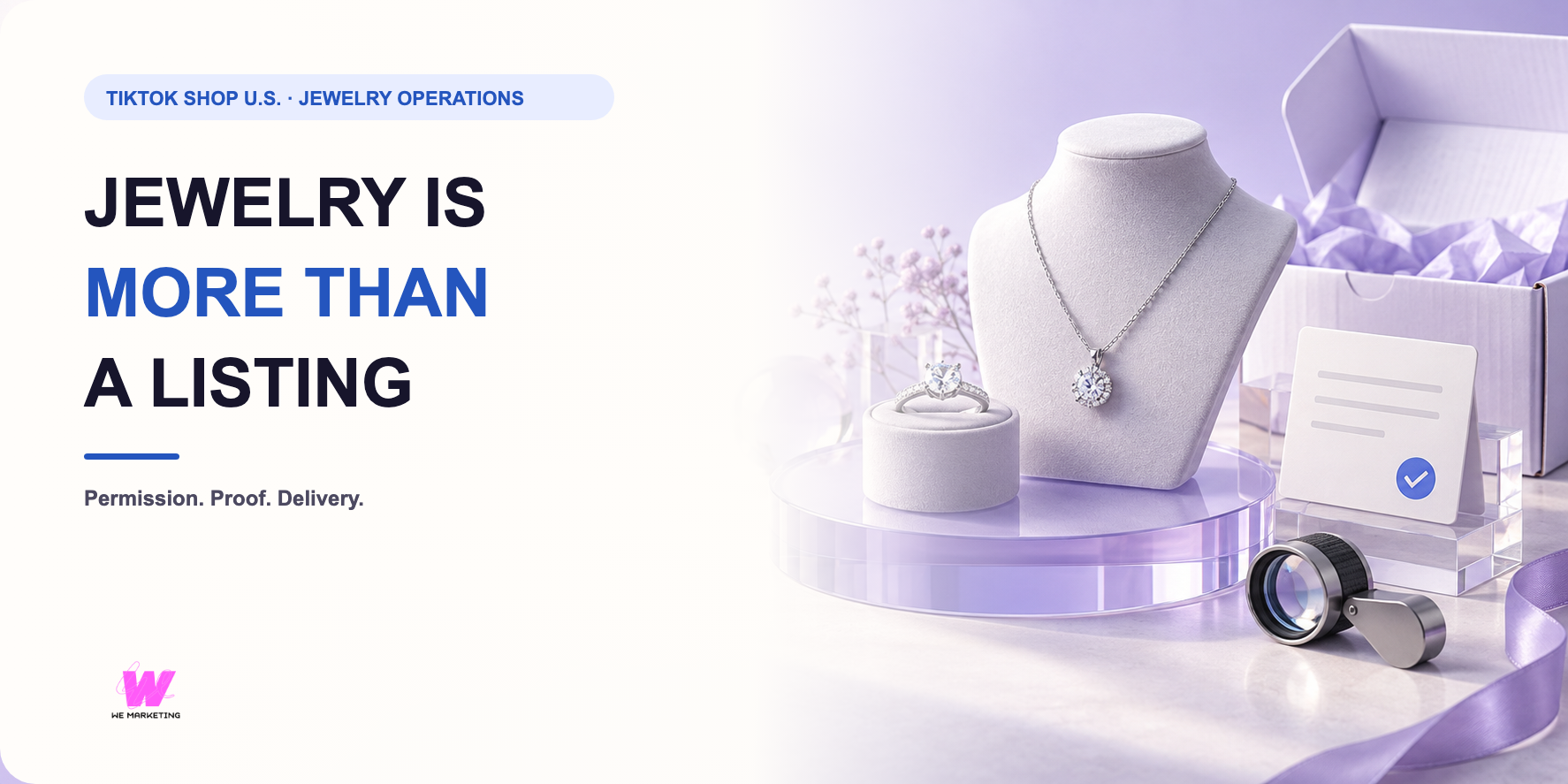
TIKTOK SHOP U.S. · JEWELRY OPERATIONS
TikTok Shop for Jewelry: A Category Operating System Beyond Product Listings
WE Marketing Team · Sep 21, 2026 · 15 min read
The direct answer
A jewelry brand does not become TikTok Shop-ready when its product images are uploaded. Jewelry combines material claims, sizing, visual proof, authenticity, packaging, buyer expectations and category-specific permissions. One wrong metal description or mismatched certificate can damage the entire buying path. The operating question is not how quickly the team can list more pieces. It is which exact pieces can be sold, explained, delivered and supported with evidence at the same time.
The practical answer is a category operating system: one item-level record that connects permission, documented product truth, the product detail page, the on-camera demonstration, the sellable unit, and aftersales resolution. Begin with a small, clearly differentiated assortment. Release a piece only when each link describes the same item. Use creator content to answer real buyer questions, not to invent luxury or investment claims. This is WEM's operating framework, not a TikTok Shop rule or a claim that every jewelry subcategory has the same requirements.
1. Separate category permission from product appeal
Start with the exact product: new or pre-owned, metal, stone, treatment, brand, origin, condition, package contents and variation. Then check the current U.S. Seller Center category and the Jewelry Products Requirements that apply to that material. The official guidance says sellers may need category qualification or documents for listing review, and that requirements vary by jewelry type. Gold, diamonds and ruby, sapphire or emerald products have different evidence paths. A general approval impression is not a substitute for the actual item and current Seller Center result.
Create a release state for every SKU: permitted and evidence complete, pending documentation, rejected with a stated reason, or prohibited. Hold the SKU when permission is uncertain. Do not put a restricted item under a convenient accessory category to test demand. The Product Listing Policy requires the most accurate category and warns that some categories need prior approval. The Prohibited Products Policy also identifies unqualified jewelry and unapproved pre-owned fine jewelry as prohibited. A beautiful item can fail the permission gate; marketing should not override that gate.
2. Build an evidence file for the exact sellable unit
The documentation file should be as specific as the product, not a folder of generic supplier PDFs. TikTok Shop's current jewelry page calls for product and packaging photos that match listings and submitted documents. Gold products may require a qualifying recent test report and authenticity record showing the product name and gold purity. Diamond and specified precious-gemstone products have certificate requirements tied to the stone and image. Where origin display is required, the product or packaging must show it as specified. The team should read the full current rule rather than copying a certificate checklist from another material.
Give each piece or truly identical batch a traceable record: internal item ID, purchased source, material statement, stone description, size, weight if relevant, test or certificate number, photo set, condition, included accessories and owner. Record document issue dates and the listing version to which they belong. If a seller changes the stone, setting, plated material or included contents, review whether it remains the same item before reusing reviews or documentation. The goal is to prevent a polished story about one piece from being attached to a different item that the buyer receives.
3. Make the product page answer jewelry-specific questions
A jewelry product detail page must make the item recognizable without requiring the shopper to decode a creator's video. State the accurate material, finish, dimensions, chain length, ring size or earring format, stone status, quantity, included pieces, care limits and any legally required disclosures that apply. Show scale and relevant angles, not only a close crop that makes a small item look large. TikTok Shop's listing policy requires truthful descriptions and consistency between text, attributes, images and delivered product. Its listing-quality guide identifies material as category-specific information for jewelry accessories and derivatives.
Make one product-truth sheet the source for the listing, creator brief, customer service answer and packing checklist. Check the video against that sheet before publishing. If the listing says sterling silver, the host cannot call it solid gold; if a plated item is shown beside solid gold, each needs its own unambiguous explanation. Do not write unsupported durability, hypoallergenic, appraisal, scarcity or resale-value claims. A simple side-by-side material and scale demonstration often resolves more buyer uncertainty than a vague luxury adjective. Review returns and questions weekly to find the next missing fact.
4. Give each format a buyer job, not a posting quota
Short video can reveal how a piece sits on a person, changes under ordinary light or pairs with everyday clothing. The first seconds should make the jewelry type identifiable. TikTok Shop's shoppable-video guidance explicitly calls for viewers to recognize whether the item is earrings, a bracelet, necklace or another type, then suggests discussing style and materials. A second asset can show clasp operation, scale, layering or what comes in the box. A LIVE session is useful when buyers need repeated questions answered in real time, but only if the room can keep product, variation, price and inventory accurate.
Choose one job per asset: identify, compare, demonstrate, reassure or resolve an objection. Match the creator to the item and buyer situation, not merely to a follower count. Give the creator verified product facts, prohibited claims, exact product link, allowed demonstrations and a route for questions they cannot answer. Use ordinary, reproducible lighting when making material or color claims. Track useful buyer questions, qualified product clicks, order issues and return reasons. More content is valuable only if it improves a specific point in the buyer path and leaves a reusable answer for the next asset.
5. Do not assume jewelry belongs in LIVE Auction
LIVE Auction is an eligibility and format decision, not a creative shortcut. TikTok Shop's current LIVE Auction Requirements say auctions are permitted only for categories and formats the platform expressly allows, and bidding must use the native LIVE Auction feature. Unsupported categories or off-feature bidding are prohibited. A jewelry product's listing approval does not itself prove that the same product can be auctioned. Before scripting an auction, the seller must check current account access, exact category and product eligibility, required qualifications, the native listing configuration, and the applicable aftersales rules.
If the current Seller Center cannot show that the exact format is permitted for the exact item, use ordinary shoppable video, a compliant product listing or an eligible standard LIVE demonstration instead. Do not run informal bids in comments, DMs or another channel. If the format is available, reconcile the item shown, item offered and item shipped, and model labor, packaging, fees, returns and customer-service exposure before deciding whether it is worth operating. Treat the auction boundary as a hold gate, not as a headline growth tactic for every jewelry brand.
6. Fulfillment and aftersales complete the promise
A jewelry order has identity and condition risks that a generic parcel checklist may miss. The picker needs the exact variation and item ID; the packer needs to confirm the piece, certificate or authenticity card when applicable, included chain or accessory, condition and protective packaging. Record the packed unit and handoff without exposing sensitive buyer information in creator content. Shipping promises must match the current fulfillment workflow. An expensive-looking box does not repair a wrong stone, missing part, damaged setting or inaccurate material claim.
Give customer service a fact-based response path for sizing, care, authenticity documents, damage, missing components and not-as-described complaints. Do not promise that jewelry is automatically final sale. Return and cancellation treatment depends on the actual product and transaction rules, and valid buyer issues still require resolution. Compare buyer questions and returns back to the listing and demonstration: if shoppers repeatedly ask whether a finish is solid or plated, the upstream truth is insufficient. The operating loop ends only when the buyer's received item and the shop's records agree.
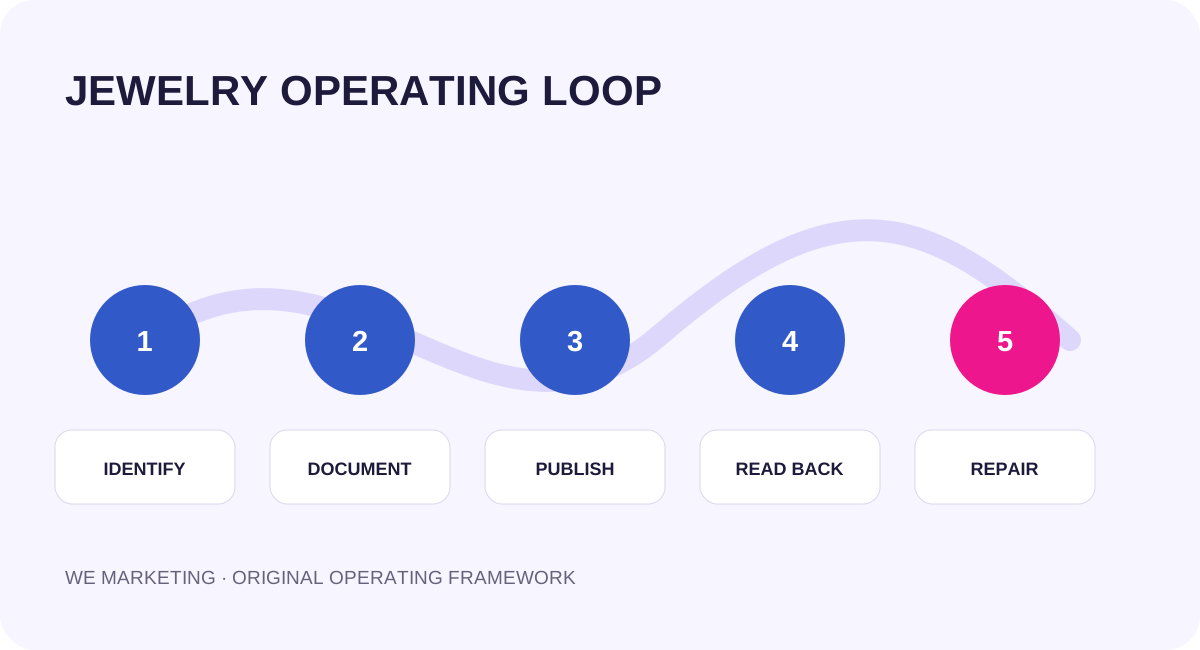
7. Run a small release gate before scaling assortment
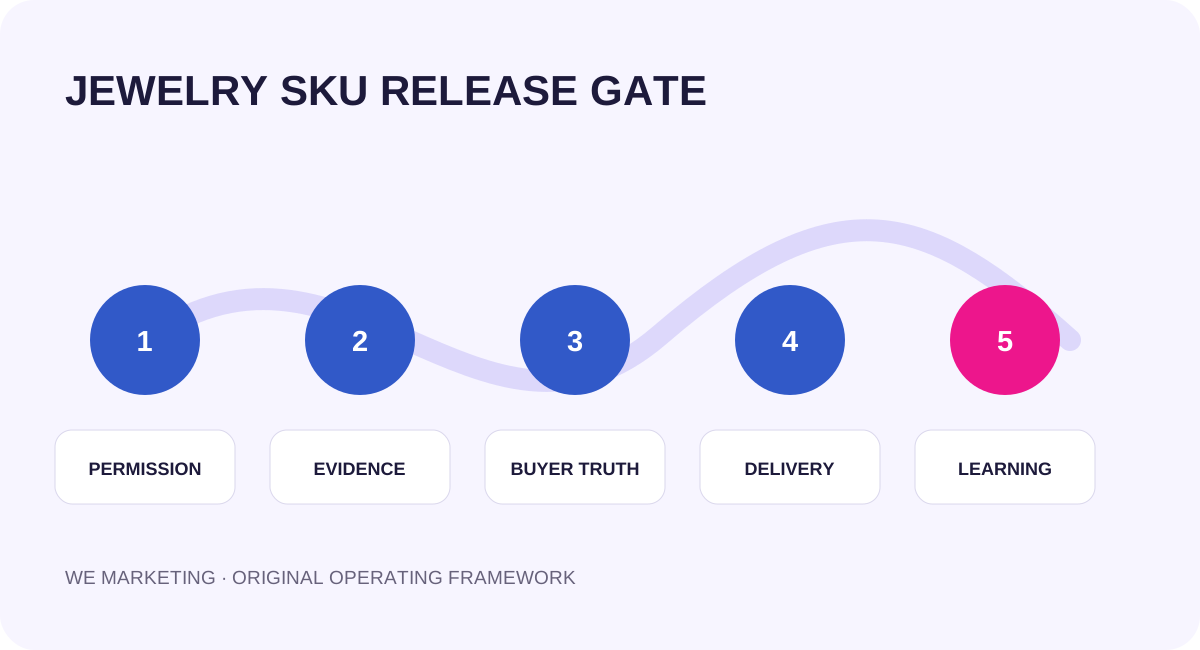
Use a five-column item board rather than launching the entire catalog. Column one is permission: correct category and current qualification result. Column two is evidence: item-matched photos, material records and any required report or certificate. Column three is buyer truth: accurate listing, scale demonstration, approved claims and creator brief. Column four is deliverability: sellable unit, packaging, carrier promise and exception owner. Column five is learning: buyer questions, clicks, order issues and the next decision. A SKU moves forward only when all five have evidence and an owner.
For a first controlled release, select two or three pieces with different buyer jobs rather than twenty variants of the same uncertainty. Keep price, inventory and content version visible so one change can be interpreted. If one item attracts attention but creates material confusion or not-as-described tickets, pause that item and repair its truth before increasing creator reach. If a second item earns useful questions but few clicks, test whether scale, styling or product destination is unclear. The decision is not simply sell more; it is learn which exact piece can responsibly support more demand.
A hypothetical operating example
Consider a hypothetical jewelry brand with a plated necklace, a gold ring and a diamond pendant. The team initially plans one creator brief and one broad campaign for all three. The release board shows that the necklace has complete product truth but its scale is unclear on camera; the ring has attractive creative but its current document package does not match the exact variation; the pendant has correct documents but packing instructions omit its certificate. The brand releases only the necklace after a scale demonstration, holds the ring for document reconciliation and holds the pendant until the packed-unit checklist includes the certificate. It then asks the creator to answer chain length and finish questions for the released necklace. No claim of platform endorsement or performance improvement is implied; the example illustrates WEM's decision sequence.
The smallest useful action today
Today, choose one proposed jewelry SKU. Write its exact material, stone, size, condition, category, qualification state, document set, listing promise, creator claim boundary, packed contents and exception owner in one row. Open current Seller Center and compare each field with the live record. If any required fact is unknown or mismatched, hold the SKU. Fix the first missing link before producing more content or paying for reach.
Source notes
This original WEM jewelry operating framework draws on complete current TikTok Shop U.S. Seller University material revalidated September 21, 2026: Jewelry Products Requirements, Product Listing Policy, Product Detail Pages & Listing Quality Guidelines, Tips on Creating Quality Shoppable Videos, LIVE Auction Requirements, Prohibited Products Policy. The official documents establish jewelry evidence, listing, video and auction boundaries; the five-field release system and cross-team learning loop are WEM operating judgments. Category access, features, documents and aftersales rules can change. Verify the current U.S. Seller Center and qualified legal or compliance guidance where needed before execution.
Frequently asked questions
Does every jewelry product need the same approval documents?
No. The current Jewelry Products Requirements vary by product type. Check the exact material, category and Seller Center request for that SKU.
Can we use one certificate for every similar-looking item?
Do not assume so. The relevant document must match the exact listing and product photos, and any required validity period and issuing body must be satisfied.
Can we call plated jewelry solid gold if the look is similar?
No. Material statements must accurately describe what the buyer receives. Keep the product page, video and packing record consistent.
Is a listed jewelry item automatically eligible for LIVE Auction?
No. Auction eligibility is separate. TikTok Shop permits auctions only in expressly allowed categories and formats through its native feature.
What should a creator show first?
Make the jewelry type identifiable, then show scale, material, use or styling that answers one real buyer question without unsupported claims.
What is the smallest useful next action?
Audit one exact SKU across category permission, evidence, buyer truth, creator brief, packed unit and aftersales owner. Hold it wherever a required link is unproven.