TIKTOK SHOP U.S. · CONTENT PORTFOLIO
Creator Content, Merchant Content or Both? Allocate Your TikTok Shop Resources by Growth Stage
WE Marketing Team · Sep 13, 2026 · 15 min read
Direct answer
Use merchant content to establish repeatable product truth and use creator content to add credible, varied demonstrations where a defined buyer question needs a different voice or audience context. Run both only when the brand can keep the product, claim, inventory, commission and review loop coherent. The correct mix changes with the growth stage and the constraint the team can actually prove.
A content-allocation system is a weekly decision record that assigns each active SKU and buyer question to a content lane, owner, budget boundary, evidence requirement and readback. It does not rank creators above merchants or merchants above creators. It prevents the team from buying more content before it knows which unanswered buyer question the next asset must solve.
The operating question is never “what can the tool do?” It is “what decision can the team safely make from current evidence, and who owns the readback?”
Why stage and buyer question comes before execution
A team can produce more assets while repeatedly answering a question shoppers are not asking. That is why the first operating move is specific: Name the current growth stage and the one buyer question blocking the next decision before choosing a producer. The evidence is equally specific: Current SKU, buyer comments, search terms, product-page questions, funnel evidence and a named owner. A fast interface cannot repair a wrong classification or an unverified starting point. It can only execute the team's assumption more quickly.
This article therefore treats stage and buyer question and merchant truth lane as connected release gates. The team does not advance because a recommendation looks confident or a dashboard tile turns green. It advances when the exact object is known, the current account evidence supports the action and the consequence of being wrong is inside a written guardrail.
The evidence packet for this decision
Build one packet from the evidence families used across this workflow: Current SKU, buyer comments, search terms, product-page questions, funnel evidence and a named owner. Sellable product, approved claims, current price or offer condition, product-page match and a reusable shot list. Creator evidence, selected SKU, factual brief, disclosure boundary, sample or commission plan and review owner. These records answer different questions and should not be collapsed into one score. Platform evidence describes access and observed state. Brand evidence describes product truth, cost, stock, staffing and what the customer can actually receive.
Keep the later-stage records beside them: Contribution floor, inventory, sample capacity, owner time, expected revisions and pause threshold. Versioned brief, baseline, release date, destination, measurement window and stop rule. Published links, product state, comments, clicks, orders, inventory, creator status, costs and decision note. Mark unavailable facts as unknown, with an owner and resolution date. If the missing fact affects product identity, permission, customer safety, sellable inventory, fulfillment or the economic floor, it is a stop condition. If it only limits confidence in an optimization idea, the team may choose a smaller reversible test.
1. Stage and buyer question
Operating move: Name the current growth stage and the one buyer question blocking the next decision before choosing a producer.
Required evidence: Current SKU, buyer comments, search terms, product-page questions, funnel evidence and a named owner.
Failure mode: A team can produce more assets while repeatedly answering a question shoppers are not asking.
Before closing this gate, assign one owner and one readback time. Save the exact page, asset, product, session or order identifier. If the live state differs from the approved state, stop the sequence, record the exception and repair the earliest broken handoff rather than compensating later with more traffic, discount or content.
2. Merchant truth lane
Operating move: Use the brand lane for exact product demonstration, variation clarity, approved facts, repeatable hooks and fast revision.
Required evidence: Sellable product, approved claims, current price or offer condition, product-page match and a reusable shot list.
Failure mode: Brand content becomes expensive noise when it recreates polished assets without improving a buyer handoff.
Before closing this gate, assign one owner and one readback time. Save the exact page, asset, product, session or order identifier. If the live state differs from the approved state, stop the sequence, record the exception and repair the earliest broken handoff rather than compensating later with more traffic, discount or content.
3. Creator fit lane
Operating move: Use a creator lane when a specific audience context, use case, objection, style or proof source is needed and can be briefed truthfully.
Required evidence: Creator evidence, selected SKU, factual brief, disclosure boundary, sample or commission plan and review owner.
Failure mode: A broad outreach push can create mismatched content, unsupported claims and unowned follow-up.
Before closing this gate, assign one owner and one readback time. Save the exact page, asset, product, session or order identifier. If the live state differs from the approved state, stop the sequence, record the exception and repair the earliest broken handoff rather than compensating later with more traffic, discount or content.
4. Resource and economics gate
Operating move: Set the number of active SKUs, samples, commission exposure, production hours and review capacity before expanding either lane.
Required evidence: Contribution floor, inventory, sample capacity, owner time, expected revisions and pause threshold.
Failure mode: Views can rise while the team loses the capacity to fulfill, review or learn from the resulting demand.
Before closing this gate, assign one owner and one readback time. Save the exact page, asset, product, session or order identifier. If the live state differs from the approved state, stop the sequence, record the exception and repair the earliest broken handoff rather than compensating later with more traffic, discount or content.
5. Controlled portfolio release
Operating move: Choose one merchant asset, one creator hypothesis or a deliberately small paired test with a single comparable question.
Required evidence: Versioned brief, baseline, release date, destination, measurement window and stop rule.
Failure mode: Changing format, creator, price, product and traffic together creates activity without interpretable learning.
Before closing this gate, assign one owner and one readback time. Save the exact page, asset, product, session or order identifier. If the live state differs from the approved state, stop the sequence, record the exception and repair the earliest broken handoff rather than compensating later with more traffic, discount or content.
6. Readback and reallocation
Operating move: Read content, product and operating signals together, then keep, repair, expand, narrow or stop the next allocation.
Required evidence: Published links, product state, comments, clicks, orders, inventory, creator status, costs and decision note.
Failure mode: A posted video or accepted collaboration is not proof that the content solved the intended buyer problem.
Before closing this gate, assign one owner and one readback time. Save the exact page, asset, product, session or order identifier. If the live state differs from the approved state, stop the sequence, record the exception and repair the earliest broken handoff rather than compensating later with more traffic, discount or content.
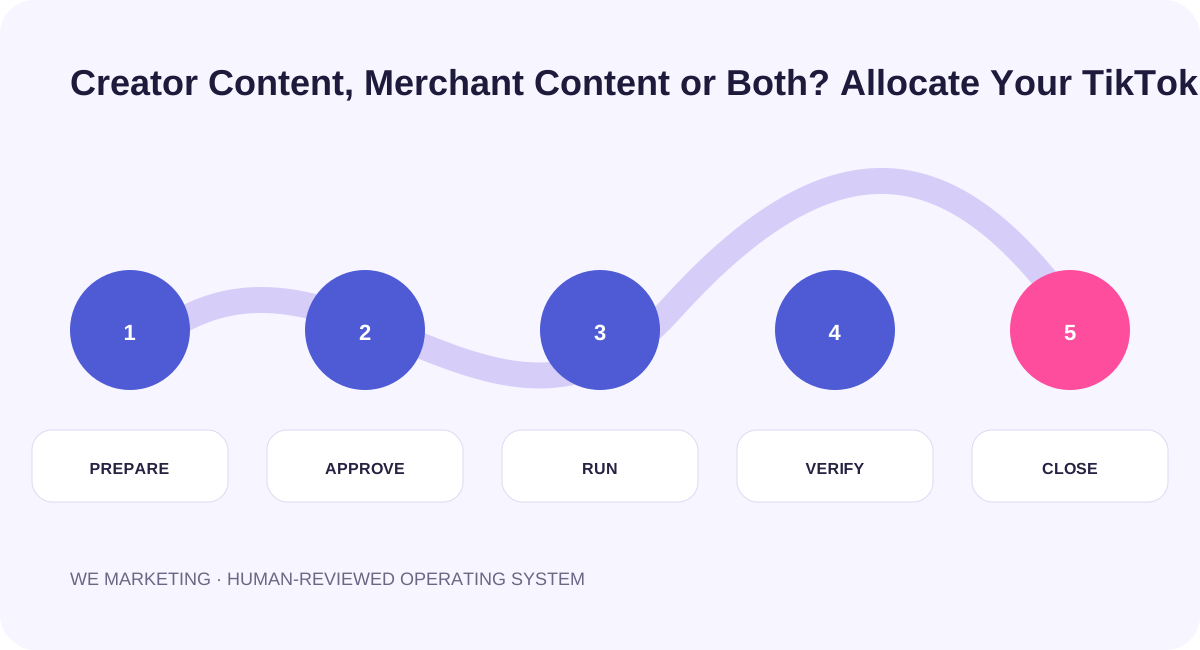
Tradeoffs and stop rules for controlled portfolio release
The central tradeoff is between creator fit lane and controlled portfolio release. Moving early may capture demand or learning, but it also exposes the failure mode already named in the workflow: Changing format, creator, price, product and traffic together creates activity without interpretable learning. Waiting for perfect information may waste a time-bound opportunity. The practical answer is not maximum speed or maximum caution. It is the smallest release whose downside the owner can observe and stop.
Write stop rules from the actual failure modes: A team can produce more assets while repeatedly answering a question shoppers are not asking. Brand content becomes expensive noise when it recreates polished assets without improving a buyer handoff. A broad outreach push can create mismatched content, unsupported claims and unowned follow-up. Views can rise while the team loses the capacity to fulfill, review or learn from the resulting demand. Changing format, creator, price, product and traffic together creates activity without interpretable learning. A posted video or accepted collaboration is not proof that the content solved the intended buyer problem. Convert the relevant conditions into observable thresholds and give one person authority to pause. The rule should also name the safe state after a stop, such as hold the product, end paid support, remove the item from the session, repair the listing or reconcile affected orders.
Hypothetical operating example
A hypothetical skincare brand is early in a new-product launch. Its merchant account can show the exact texture, use order, included unit and product page, but comments keep asking whether the routine works for a specific daily situation. The team does not send samples to every interested creator. It first makes one merchant clarification asset, then selects two creators whose audiences genuinely encounter that situation. Each receives the exact SKU, permitted facts, disclosure boundary and a controlled sample plan. The weekly review compares the same buyer question across the three assets, checks the linked variation and inventory, then decides whether to refine the merchant library, add creators or pause the offer.
This example is illustrative, not a WEM client result. The point is the decision sequence: classify the object, gather current evidence, separate hard gates from optimization choices, release the smallest defensible action and verify the named live state. If the conditions change materially, the team starts a new comparison rather than forcing the result into the old test.
Review the six gates as one sequence
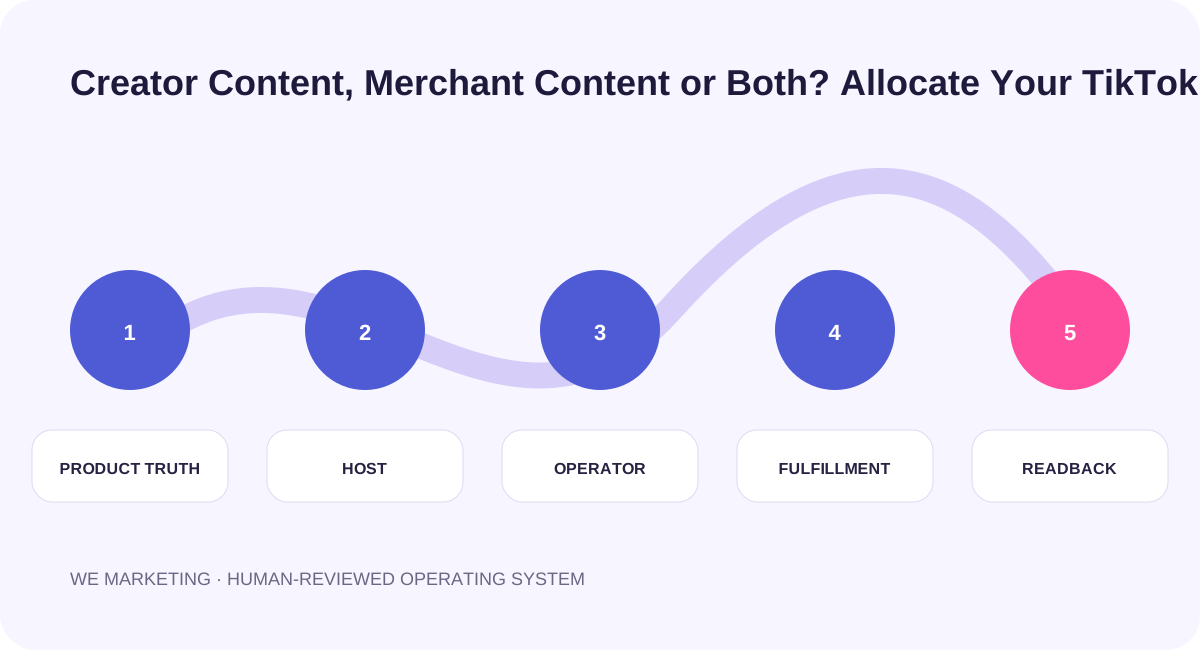
The review order is Stage and buyer question, Merchant truth lane, Creator fit lane, Resource and economics gate, Controlled portfolio release, Readback and reallocation. Keep one active row for each unresolved gate and connect it to the exact product, event, campaign or decision. A row is pending when its required evidence is missing, blocked when a named condition prevents safe work, released when the approved action is visibly live and verified only after readback and reallocation closes the consequence.
The weekly decision must be topic-specific. Close the row as repeat when the same controlled conditions should run again, repair when an earlier gate failed, expand when comparable evidence supports more exposure, monitor when no action is currently justified or stop when the risk or economics no longer support the path. A draft, upload, submission or recommendation cannot close this sequence.
Smallest useful next action
Choose one active SKU and write three buyer questions. Mark each as product truth, audience context or live objection. Assign one merchant asset, one selected-creator hypothesis or no content until a missing product or operating condition is repaired. Give every approved asset an owner, destination, evidence boundary and readback date.
Source notes
This original WEM operating framework draws on complete current TikTok Shop U.S. Seller University material revalidated September 9, 2026: official source 1, official source 2, official source 3, official source 4. The official material establishes the current platform capabilities, eligibility, policy or measurement context used here. WEM adds the decision gates, ownership, economics, stop rules and readback discipline. Interface paths, availability, thresholds, attribution and policies can change. Verify the current U.S. Seller Center, the exact account state and qualified legal or compliance guidance where required before execution.
Frequently asked questions
What is the first decision to make?
Use merchant content to establish repeatable product truth and use creator content to add credible, varied demonstrations where a defined buyer question needs a different voice or audience context. Run both only when the brand can keep the product, claim, inventory, commission and review loop coherent. The correct mix changes with the growth stage and the constraint the team can actually prove.
Can a platform recommendation replace human approval?
No. Treat recommendations as hypotheses or navigation help. Verify the current native record, product truth, economics, policy and operating context before any consequential action.
What should the team record as unknown?
Any unavailable qualification, metric, inventory, cost, claim, policy or customer fact should be marked unknown with an owner and resolution date. Unknown is not zero and is not approval.
How many variables should change at once?
Change one controllable variable where practical. If safety, compliance or inventory requires a larger correction, protect the business first and label the period non-comparable.
When is the work complete?
Only after the intended live state is visible, the named record is read back, exceptions are reconciled and the next decision is recorded. Submission or a green-looking dashboard is not terminal evidence.
What is the smallest useful action today?
Choose one active SKU and write three buyer questions. Mark each as product truth, audience context or live objection. Assign one merchant asset, one selected-creator hypothesis or no content until a missing product or operating condition is repaired. Give every approved asset an owner, destination, evidence boundary and readback date.