TIKTOK SHOP U.S. · BFCM OPERATIONS
TikTok Shop Virtual Bundles for BFCM: Keep the Offer, Inventory and Returns Telling One Story

Direct answer: a virtual bundle is one offer, not one vague promise
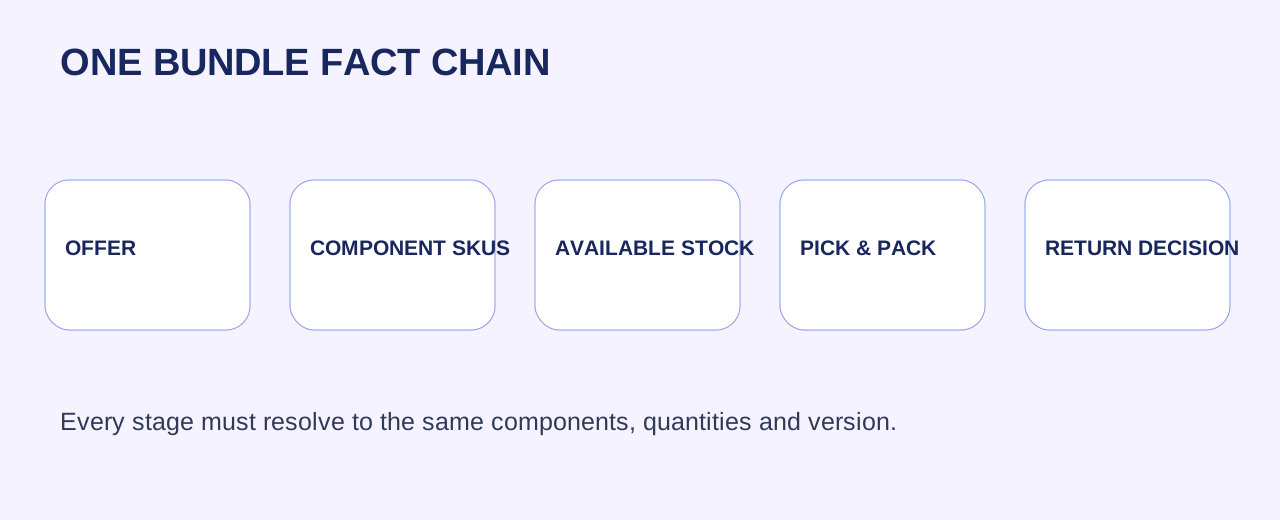
A Virtual Bundle is a group of existing products sold as a single package without needing physical pre-packing. For BFCM, that convenience becomes safe only when the product page, component SKU list, available-to-promise inventory, warehouse instruction, package tracking and aftersales record all resolve to the same bundle version. A campaign tile is not proof that the operations behind it agree.
The current U.S. guide describes Virtual Bundles as whitelist-only. If the feature entry is absent, eligibility is not implied. Check Seller Center and the Account Manager path named by the guide before planning a launch, then keep the enablement result with the bundle record.
Start with a component truth record
Create one versioned record before the offer is published: bundle ID, main product, every component SKU and quantity, selectable options, shopper title, price, images, included and excluded accessories, warehouse locations, available-to-promise calculation, fulfillment owner and returns owner. Attach the source screenshots or exports used to approve the record.
This is not duplicate administration. It is the bridge between the shopper promise and the order that a warehouse or support team can actually read. If a component changes, create a new version and decide whether the shopper-facing offer, stock mapping or returns instruction must change too.
Do not let a BFCM offer outrun component inventory
A bundle can look in stock while one critical component is near depletion. Build availability from the limiting component and its required quantity, not from a total of unrelated units. Hold back a safety buffer where late scans, transfers, damaged units or campaign spikes are meaningful. The rule should name the owner who can pause the offer.
The official guide also describes additional allowlisting for some cross-warehouse, split-package, multi-tracking and FBT multi-FC cases. Treat those paths as a separate feasibility check. Do not promise one delivery experience until the live account configuration and fulfillment path have been read back.
Make the visual count match the order truth
A BFCM bundle image must show what the buyer will receive, not a more photogenic collection. Current AIGC requirements specifically prohibit changing bundle contents, quantity, SKU or included accessories through AI-assisted visuals. The product images, option, title and description must tell the same story.
Review the main image, alternate images, video, creator brief and landing copy against the component record. Count visible items. Match variation-specific images to the selected variation. If an image contains a lifestyle prop or a non-included accessory, label it clearly or replace it. Do not use an attractive rendering as a substitute for item truth.
Write pick-pack instructions that can survive a split
Virtual Bundles do not require physical pre-packing, which means the warehouse needs a precise instruction for component selection, quantity verification, packing sequence and exception handling. When a permitted configuration uses multiple packages or tracking numbers, connect each shipment to the same order and component list.
Test a small controlled order before scale. Capture the picker-facing instruction, packed components, labels and buyer-facing tracking. A successful order creation is not enough: the operational readback must prove that the ordered bundle can be fulfilled without manual inference.
Route returns at component level and whole-bundle level
The current returns policy says both sellers and customers can initiate returns or refunds for specific product(s) or for the entire virtual bundle, while replacement and exchange availability may be limited. That makes the return path part of the original bundle design, not an afterthought.
Define what support should inspect: order ID, bundle version, requested scope, returned components, condition evidence and disposition. Do not force a customer or agent to reconstruct a bundle from a generic catalog. Where the live policy or account flow determines the outcome, preserve the Seller Center readback rather than inventing a blanket rule.
Use a three-state launch decision
Launch when eligibility, the component record, limiting inventory, fulfillment route, visuals and aftersales instruction are all confirmed. Hold when any component, count, image or operational owner is unknown. Escalate when cross-warehouse, split-package, FBT or policy configuration needs account-specific confirmation.
The smallest useful next action is one controlled BFCM bundle: audit the live offer against the component record, place one test order and attempt a support-side return intake. Mark every missing fact as missing, never as zero or complete.
Run one daily control ledger through the BFCM window
Give the bundle one daily control row that an operator can close without interpreting marketing copy. Record the approved bundle version, live price and promotion, each component SKU, required quantity, sellable units, reserved units, limiting-component capacity, open orders, fulfillment exceptions, return cases and the time of the latest readback. Name the commercial owner, inventory owner, warehouse owner and support owner. A screenshot belongs beside the field it proves, not in an unsearchable folder.
Review the row before each campaign change and after every material exception. If the limiting component falls below the release floor, pause or reduce the bundle before the page creates demand the operation cannot honor. If the offer changes, repeat the image and copy count. If a test order splits, capture how the buyer sees tracking. If a return exposes ambiguous scope, repair the support instruction before reopening scale. This turns a bundle from a seasonal creative idea into a controlled operating object.
Set release floors before traffic arrives
A bundle needs release floors for more than inventory. Define the minimum component capacity, acceptable pick error rate, maximum unresolved fulfillment exception age, support response owner and return-routing readiness before BFCM traffic begins. The floor should be measurable from records the team can actually read. If the warehouse cannot see component quantities, or support cannot identify the bundle version from an order, the offer is not ready even when every SKU shows stock.
Use three checkpoints during the event window. Before release, confirm the live page, component map, campaign price and test order. During scale, compare orders against limiting capacity and inspect exceptions by bundle version. After each promotion change, read back the shopper page and one operational record again. Do not assume a price edit leaves imagery, attribution, fulfillment instructions or return scope untouched. Assign one person to declare hold, one to repair the underlying record and one to confirm reopening evidence.
This control also protects learning. When sales underperform, the team can separate a weak offer from a broken component path. When sales accelerate, it can tell whether margin, inventory and support capacity still agree. Without those checkpoints, BFCM volume creates ambiguous signals: a conversion problem may actually be an image-count mismatch, an apparent stockout may be one exhausted component, and a return spike may be unclear bundle scope. Preserve the evidence so the next bundle begins with facts rather than recollection.
Source notes
This WEM operating framework is based on the complete current TikTok Shop U.S. Virtual Bundles guide, AIGC listing-image requirements and returns policy, revalidated October 24, 2026. Eligibility, allowlisting, fulfillment capability, interface and aftersales rules can change; verify the live Seller Center account and readback before acting.
Related WEM guides
Frequently asked questions
Do Virtual Bundles require physical pre-packing?
No. They combine existing products into one offer without requiring physical pre-packing.
Can a bundle use split-package fulfillment?
Some account paths need additional allowlisting. Verify the live configuration before promising it.
How should inventory be calculated?
Use the limiting component and its required quantity, with a documented safety buffer.
Can customers return one component?
The policy allows requests for specific products or an entire virtual bundle.
Can AI images show more items than the bundle contains?
No. Images, SKU options, title and description must accurately match included contents.
What is the smallest useful next action?
Audit one live bundle, place one test order and test return intake against its component record.