TIKTOK SHOP U.S. · BFCM CREATOR OPERATIONS
A TikTok Shop BFCM Creator Brief That Creators Can Actually Follow
Direct answer: a useful BFCM creator brief is a one-page execution control sheet, not a mood board and not a word-for-word script. It gives the creator one verified product truth, one audience decision, one visible proof task, the current offer-check rule, clear claim boundaries, the correct product link, timing and a named owner for questions. The evidence lives behind that page as attachments.
The brief should be strict where an error could mislead a shopper and flexible where the creator's own voice creates attention. Lock the SKU, variant, quantity, material, included items, compatibility, approved claims, conditions, posting window and rights. Do not force every creator to use the same hook, sentence order, room or personality. A seasonal brief succeeds when a creator can film accurately without opening a ten-page deck during production.
BFCM makes this separation more important. The current U.S. creator campaign guide tells participants to prepare content and listings ahead of the campaign, rely on official seller information, make supportable claims, avoid restricted topics and use authorized intellectual property. The current Content Policy applies to spoken words, on-screen text, covers, titles, props, demonstrations and other promoted elements. A safe brief therefore controls the complete content package, not only the caption.
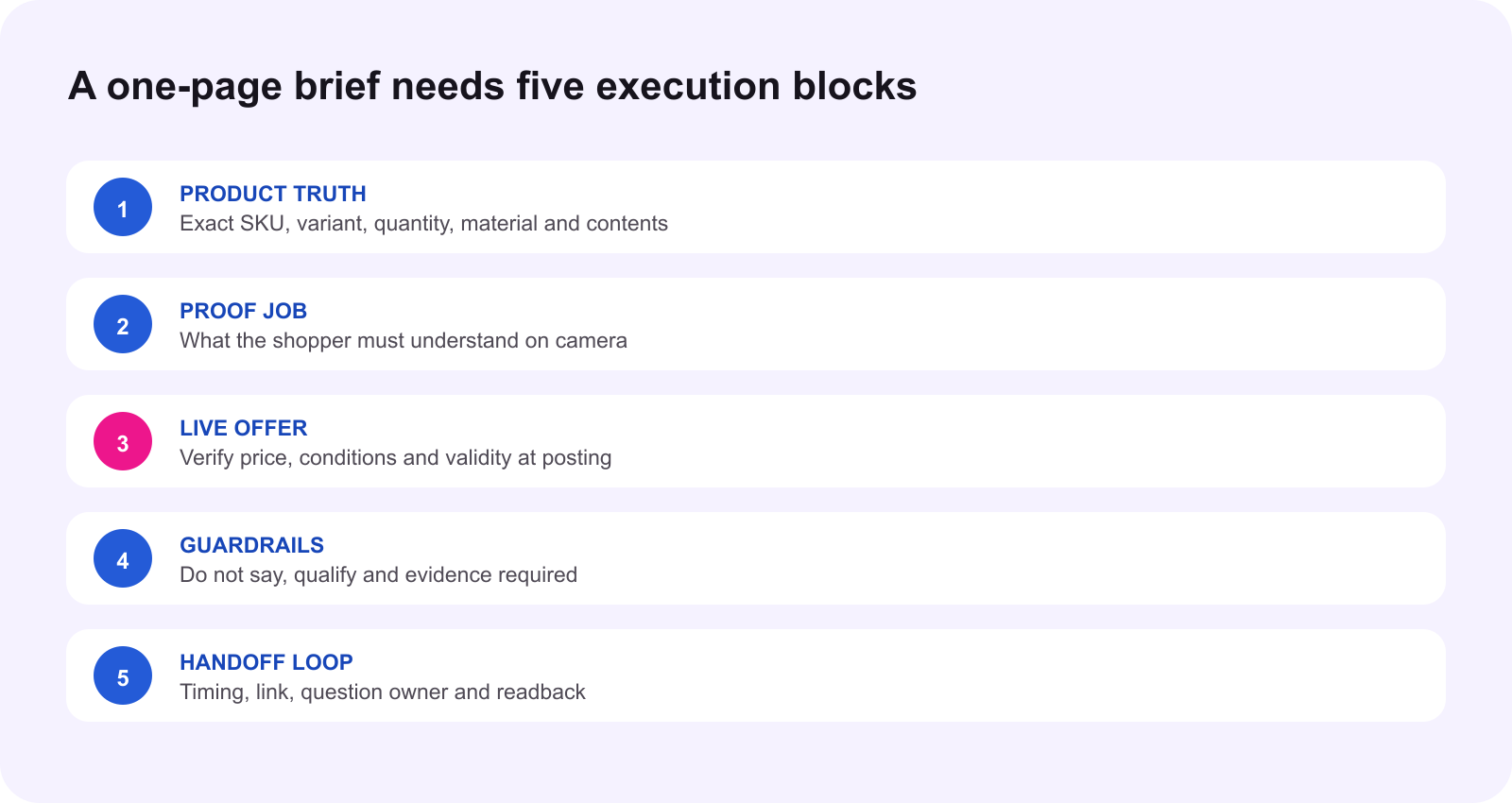
Start with the campaign job, not the slogan
Write one sentence that says what the content should help a shopper understand or decide. Examples include choosing the correct size, seeing what arrives in the box, understanding a setup step, comparing two approved variants or recognizing who the product is for. “Create an exciting BFCM video” is not an executable job. It does not tell the creator what proof the shopper needs.
Connect that job to one audience situation. Describe the buyer in behavioral terms, such as a renter who needs compact storage or a parent comparing pack sizes, rather than a vague demographic profile. Then name the visible proof: show the folded dimensions, count the included pieces, demonstrate the approved installation or compare the texture under normal lighting. One content asset can have more than one benefit, but it should have one primary proof job.
Do not turn the proof task into a performance promise. A demonstration shows what happened in a defined setup. It does not establish that everyone will obtain the same result. Record the product, variant, accessories, conditions and time used in the demonstration so the final edit can be checked against the exact SKU.
Block 1: freeze the product truth
The first section of the brief should identify the sellable unit: product name, PID or product link, SKU or variant, color, size, quantity, material, included accessories and current packaging. Add only the facts that matter for the content job. The creator must know whether the sample differs from the sellable unit and which differences cannot appear on camera.
The current Content Policy prohibits information that is false, misleading or inconsistent with the advertised product. It covers key attributes, models, product guarantees, warranties, delivery, logistics, returns and customer service. AI-generated demonstrations also cannot change scale, material, color, bundle quantity, lighting effect, movement, installation, surface compatibility, rated capacity or results. The brief should link each material fact to the product page or an evidence attachment.
For BFCM, confirm that the creator is linking the registered product and intended variation. The current campaign guide says variations cannot be changed after a product is registered during the campaign. If the sample, product page and registered variation do not match, do not ask the creator to explain around the conflict. Hold the asset until the correct unit and link are available.
Block 2: define the proof and creative freedom
Separate mandatory truth from creative preference. Mandatory items may include showing the exact product, demonstrating a specific step accurately, naming the correct pack count, using a required disclosure and attaching the correct product link. Creative preferences include the opening hook, room, transitions, music choice within available rights, edit pace and personal wording.
A creator should not receive a list of ten equal benefits. Prioritize two or three facts and identify the one fact the camera must prove. Give examples of acceptable proof, not a single shot-for-shot storyboard. If the creator discovers a clearer demonstration, the question should be whether it remains accurate and authorized, not whether it matches the brand team's favorite transition.
High-quality seasonal content still needs a recognizable creator. The Content Policy treats content that lacks meaningful presentation or product demonstration as low quality. A checkout recording or static graphic is not a substitute for useful product information. Ask the creator to explain, handle, use or compare the item in a way that resolves the defined buyer question.
Block 3: create a posting-time price gate
A BFCM brief should not turn a planned price into an unconditional promise. Prices may depend on coupons, selected SKUs, bundles, minimum spend, user eligibility, shipping, taxes, fees or the promotion period. The current price-and-discount guide says the safest reference is the price shown in the showcase when the creator binds the product, unless a lower price is supported by an active coupon, selected SKU or promotion and the key conditions are explained.
Use three fields: offer source, valid window and required qualifier. The offer source is the current product path or approved campaign record. The valid window is the period during which the claim can be published as active. The qualifier explains coupon clipping, selected variant, bundle, new-user status, minimum spend, availability or other conditions. Add a posting-time readback owner rather than asking the creator to rely on a screenshot from the briefing date.
Preheat is not activation. If a price, coupon or campaign is scheduled but not public, do not tell viewers they can obtain it now. Likewise, avoid unsupported absolute language such as “lowest price,” “cheapest” or “guaranteed.” If a video is expected to remain live after BFCM, consider a product-led version without a specific price, or establish an expiration cleanup plan before posting.
Block 4: show the boundaries in usable language
Do not paste an entire policy into the brief. Translate the relevant risk into three columns: approved wording, wording that requires a condition and wording that is not allowed. For a skincare product, the file might permit a texture demonstration and cosmetic appearance language, require a “results may vary” treatment only where the current rule supports it, and prohibit disease, medical or dramatic instant-result claims.
The BFCM creator guide calls out truthful product claims, medical and weight-management restrictions, minors, fundraising, off-platform redirection, sensitive topics, inappropriate content and unauthorized IP. It also says creators should use seller-provided information and focus on features and functionality instead of unrealistic promises. A brand should narrow the brief to the risks that actually apply to the SKU and planned scene.
Include rights boundaries. The creator should know which logos, character assets, brand images and music may be used. An available image file is not proof of commercial permission. The campaign guide warns against counterfeit goods, unauthorized logos or trademarks, unlicensed characters, music and other protected assets. Put approved assets in one controlled folder and label everything else unavailable.
Block 5: make the handoff executable
State the deliverable, posting window, required product visibility, link instructions, draft or review rule when applicable, and the owner who will answer questions. Separate factual corrections from optional creative feedback. A correction addresses the wrong SKU, unsupported claim, inaccurate price, missing condition, rights issue or broken link. A preference changes style without correcting a material risk.
Set response times. If a creator asks whether a claim or offer is approved, the answer must arrive while production can still change. Assign one source owner for product facts, one for live offers and one final release owner. If nobody owns an answer, the creator should omit the uncertain claim rather than improvise.
Record the final asset ID, linked product, posting date, offer readback, approval version and public URL. A draft approval is not proof that the posted video used the same file or product link. After posting, verify the public asset and capture any product-anchor, price or policy notice that changes the operating state.
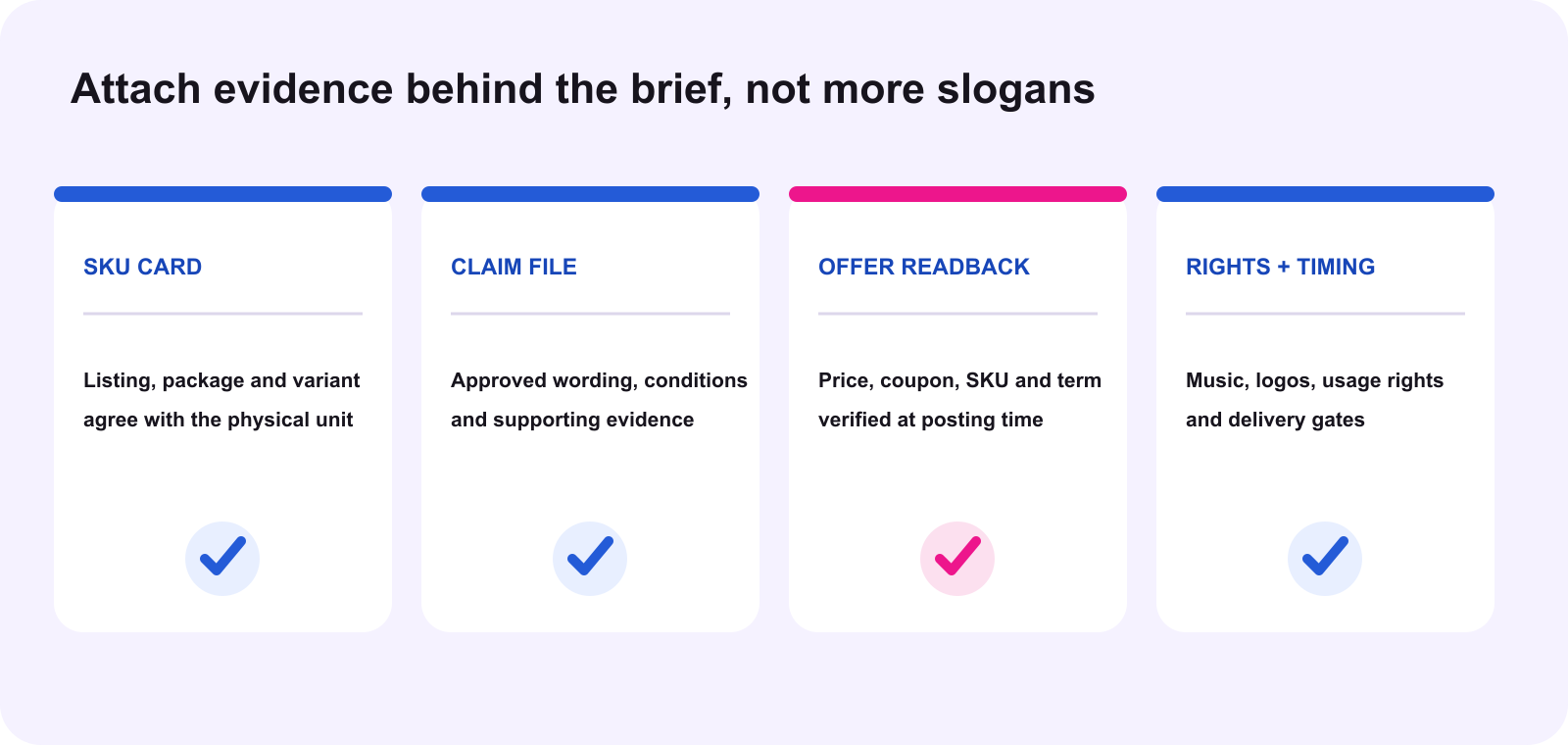
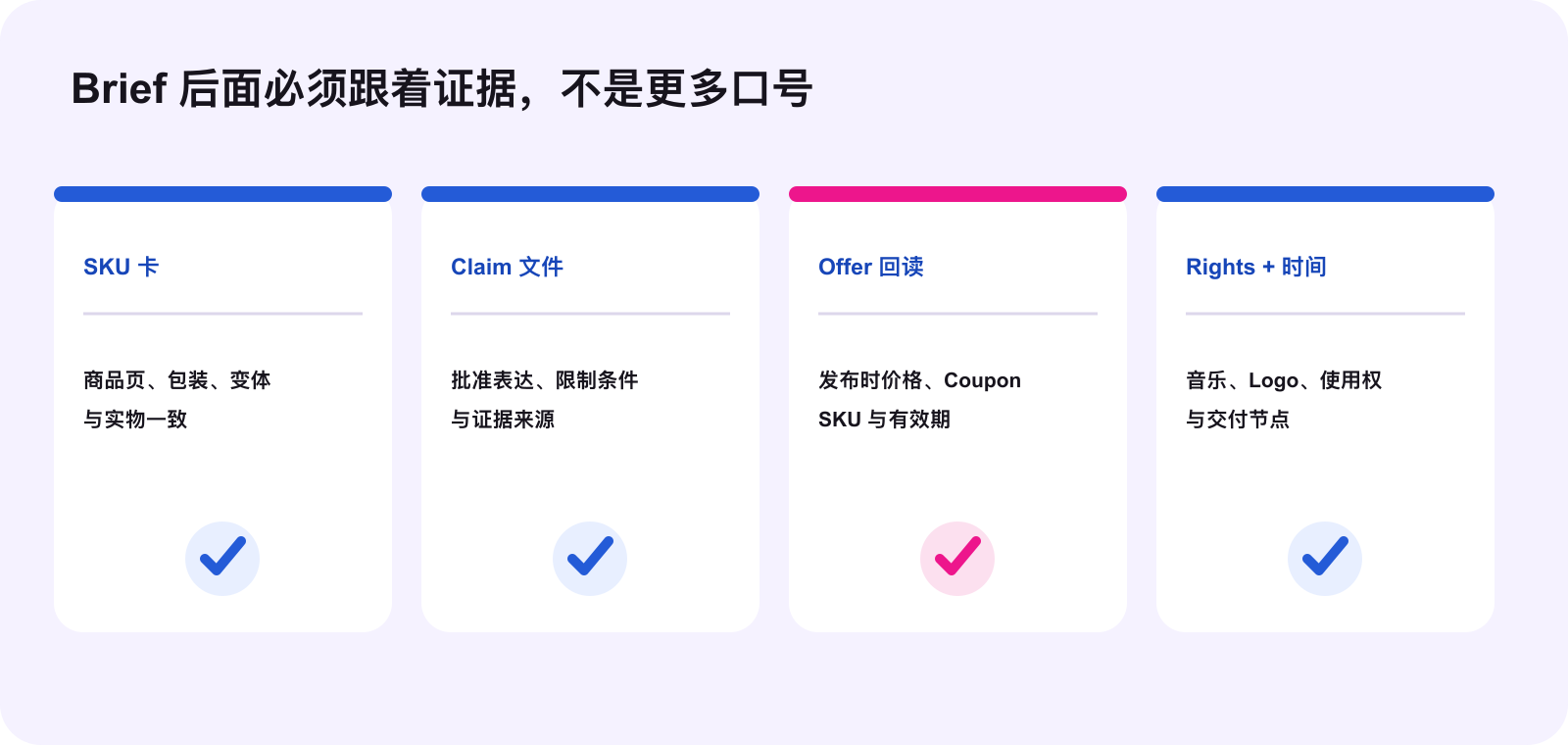
Attach four evidence packets
SKU card: current product page, variant map, package photo and sample-to-sellable-unit differences. Claim file: approved claims, supporting source, conditions and owner. Offer readback: posting-time showcase or product-path price, coupon, selected SKU, eligibility and validity. Rights and timing: approved logos, music route, usage-rights terms, delivery milestones and escalation contacts.
The brief remains one page because these packets hold the depth. Use links or IDs that point to a controlled version, not a folder of ambiguous drafts. Every packet needs a last-verified date and owner. When product packaging, a variant, claim, promotion or rights term changes, update the packet and issue a new brief version only to affected creators.
A BFCM creator workflow
Before sample shipment, confirm the creator-product fit, exact sample and sellable SKU. At receipt, ask the creator to report damage, mismatch or missing contents before filming. Before filming, close open product and claim questions. Before posting, verify the final product link, active offer and conditions. After posting, read back the public content, product anchor and current campaign or account notices.
During the campaign, monitor more than output count. The official guide explains that creator participation may depend on CHR, PPS and additional quality or compliance signals, and that performance is monitored. The brief cannot guarantee eligibility or prevent enforcement. It can reduce avoidable inconsistency and provide a cleaner record for correction.
When an offer expires, review every asset containing specific price or urgency language. The current price guide recommends updating, unlinking, removing or stopping promotion of outdated claims where possible. A reusable content system should tag price-sensitive assets at approval so the team can find them without searching the whole creator library after the campaign.
One-page template
| Section | What the brand supplies | Release check |
|---|---|---|
| Campaign job | One buyer decision and one audience situation | The job is observable on camera |
| Product truth | Exact SKU, variant, contents, material, compatibility and link | Sample, listing and sellable unit agree |
| Proof task | One visible demonstration plus two or three priority facts | Setup and result stay within evidence |
| Offer | Source, active window, conditions and fallback language | Posting-time readback is recorded |
| Guardrails | Approved, conditional and prohibited wording | Claim and rights owners have cleared it |
| Handoff | Deliverable, timing, link, rights, contacts and version | Public asset and product anchor are verified |
Operational example: a holiday kitchen bundle
Consider a hypothetical brand briefing creators for a BFCM kitchen-tool bundle. The sellable unit contains four tools, but an early sample contains three. The team does not tell creators to mention four while filming three. It waits for the correct sample or limits the shot to an accurate demonstration that does not misrepresent quantity, then records the final package before release.
The planned discount applies only to the bundle and requires an active coupon. The brief does not say everyone gets one universal price. It gives a release-day product-path check, the conditional sentence, and a no-specific-price fallback. The proof job is to show how the four tools store together. Claims about being the “best” or “cheapest” are excluded. This is a WEM operating example, not a claim about platform approval or performance.
The smallest useful action today
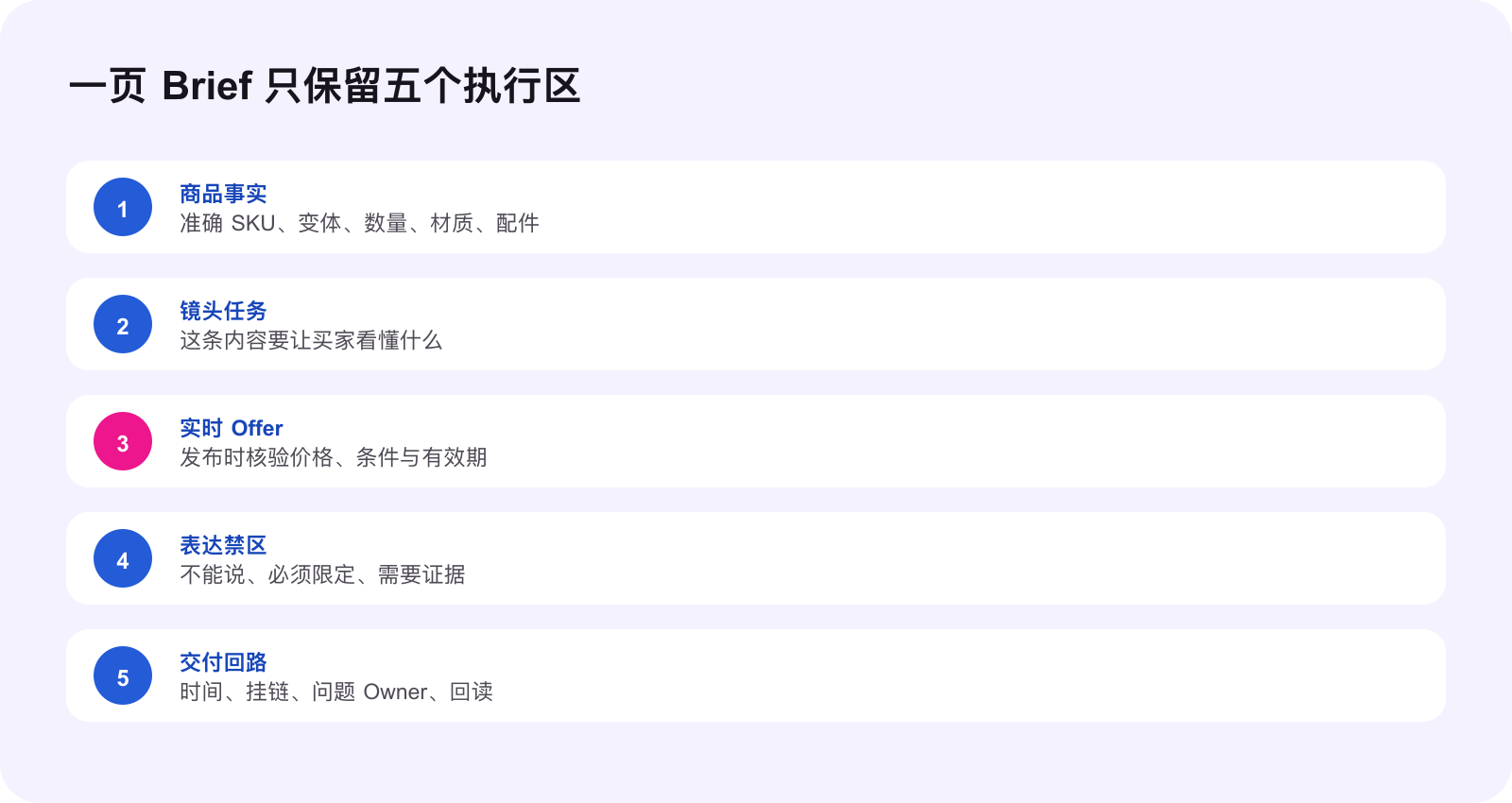
Choose one priority BFCM SKU and compress its current creator instructions into five blocks: product truth, proof job, live offer, guardrails and handoff. Delete any instruction that cannot be verified or acted on. Put the supporting product, claim, offer and rights records behind the page, assign owners, then test the brief with one person who did not write it. If they cannot identify the exact SKU, proof and posting-time check in two minutes, revise before sending it to creators.
Source notes and execution boundary
This original WE Marketing operating framework draws on the complete current TikTok Shop U.S. Seller University Content Policy, published September 25, 2026, the 2026 BFCM Creator Campaign Guide, published September 23, 2026, and the Price and Discount Content Claims Guide, published July 16, 2026. All three were revalidated October 9, 2026. Platform interfaces, campaign eligibility, scores, offers and enforcement can change. Verify the current creator tools, Seller Center, product path and applicable policies before execution. This brief system does not guarantee campaign eligibility, distribution, sales or absence of enforcement.
Common questions
What should a TikTok Shop BFCM creator brief include?
Include the exact SKU and variant, product truth, one visible proof task, approved claim boundaries, a live-offer verification rule, deliverables, timing, product-link instructions, rights terms and a named contact for questions.
Should a BFCM creator brief include a fixed promotional price?
Only when the price is active, verified and the conditions are clear. For content posted before activation or expected to remain live after the event, use a posting-time price check and conditional language instead of a stale universal price promise.
Should brands write the full creator script?
Usually no. Lock product facts, required disclosures, prohibited claims and operational handoffs. Give the creator freedom over the hook, phrasing and story structure unless exact approved wording is necessary.
Can a creator say lowest price or cheapest during BFCM?
The current Content Policy prohibits unsupported superlatives such as lowest or cheapest. A brief should use only supportable price language and direct the creator to verify the active product path.
What evidence should be attached to the brief?
Attach the current product page, SKU and packaging record, claim substantiation, approved visual examples, posting-time offer source, product link, rights terms and the escalation contact.
What should happen when an offer expires after a video is posted?
Review the content and product link. Where possible, update, unlink, remove or stop promoting outdated price or discount claims, following the current platform notice and available controls.