TIKTOK SHOP U.S. · CAMPAIGN OPERATIONS
Build a TikTok Shop AI Campaign Control Room Before the Sale Starts
WE Marketing Team · Sep 3, 2026 · 15 min read

Direct answer: AI surfaces work, the control room governs it
Build the campaign control room before anyone accepts an AI recommendation. The room should connect campaign eligibility, product readiness, contribution margin, inventory, approved content, compliance, customer service and recovery. TikTok Shop AI can shorten the path to a campaign page, alert or suggested action. It should not make the final decision on behalf of the brand about economic safety, demand capacity or the accuracy of the public promise.
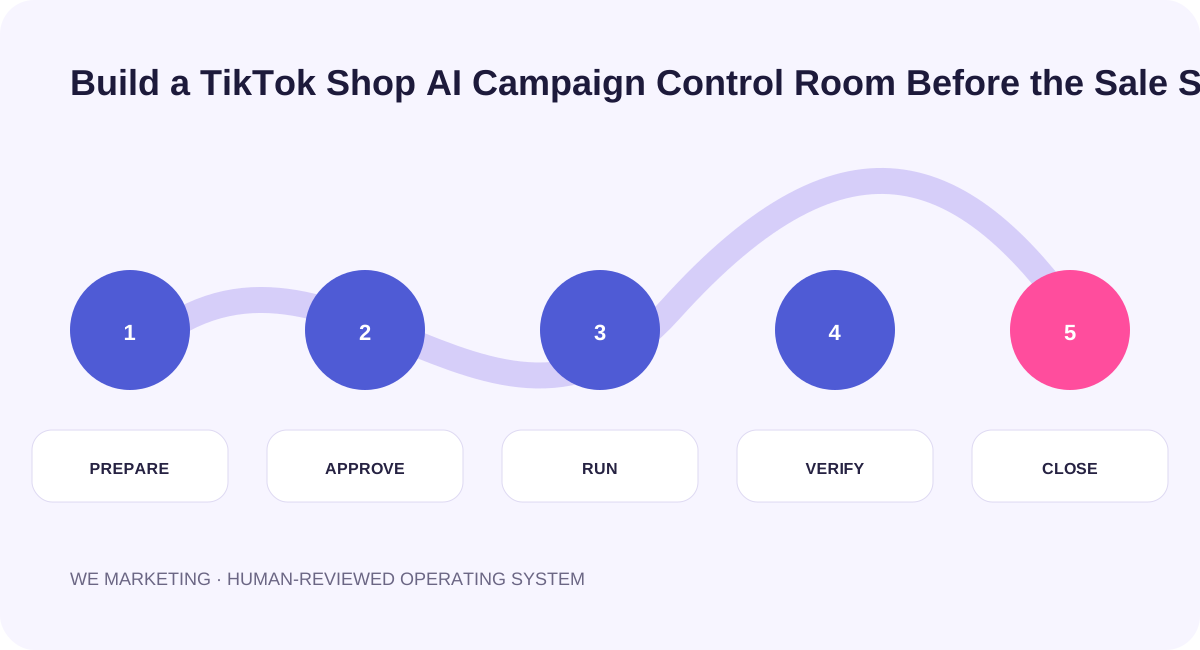
The release rule is simple: no recommendation becomes an action until one person attaches current evidence, names the consequence, chooses a guardrail and owns the live readback. This keeps AI in the role where it is most useful. It helps the team find and organize work while the brand retains control over money, product truth and customer impact.
What a campaign control room actually is
A control room is not a collection of screenshots and it is not another dashboard. It is a decision ledger. Each row names the campaign, product or issue; links the current native record; states whether the row is pending, blocked, approved, released or verified; and identifies the owner, allowed action, stop rule and readback time. A useful row can be understood by someone who was not in the meeting.
Separate system evidence from brand evidence. System evidence includes the campaign page, eligibility message, product status, violation notice, ticket and measured result. Brand evidence includes landed cost, seller-funded discount, creator commission, inventory buffer, replenishment lead time, approved claims and service capacity. The platform can surface the first family. The brand must supply and defend the second.
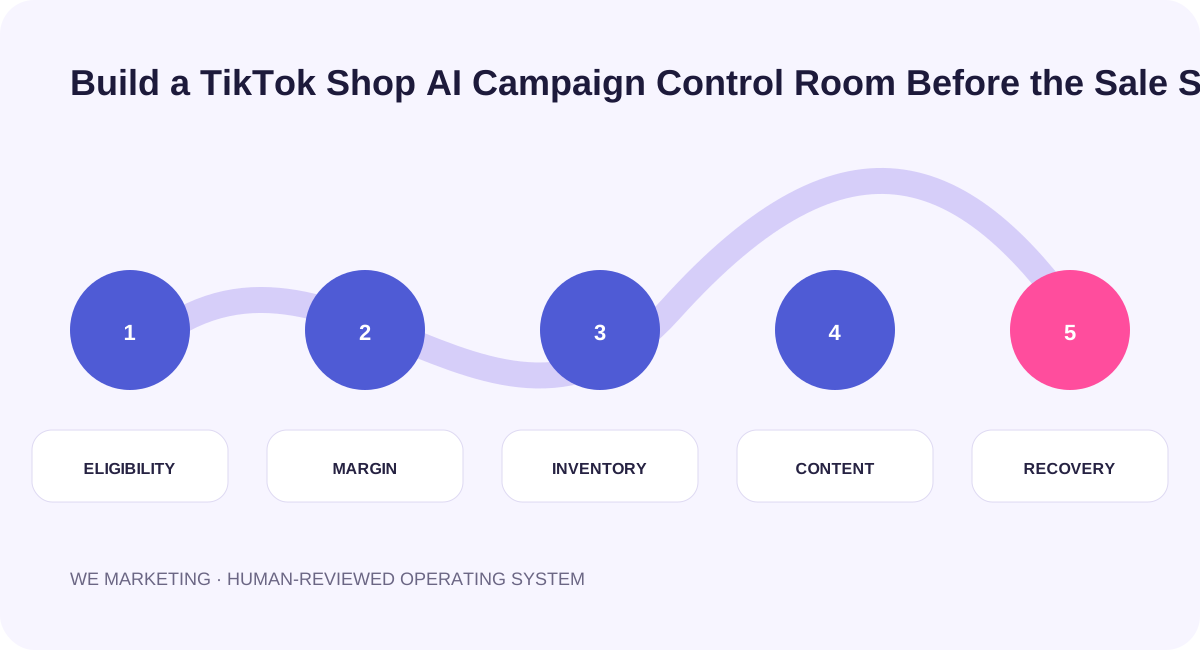
Gate 1: confirm eligibility before planning upside
Start with the exact campaign, market, shop, product and participation window. Open the current campaign page and read the qualification requirements and product state. Do not use an old email, another account or a remembered rule. If Seller Center says the shop or item is not eligible, record the exact reason and owner. Do not compensate by creating a duplicate product or repeatedly submitting an unchanged item.
Eligibility is a hard gate because every later forecast assumes the product can participate. An AI suggestion may be based on signals that are useful for discovery while still being unavailable to the exact account. The control room keeps the suggestion, but changes its state to investigation rather than approved execution. Availability, interface paths and campaign rules can change, so every approval needs a timestamp.
Gate 2: model contribution, not headline GMV
For every proposed product, calculate a downside, base and upside case after seller-funded discounts, creator commission, paid traffic, shipping support, pick and pack cost, expected cancellations, returns and customer-service exposure. Use the brand's current landed cost and contribution floor. If any figure is unavailable, label it unknown instead of entering zero. A product can be campaign-eligible and still be economically wrong for the sale.
The control room should show which lever can change and who may approve it. A margin owner may approve a smaller discount, a channel owner may constrain traffic and an inventory owner may limit units. AI can help locate a promotion or summarize performance, but it should not hide the fact that a growth recommendation crosses the brand's floor. Higher GMV is not a win when the event transfers too much value away from the business.
Gate 3: convert the demand plan into inventory stop rules
Use sellable, variant-level inventory rather than a total catalog number. Subtract reserved units, damaged stock, open customer replacements and any buffer required to protect normal operations. Add replenishment lead time and the point at which the campaign must pause. If the product has one fast-moving variation, the stop rule should protect that exact variation instead of waiting for the entire parent product to reach zero.
Write the response before demand arrives. The response may be to remove the product from the campaign, reduce traffic support, switch to an approved alternative or stop a creator push. It may not be to promise a substitute the shopper did not order. The inventory owner must be able to see the current state and execute the stop. An alert without authority is only notification noise.
Gate 4: freeze product truth and campaign copy
Match every campaign asset to the exact product, variation, quantity, price window and fulfillment promise. Check the product page, hero image, creator brief, paid creative, LIVE talking points and automated drafts against one approved facts record. Claims that require substantiation must link to the evidence and approved wording. A generated headline or summary remains a draft until the responsible reviewer accepts it.
This gate matters because campaign speed creates copy drift. One team changes the price, another updates the listing and a creator continues using an earlier brief. The control room stores the effective dates and version so the operator can see which promise is live. If content and product truth disagree, hold distribution and repair the earliest source. Do not try to solve a truth problem with a stronger call to action.
Gate 5: run the sale from exceptions, not excitement
During the campaign, watch only signals connected to a planned decision. Examples include eligibility changes, spend against guardrail, contribution, variant stock, conversion movement, cancellation rate, customer complaints, violations and open tickets. Every alert needs a threshold, owner and permitted response. The team should know which person can pause a product, traffic source or content asset without waiting for a large meeting.
Avoid reacting to one noisy metric by changing price, budget, creative and assortment together. If customer safety, compliance or inventory requires a larger correction, protect the business first and mark the period non-comparable. Otherwise, release one bounded change and keep the previous state. The goal is not to prevent all movement. It is to preserve enough control to understand the result.
Gate 6: close recovery as operating work
A campaign does not finish when the sale timer ends. Reconcile paid orders, cancellations, refunds, inventory, customer-service cases, compliance tickets and any content or product rollback. For each exception, record the exact terminal state. Submitted, uploaded and sent are intermediate states. Resolved means the intended live state is visible or the affected order and customer consequence are closed.
Recovery evidence should feed the next campaign. A repeated stock exception changes the inventory buffer. A repeated claim question changes the approved brief. A ticket that took two days to reach the right owner changes the escalation map. The control room becomes more useful when it captures these operational truths instead of preserving only the success slide.
When not to accept the AI recommendation
Do not accept when the recommendation cannot be matched to the exact campaign or product; when eligibility is stale or unknown; when margin, inventory or claim evidence is missing; when the proposed action changes several levers without a readback plan; or when the account interface does not expose the capability described. In these cases, keep the recommendation as a hypothesis and route the missing evidence to an owner.
Also decline recommendations that optimize a proxy against the real operating goal. More traffic can be wrong when the product page is confusing. A larger discount can be wrong when contribution is already below floor. A faster response can be wrong when it repeats an unsupported claim. Human review is not a ceremonial approval after the AI has decided. It is the point where business context changes the decision.
Hypothetical campaign example
A hypothetical beauty seller receives an AI recommendation to add three products to a sale. Product A has adequate margin but its fastest variation is below the inventory buffer. Product B has healthy stock, but the campaign image uses an unsupported comparative claim. Product C clears current eligibility, contribution, inventory and content review. The team does not accept all three because the suggestion appears in one card.
The control room releases Product C, assigns Product A to replenishment review and holds Product B for claim repair. During the sale, the operator watches Product C's stock and contribution against written thresholds. Afterward, the team reconciles orders, returns and service cases before calling the row verified. This is slower than one click and much faster than repairing avoidable failures across three products.
Smallest useful next action
Create six rows today: eligibility, economics, inventory, content, in-campaign control and recovery. Give each row one current source, one owner, one stop rule and one readback time. Put every AI recommendation into one of those rows before anyone acts. If a recommendation cannot survive that placement, it is not ready to become campaign work.
Source notes
This original WEM operating framework draws on complete current TikTok Shop U.S. Seller University material revalidated September 9, 2026: official source 1, official source 2. The official material establishes the current platform capabilities, eligibility, policy or measurement context used here. WEM adds the decision gates, ownership, economics, stop rules and readback discipline. Interface paths, availability, thresholds, attribution and policies can change. Verify the current U.S. Seller Center, the exact account state and qualified legal or compliance guidance where required before execution.
Frequently asked questions
When should we accept an AI campaign recommendation?
Only after it is matched to the exact campaign and product, current eligibility is confirmed, margin and inventory clear their guardrails, public copy is approved and one owner accepts the readback.
When should we reject or hold the recommendation?
Hold it when eligibility, product truth, cost, stock, claims or account availability is unknown, or when the proposed action cannot be isolated and safely stopped.
Can the control room be a dashboard?
A dashboard can supply evidence, but the control room must also record the decision, owner, allowed action, stop rule, live state and terminal reconciliation.
What should trigger an inventory pause?
Use a variant-level threshold based on sellable units, reservations, safety buffer and replenishment lead time. Set the threshold before demand arrives.
How do we avoid changing too many campaign levers?
Tie every alert to one planned decision. Change one controllable variable where practical and mark emergency multi-variable corrections as non-comparable.
When is a campaign row complete?
After the intended live state is verified and related orders, inventory, tickets and customer consequences are reconciled. Submission is not completion.