TIKTOK SHOP U.S. · AI ANALYTICS
Validate a TikTok Shop AI Report Before You Make a Growth Decision
WE Marketing Team · Aug 25, 2026 · 15 min read
Direct answer
Treat an AI report as a fast hypothesis and navigation layer, not as the business record. Validate the metric definition, date window, timezone, attribution logic, granularity, filters, exclusions, and data freshness before changing products, commission, promotion, creator strategy, or ad spend.
Seller Center AI tools can surface shop insights and answer questions using live account context. The usefulness of the answer still depends on the question and the underlying metric scope. A weekly GMV answer, for example, does not automatically state whether the value is paid or settled, which timezone was used, whether refunds are reflected, or which product and creator filters apply.
WEM treats AI report validation as an operating system, not a shortcut. The platform can accelerate navigation and pattern finding, but a seller still owns the commercial promise made to shoppers, creators, employees, and regulators. Any missing account fact remains unknown. It must not be converted into zero, approval, eligibility, or a public claim.
Define the decision before touching the tool
Start with one sentence: “We need to decide whether to keep, repair, expand, pause, or stop this specific object.” Name the object, owner, deadline, and evidence source. This keeps the work focused when Seller Center exposes several related cards, reports, tickets, products, or workflows at once.
Then separate four layers: the platform record, the AI or human interpretation, the proposed action, and the terminal result. Those layers often look adjacent in the interface but they are not interchangeable. A recommendation is not permission, a submission is not approval, and an activity count is not a business outcome.
The five-part WEM control gate
| Gate | Required question | Stop condition |
|---|---|---|
| Definition | What exactly does the metric count? | The label is accepted without a definition. |
| Window | Which dates, timezone, and refresh cutoff apply? | The period cannot be reproduced. |
| Scope | Which shop, product, creator, campaign, or channel is included? | The population is mixed. |
| Comparison | Can the answer be reconciled with a native report or export? | No second source exists. |
| Decision | What one action would change, and what evidence would reverse it? | The report leads to a broad batch change. |
Use the gate in order. Do not compensate for one missing layer by adding confidence to another. A clear recommendation with the wrong product ID is still wrong. Strong evidence submitted after a live deadline may still fail. A successful click without terminal readback remains an attempt.
Build an evidence packet that another operator can audit
The minimum packet contains the account and object identity, current status, relevant date window, source record, decisive screenshots or exports, proposed change, owner, and next readback. For a policy or claim decision, add the exact wording and supporting document. For an analytics decision, add metric definition, filter, timezone, granularity, and refresh time. For an AI-assisted action, add the permission boundary and the final live record.
Keep originals before editing. A team cannot defend an appeal, explain a change, or learn from a failed recommendation if the prior state disappeared. Store evidence with a stable name and date. If privacy or account restrictions apply, record where the evidence lives rather than copying sensitive data into an open document.
Run the operating sequence
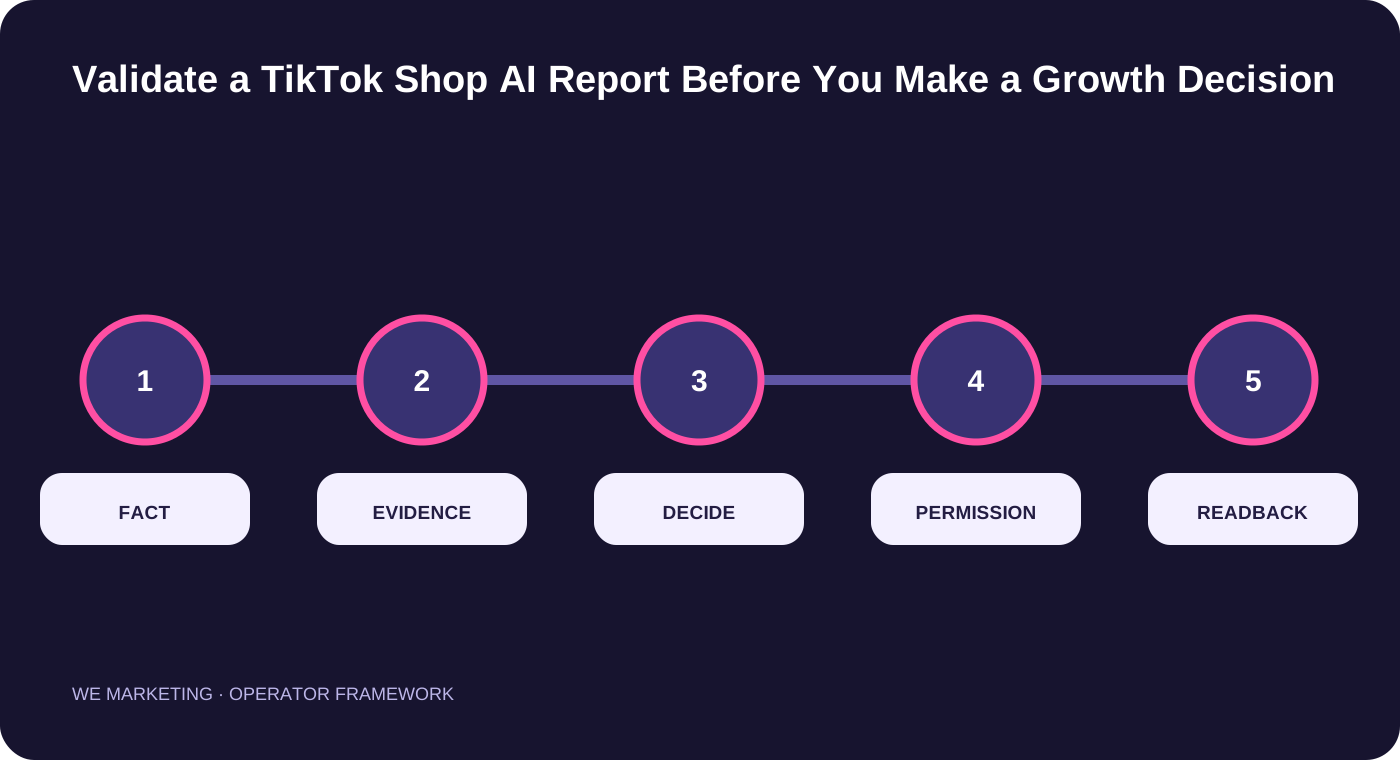
- 1. Write the decision before writing the prompt.
- 2. Ask for the metric, window, filters, and data freshness explicitly.
- 3. Open the native report that owns the metric.
- 4. Export or record the comparison at the same granularity.
- 5. Explain any difference instead of averaging it away.
- 6. Make one bounded decision and state the stop condition.
- 7. Schedule the next readback after the data can reasonably update.
Each step should leave a visible state. “Reviewed” needs a named reviewer and source. “Submitted” needs a receipt. “Live” needs the public or account-side record. “Resolved” needs a terminal status. This discipline matters most when several teams share product, compliance, affiliate, fulfillment, finance, and advertising responsibilities.
Separate reversible actions from high-consequence actions
Low-consequence actions include opening a report, drafting a checklist, comparing a record, or preparing a proposed change. Higher-consequence actions include changing price or commission, publishing a claim, editing fulfillment data, submitting a policy response, refunding an order, launching spend, or altering bank and business information. Require more explicit evidence and permission as consequence rises.
Batch actions require their own gate. A safe decision for one SKU, ticket, creator, or campaign does not automatically generalize. Test the smallest useful scope, observe the result, and expand only when the rule and exception path are stable. This is how speed becomes repeatable rather than merely fast.
Measure decision quality, not just activity
Track whether the team found the correct record, reproduced the source number or status, acted before the real deadline, avoided unnecessary scope, and closed with terminal evidence. Also track reversals, unresolved exceptions, and how often a recommendation changed after a native report or policy source was opened. Those are useful signals about the operating system.
Do not reward the team for generating more prompts, reports, edits, or submissions. Reward fewer unforced errors, faster exception ownership, clearer evidence, and a smaller gap between the proposed action and the verified result. A good system makes the next decision easier to explain.
Hypothetical operating example
This is a hypothetical example, not a WEM client result. An AI summary says affiliate GMV fell last week. The team first confirms Pacific Time, compares paid and settled order views, separates one out-of-stock hero SKU, and checks whether the prior week included a campaign spike. The diagnosis changes from “creator demand is falling” to “the hero product was unavailable for two high-converting videos.” The next action becomes inventory repair, not a catalog-wide commission increase.
The important outcome is not that the tool “worked.” The important outcome is that the team could reconstruct why it acted, which boundary it respected, and what live evidence proved the next state. If the evidence had disagreed, the same process would have stopped or reversed the action.
Weekly review questions
- Which decisions used a complete live record and which relied on an assumption?
- Which deadlines, filters, or eligibility rules changed during the week?
- Where did a generated explanation disagree with a native report or policy page?
- Which action lacked a named terminal readback?
- Which exception should become a new checklist item, permission boundary, or stop rule?
- What is the single smallest repair that reduces the most operating risk next week?
Keep the review bounded. The goal is not to rewrite every SOP. Choose one repeated error, add one control, assign one owner, and inspect the next occurrence.
Smallest useful next action
Choose one current AI report validation decision. Write the object, live status, source, exact proposed action, possible consequence, approving owner, and terminal readback in one row. If any field is unknown, resolve that field before expanding the scope. This one-row discipline is more valuable than a broad automation promise.
Source notes
This original WEM operating framework draws on complete current U.S. TikTok Shop Seller University materials revalidated on August 31, 2026: TikTok Shop Seller University source 5898943267702529, TikTok Shop Seller University source 5901602913519376, TikTok Shop Seller University source 1822229630584583. Platform interfaces, availability, eligibility, limits, metric definitions, enforcement records, and account-level actions can change. Verify the current U.S. Seller Center record and the brand's own facts before execution.
Frequently asked questions
Can the team rely on an AI or platform summary alone?
No. Use it to navigate and form a hypothesis, then check the native record, exact scope, and current source before acting.
What does a successful submission prove?
Only that a submission was accepted for processing. Read the live status or terminal record before calling the business outcome complete.
Should unknown data be treated as zero?
No. Unknown means the source was unavailable, not refreshed, or not in scope. Label it and resolve it before making a dependent decision.
When is a batch action appropriate?
Only after the rule has worked on a bounded scope, the exception path is known, and the owner can stop or reverse the action.
Who should own AI report validation?
One accountable operator should own the final decision, with product, policy, finance, fulfillment, or analytics reviewers added according to consequence.
How often should the framework be reviewed?
Review after every material exception and during the weekly operating cadence. Revalidate volatile platform paths and rules at execution time.