TikTok Shop Product Card Strategy: How U.S. Brands Turn Creator Demand Into Conversion
Product-card traffic is not a discount strategy
TikTok Shop Academy’s current U.S. guidance names competitive pricing, a deliberate promotion mix, and participation in platform campaigns as practical ways to improve product-card visibility. That is the platform layer. The operator layer is deciding which product can carry the offer, which promotion has one clear job, and whether the product card can convert the demand that creators, LIVEs, or ads create.
For a brand, the product card is where a shopper checks whether the content promise is real. They compare the item, price, shipping, delivery expectation, reviews, offer, and perceived risk in one decision. A strong creator video can start the consideration. It cannot make an unclear product card feel easy to buy.
- Choose one or a small number of hero SKUs before building a promotion calendar.
- Model landed margin before a creator push, ad test, or platform campaign adds demand.
- Treat item price and shipping as one shopper-facing price decision.
- Give each promotion layer a defined job instead of stacking discounts by habit.
- Use customer questions, returns, and creator feedback to improve the card each week.
This article uses TikTok Shop Academy’s April 1, 2026 U.S. guidance on product-card traffic as the source for current promotion mechanics. WEM’s operating framework connects those mechanics to cold start, creator content, and shop conversion. It is not a guarantee of visibility, sales, or campaign eligibility.
Start with a product that can carry the traffic
The first correction is usually product selection, not discount depth. When a new shop gives equal attention to every SKU, creators receive vague briefs, the promotion menu fills with competing offers, and the team cannot tell which product page actually deserves more traffic. A cold start needs a hero SKU: a product with a clear demonstration, a readable use case, stable inventory, and enough economics to support sampling, content, and a customer incentive when appropriate.
Before activation, write the full landed-margin model. TikTok Shop Academy describes disposable profit as selling price less product cost, total logistics cost, platform commission, and loss or damage. Its current ad guidance uses a 45% to 60% disposable-profit margin as a reference point and says sustained campaigns that perform well typically have a 10% to 30% ad-spend ratio. Those figures are planning references, not an instruction to spend or a promise that a product will work.
This is where WEM is hands-on. We help brands decide what the hero product should prove, build the creator brief around that proof, review the product-card experience, and make sure a launch offer does not undermine the SKU before it has a chance to learn.
Treat visible price and shipping as one decision
A shopper does not separate the item price from the price they expect to pay. TikTok Shop Academy specifically cautions sellers against a very low listed price paired with high shipping fees. That pattern may create an attractive first impression, but it damages the value proposition at checkout and can reduce trust.
The same is true of a misleading price. The Academy warns that inaccurate pricing can affect product, shop-health, or selling privileges. The practical lesson is simple: the product card should make the offer easier to understand, not easier to misunderstand.
For a launch, make the price architecture legible in one screen: the hero SKU, any qualifying quantity or spend threshold, the shipping condition, and the reason for the offer. If a creator is telling a specific product story, the card should preserve that exact story rather than redirecting the shopper into a general sale.
Build one job at each promotion layer
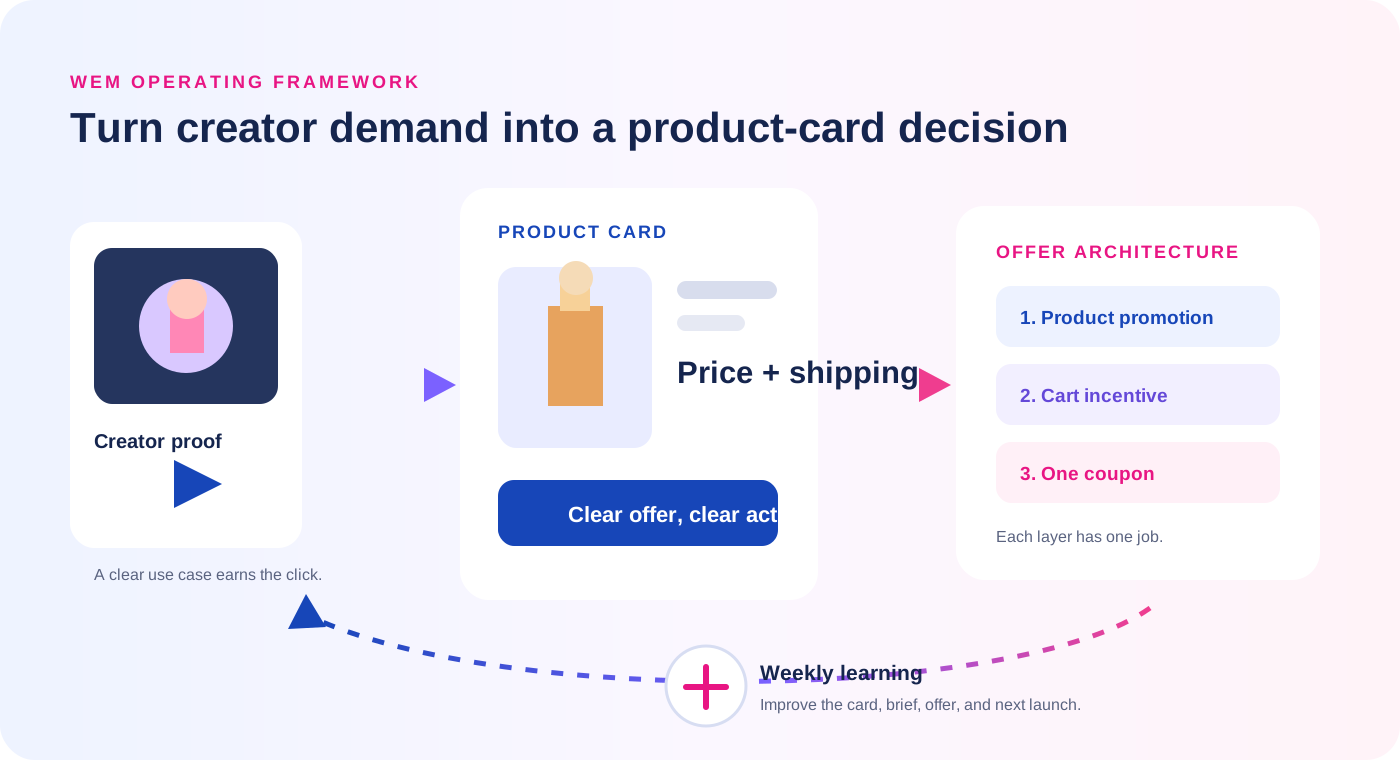
TikTok Shop’s promotion tools give brands several ways to create an incentive. The better question is not which tool is available. It is which tool solves the customer decision in front of the product card. A product-level price can create a simple entry point. A cart incentive can reward a larger order. A coupon can give a selected audience a final nudge. They should not all do the same job.
The Academy’s current stacking rules say a cart promotion can stack with the product-promotion layer, and one coupon can then stack with those layers. The minimum spend for a cart promotion is based on the product price after the first layer. Verify the live rules in Seller Center before launch, because platform mechanics can change.
For many brands, Gift with Purchase is worth considering when a low headline price would weaken the product’s positioning. A relevant mini size, accessory, or complementary item can create an incentive without teaching the market to wait for the deepest discount. That only works when the gift has a real product connection and fulfillment can handle it.
Use Flash Sale, Product Discount, BMSM, and GWP for different situations
Flash Sale is useful when the team needs urgency around a proven, well-stocked SKU and can protect the product’s floor price. TikTok Shop Academy states that a product with orders in the previous 30 days must use a Flash Sale price no higher than the lowest price paid by any buyer in the prior 30 days, excluding Flash Sale orders. A product with no order history needs a Flash Sale price below its regular retail price.
Product Discount is more appropriate when a brand wants a simpler item-level offer without the same urgency mechanics. The Academy says Product Discount can stack with Hero Product Boost, while Flash Sale cannot. It also says Flash Sale does not stack with Seller Discount or Hero Product Boost, but can stack with BMSM. The platform’s Promotion Simulator is the place to check the actual outcome before publishing an offer.
- Use Flash Sale when urgency is the point and the price history allows it.
- Use Product Discount for a clearer, steadier hero-SKU offer.
- Use BMSM when a meaningful cart threshold can improve the unit economics of the order.
- Use GWP when a relevant item adds value better than a further price cut.
- Use free shipping only when the economics, shipping promise, and customer expectation stay intact.
No promotion tool fixes an unclear product story. If creators need to explain three exceptions, the offer is probably too complicated for a short-form commerce environment.
Creators create demand. The product card has to convert it.
A creator’s job is not merely to drive a click. The right creator makes the product understandable to the right customer: what it does, who it is for, what result or experience is realistic, and why the hero SKU is worth considering now. When that content lands, the product card must repeat the essentials without forcing the shopper to reconstruct the promise.
This is why WEM treats creator operations and shop conversion as one system. Our active 8,000+ creator and affiliate community helps us recruit for product fit and activate quickly, but recruitment alone is not the service. We can support the brief, sample follow-up, content review, coaching calls, product-page feedback, and weekly learning loop that tells the next group of creators what customers actually needed to see.
For a new product launch, that continuity matters. A creator may uncover the angle that earns attention. The shop team needs to check whether product questions, variant confusion, price objections, or shipping friction are stopping the order. Then the next brief and the next card update should answer the evidence, not just repeat the first concept.
A 30-day product-card traffic plan
- Week 1: Select one hero SKU. Audit landed margin, visible price, shipping, inventory, product-card clarity, reviews, and the single proof point a creator needs to demonstrate.
- Week 2: Build one offer. Choose a product promotion and only add a cart incentive or coupon if it has a separate job. Test it in Promotion Simulator before content goes live.
- Week 3: Activate demand. Recruit creators whose audience and format can demonstrate the actual product use case. Review content for claim clarity, product-card alignment, and customer objections.
- Week 4: Review the whole path. Compare creator angles, product-card visits, conversion, order value, shipping questions, return reasons, and offer performance. Keep the learning, not every discount.
The first month is not about running every promotion type. It is about proving that one product, one story, one offer, and one fulfillment promise can work together before the brand scales the number of creators or campaigns.
Where WEM fits
WE Marketing (WEM) is an official TikTok Shop Partner agency and a full-service management partner for U.S. brands. We are built for the stage where a brand needs more than a large agency deck and more than a standalone creator list: a capable, responsive operating team that can turn a product launch into a connected shop, creator, content, offer, and weekly-review system.
Brands tend to get the most value from WEM when they are entering TikTok Shop, launching a new hero SKU, rebuilding an affiliate program, or seeing creator traffic that the product card is not yet converting. We bring creator recruitment and brand-owned community building, content coaching, shop and offer coordination, and direct operator access into one working rhythm.
The goal is not to make every product cheaper. It is to make the product-card decision clearer, give creators a story they can demonstrate honestly, and build a launch system that can learn before the brand spends harder.
Talk through your TikTok Shop product-card strategy with WEM →Sources and boundaries
Primary source: TikTok Shop Academy, “How to Drive Traffic for Your Product Card,” dated April 1, 2026 and applicable to the United States. The source was reviewed directly on July 20, 2026.
Current promotion mechanics, stacking descriptions, pricing cautions, and the stated margin and ad-spend references are attributed to that Academy page. WEM’s hero-SKU process, creator-to-card workflow, offer architecture, and 30-day plan are operating frameworks, not TikTok Shop policy or a performance promise. Sellers should confirm live eligibility, price requirements, and stacking behavior in Seller Center before execution.
Read the official TikTok Shop Academy source