TIKTOK SHOP U.S. · AFFILIATE PORTFOLIO
Which Products Actually Belong in TikTok Shop Open Collaboration?
WE Marketing Team · Aug 15, 2026 · 15 min read
Direct answer: put products into Open Collaboration only when the product can survive broad creator discovery
Open Collaboration is useful for making selected affiliate products discoverable to a wider creator pool. It is not a reason to expose every listing. A product belongs there when the brand can state the buyer job, show honest proof, keep the linked variation sellable, support the delivery promise, fund the commission and sample path, and handle creator interest without losing control of claims or stock. If any of those conditions is unknown, the next move is preparation, not wider availability.
WEM treats Open Collaboration as a governed discovery layer. It can reveal which products creators add to Showcase, which products receive content, and which creator-product matches deserve a closer operating relationship. It is not the core growth motion by itself. For a priority SKU with a specific creator fit and a reason to invest in follow-through, Target Collaboration remains the more deliberate path. The two can coexist, but the team must know why one product is open, who owns it, and what evidence would cause it to be revised or removed.
Open Collaboration should widen a proven, supportable offer. It should not broadcast an unresolved product problem.
What “belongs” means in practice
An affiliate-ready product is eligible under the live platform rules and operationally ready for a creator to represent. A portfolio-ready product also has a defined role in the brand's current growth plan. It may be a discovery entry point, a hero demonstration SKU, a basket builder, or a controlled learning candidate. The distinction matters. Technical enrollment can make a product visible. It does not make the product easy to explain, safe to sample, profitable to commission, or helpful to a real creator relationship.
Current TikTok Shop U.S. material describes Open Collaboration as making qualified products visible to affiliate creators, with account controls that may include approval. The live policy says shop and product qualification are separate: current shop and product health, customer experience, authenticity, intellectual-property, fair-trading, and review signals can affect access. These conditions are volatile and account-specific. Confirm the current U.S. Seller Center status before adding, auto-adding, sampling, or removing any product.
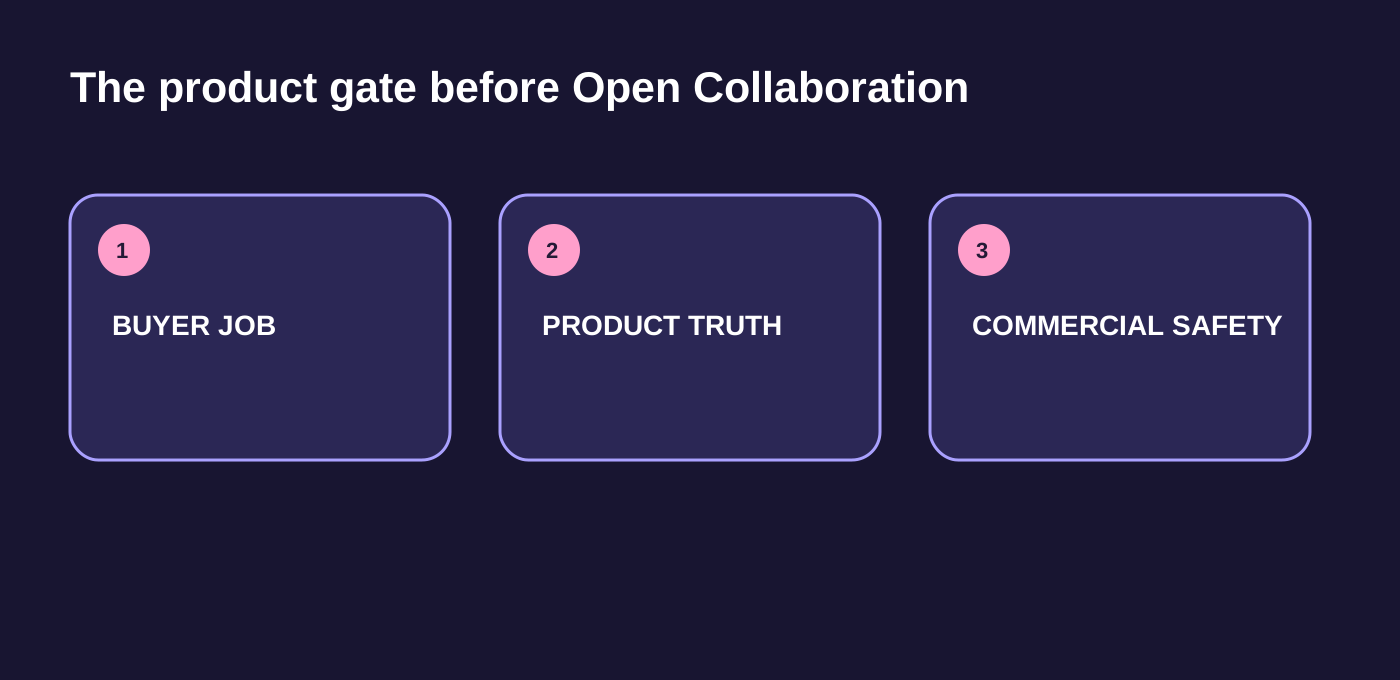
The WEM open-collaboration product gate
| Gate | What the owner must confirm | Decision if incomplete |
|---|---|---|
| Buyer job | One clear reason a shopper would choose this product now. | Do not list it as an open opportunity. |
| Product truth | Accurate facts, usable images, variation choice, approved claim boundaries, and a linked product card that finishes the video promise. | Repair the listing and brief first. |
| Commercial safety | Current price, commission, sample cost, refund exposure, and contribution floor have one commercial owner. | Do not let a suggested rate substitute for a decision. |
| Supply and service | Sellable stock, realistic fulfillment expectation, sample capacity, and a repeatable answer to likely questions. | Pause demand until the promise is supportable. |
| Creator fit | A plausible content use case and a way to review creator applications or resulting content. | Keep the SKU in a controlled test, not broad expansion. |
| Readback | A weekly owner can inspect Showcase adds, posted content, questions, stock, and economics together. | Do not auto-add by default. |
This is a WEM operating gate, not a TikTok Shop eligibility score. It deliberately adds commercial and service accountability around the platform controls. The goal is not to make the open portfolio tiny forever. It is to make every addition interpretable. When a product performs poorly, the team should be able to distinguish weak creator fit from a product-page issue, a stock exception, a misleading promise, or a commission decision.
Choose roles, not a catalog dump
Start with one to three hero SKUs, then give every product a job. An entry SKU earns discovery because it is understandable and easy to demonstrate. A hero SKU carries the strongest buyer proof. A basket builder should make the next purchase choice simpler, not create a maze of near-identical options. A learning candidate may be exposed to a limited set of creators only when its inventory, sample budget, and feedback loop are explicitly owned. Everything else can remain listed in the shop without becoming a default creator opportunity.
This is especially important for brands with many variants or a wide catalog. More available products can create more choice for creators, but it can also distribute attention, confuse the brief, and complicate stock and support. WEM does not use an open plan to ask creators to discover the brand strategy for us. The product owner decides the small active portfolio, the creator operator provides a truthful product story and reference material, and the commercial owner defines the conditions under which the product stays active.
Open and Target have different jobs
Use Open Collaboration to learn where broader creator availability is justified. Use Target Collaboration when the brand has selected creators, a selected product, and a reason to make a more specific invitation. Current TikTok Shop guidance says a product can be in multiple collaborations, but Target commission takes priority over Open commission. Do not treat that rule as a pricing trick. It means the commission map must be reviewed before the same SKU is opened broadly and invited selectively. A creator should not discover a different commercial promise after agreeing to make content.
For a targeted lane, the brief should identify the SKU, content job, factual proof, permitted claim range, sample route, deadline, and escalation owner. For the open lane, define the application or approval approach, the creator signals to review, the sample rules, the listing facts, and the stop rule. If the team cannot describe the difference, it is not running a portfolio. It is leaving the same product exposed through two channels without governance.
Commission and sample settings are relationship decisions
Commission is not just an acquisition input. It tells creators what the brand expects to exchange for their work and promotion. Current U.S. Academy material says Open Collaboration rate edits have timing and protection rules, and creators already promoting an affected product can be treated differently from new creators. The current interface also surfaces status and commission history. Before any change, the commercial owner should check the active rate, creator exposure, effective period, and whether the business is changing standard or Shop Ads commission. Do not promise a rate, then use a batch edit as though there were no creator relationship consequence.
Samples need the same discipline. A free sample can be a useful invitation to learn, but it consumes product, fulfillment capacity, and review time. Set a sample quantity, request period, and eligibility rules that the team can actually support. For sensitive, expensive, low-stock, complex, or claim-dependent products, manual review and a tighter creator set may be safer than automatic scale. The correct setting is account- and product-specific, so verify the currently available option and its result in Seller Center.
A seven-day operating sequence
- Monday, product owner: confirm the active SKU list, stock, variation, listing facts, and top customer questions.
- Tuesday, commercial owner: confirm commission, sample capacity, contribution boundary, and any price or promotion change.
- Wednesday, creator operator: review applications or creator evidence against category fit, demonstration ability, audience relevance, and brand-safety boundaries.
- Thursday, content owner: give the active SKU a simple reference video, product truth, required disclosure boundary, and linked-item check.
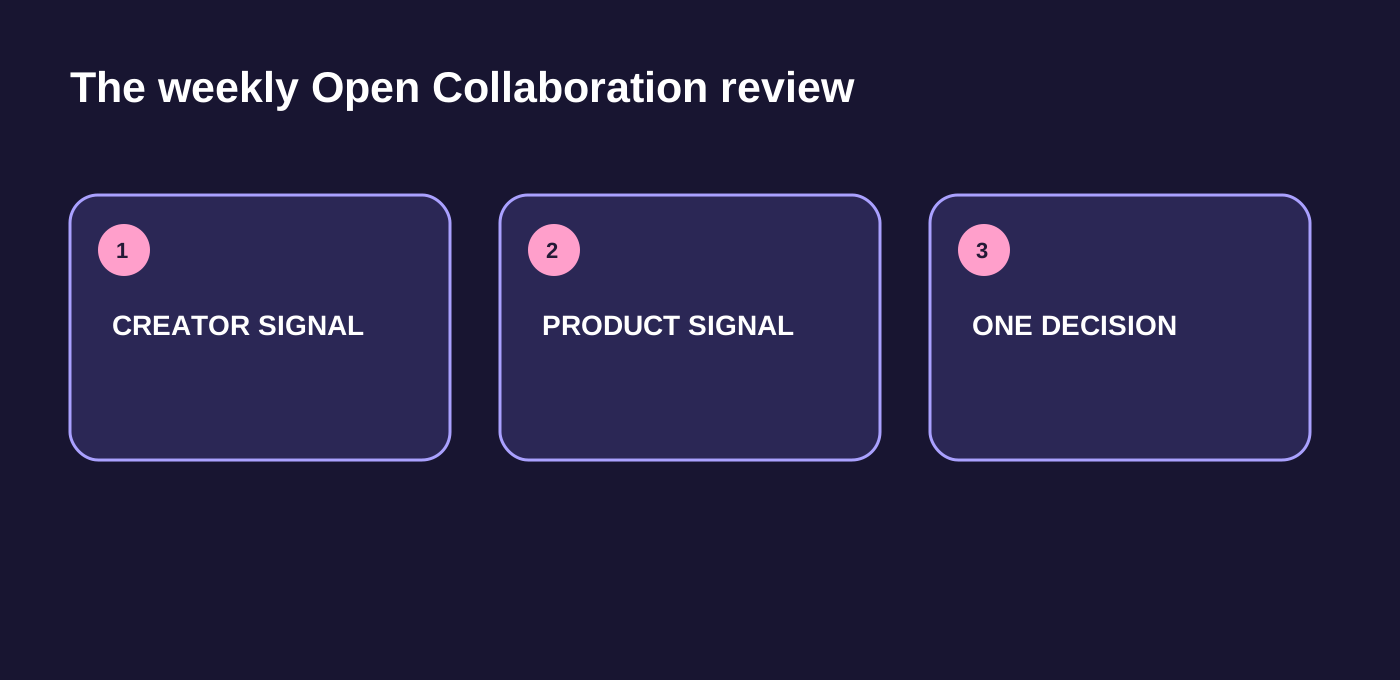
- Friday, review owner: read Showcase adds, posted content, recurring questions, stock, service signals, and economics together.
- Decision: keep, move to Target, repair, narrow, or remove. Record the reason and owner.
Do not rank the week by views alone. First ask whether creators accepted or added the right product and whether the content can carry a truthful buyer path. Then read product interest, orders, questions, returns, stock, and margin with the account's current reporting definitions and data freshness. Platform metrics can be delayed or scoped differently by feature. A dashboard is evidence input, not the decision itself.
Hypothetical example: a bundle is not automatically an open-collaboration product
This is a hypothetical operational example, not a WEM client result. A beauty brand has a three-item routine bundle, a hero cleanser, and several refills. The team considers auto-adding every listing. The bundle has unclear variation names, the refill is often low in stock, and the routine requires claims that have not been approved for creator use. The team keeps the broad plan to one well-stocked cleanser with a clear demonstration and product page. It uses a reviewed sample lane, collects the questions creators and shoppers raise, and sends a Target invitation only when a selected creator can explain the routine accurately. That is slower than a catalog dump, but it creates a signal the brand can use.
Smallest useful next action
Pick the next three products proposed for Open Collaboration. Give each one a single-page row: buyer job, link and variation, product truth owner, current stock, commission and sample boundary, creator fit, likely question, approval rule, and weekly readback date. If a row is incomplete, do not auto-add that product. Repair the missing condition or keep it out of the active affiliate portfolio.
Source notes
Primary material read in full on August 15, 2026: TikTok Shop U.S. Seller University, Setting Up Affiliate Collaborations (July 16, 2026), Affiliate Marketing Policy (July 31, 2026), and How Standard Affiliate Commission Works (June 3, 2026). Platform eligibility, controls, thresholds, commission timing, account paths, and feature availability can change. Confirm the current U.S. Seller Center for the applicable shop and product before acting.
Frequently asked questions
Should every TikTok Shop product be in Open Collaboration?
No. Use it for products that are eligible and ready to be broadly represented, with a named product, commercial, supply, and review owner.
Is Open Collaboration better than Target Collaboration?
They solve different jobs. Open creates broader discovery; Target is for selected creators and selected products. Use both only with an explicit commission and ownership map.
Can we rely on TikTok Shop suggested commission?
It can be an input, not a substitute for margin, sample, creator-relationship, and effective-date review.
What makes a product unsafe to open broadly?
Unclear facts, weak product-page handoff, unstable stock, unsupported claims, unresolved service questions, or an unowned commercial decision.
How should a brand review Open Collaboration?
Read creator adds and content alongside product questions, stock, customer experience, returns, and economics. End with keep, repair, narrow, remove, or move-to-Target.
Can a product be removed later?
Current controls allow removal, but review active creator exposure and commission history before changing a product. Confirm the current account interface and effective period.