WE Marketing · TikTok Shop U.S. · Health & Wellness
TikTok Shop Health & Wellness Cold Start: Build Trust Before You Scale
By the WE Marketing Team · Published July 26, 2026
A Health & Wellness cold start should establish trust before scale
A Health & Wellness cold start usually breaks before the ad campaign begins. The product may be attractive, but the team has not yet aligned category eligibility, evidence, claims, creator guidance, the product page, customer support, and inventory around one credible purchase path.
The better first move is concentration. Choose one to three Hero SKUs, confirm what can be sold and said, recruit creators who can explain the product responsibly, and use the first content batch to learn where trust or conversion is being lost. Paid support should amplify a working path, not hide an unresolved one.
TikTok for Business describes credibility, empathy, education, and compliance as central to Health & Wellness marketing. For a TikTok Shop brand, that principle has an operational consequence: the listing, creator brief, content, reviews, fulfillment, and paid media need to tell the same accurate story.
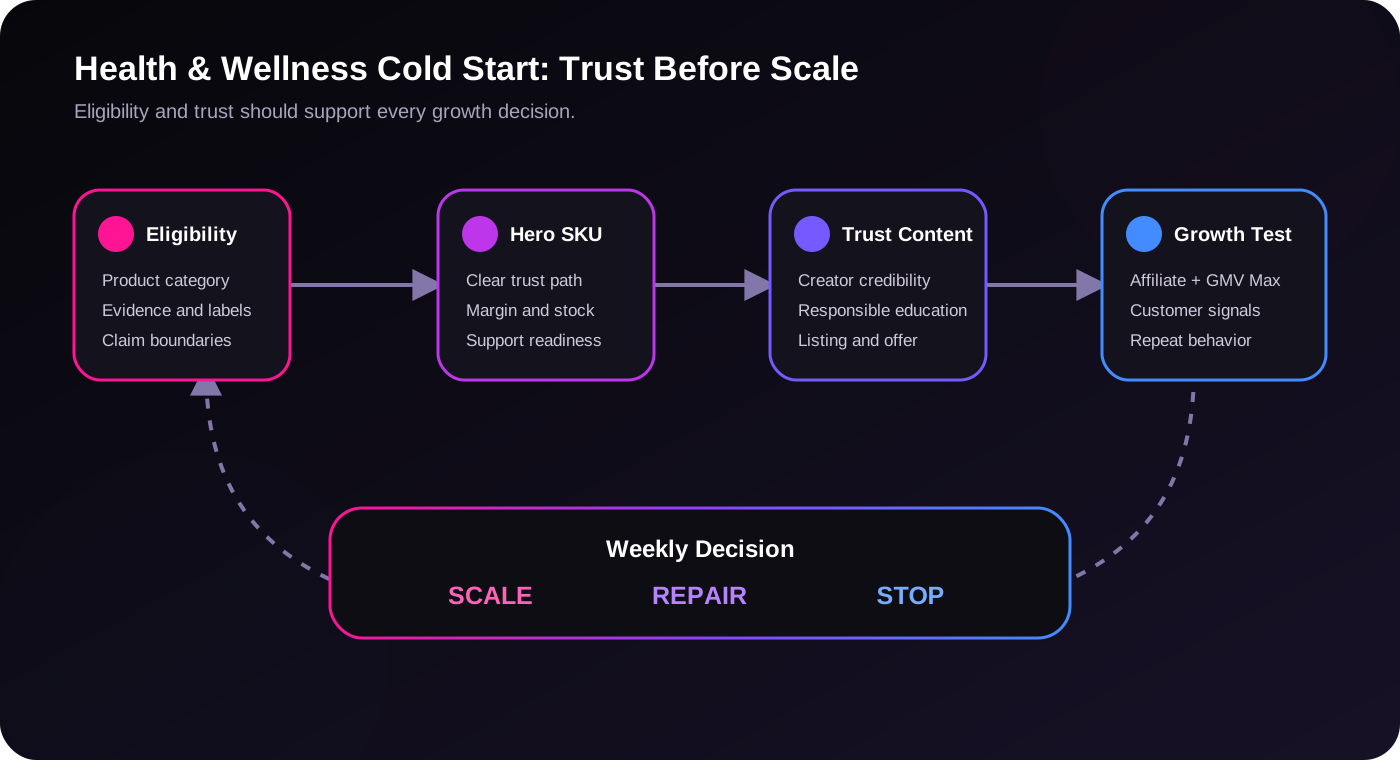
Health & Wellness cold starts are trust systems
Health & Wellness is a broad commercial category, not one content format. Supplements, fitness accessories, personal wellness products, apps, and services create different eligibility, evidence, privacy, and purchase questions.
| Product or service type | What the customer needs to trust | Useful proof format |
|---|---|---|
| Dietary supplement | Product identity, ingredients, directions, label accuracy, sourcing, testing, and realistic expectations | Label walkthrough, routine placement, product origin, responsible ingredient education |
| Fitness or recovery accessory | How it is used, physical fit, comfort, care, limitations, and who it may suit | Real demonstration, setup, fit, range of motion, cleaning and storage |
| Personal wellness product | Intended use, material, privacy, safety, care, and discreet fulfillment | Clear product demo, packaging, instructions, care and customer-experience detail |
| Wellness app or service | What the service does, who provides it, credentials, data handling, and the next step | Product tour, expert explanation, day-in-the-life context, transparent lead flow |
| OTC or health-related product | Exact classification, approved use, label, warnings, eligibility, and market restrictions | Label-consistent explanation and an approved product experience |
A video can receive attention because the topic is emotional or familiar. That does not mean the viewer trusts the product. In this category, a strong hook without accurate context can increase the gap between reach and purchase intent.
Confirm eligibility before recruiting creators
Health & Wellness brands should not treat product approval as a final listing task. It belongs at the beginning of the cold start because it changes the offer, content brief, creator pool, paid-media options, and launch timing.
TikTok Shop's current U.S. Restricted Products Policy says some categories require category-level, product-level, or invite-only qualification. Dietary supplements, certain over-the-counter products, health monitors, high-risk medical devices, and sexual wellness products can fall into restricted or invite-only paths. Separate policies may require current documents, invoices, lab reports, labels, or other qualification evidence.
The practical launch gate is simple:
- Confirm the product category and current TikTok Shop eligibility path.
- Match the legal entity, manufacturer, importer, reseller, invoices, testing, labels, and listing details.
- Identify prohibited products, ingredients, positioning, and claims before content production.
- Separate Shop listing eligibility from advertising eligibility. Approval on one surface does not automatically establish approval on every other surface.
- Keep a current evidence folder that the shop, creator, customer-support, and paid-media teams can use.
This article is operating guidance, not legal, medical, or regulatory advice. The brand remains responsible for current laws, product classification, documentation, labels, claims, privacy, and platform policies.
Select one to three Hero SKUs with a clear trust path
The best Health & Wellness Hero SKU is not simply the product with the strongest margin or the biggest claim. It is the product the team can explain accurately, demonstrate responsibly, support with evidence, fulfill reliably, and sell with sustainable economics.
| Hero SKU question | What a launch-ready answer looks like |
|---|---|
| Can a creator understand it? | The intended use, audience, routine, directions, and limitations are clear without a long medical script |
| Can the product be shown responsibly? | Demonstration does not depend on prohibited claims, misleading outcomes, or unsupported before-and-after content |
| Can the listing resolve doubt? | Identity, ingredients or materials, quantity, directions, warnings, shipping, returns, and support are accurate |
| Can the economics carry learning? | Margin can support samples, creator commission, shipping, customer care, refunds, offers, and controlled paid testing |
| Can operations support demand? | Inventory, replenishment, expiration handling, lot or batch records where relevant, and fulfillment are ready |
Start with the SKU that gives the team the clearest path to trust and useful learning. Expand only after the brand understands which audience, creator, explanation, offer, and conversion path are working.
Choose creators for credibility and explanation ability
Follower count is not the first creator decision in a trust-heavy category. A creator needs a believable reason to use or discuss the product, an audience that recognizes the use case, and the ability to explain without turning a personal story into a universal outcome.
WE Marketing evaluates four dimensions:
- Product affinity: Would this creator realistically use the product or include it in an existing routine?
- Audience relevance: Does the audience match the product's intended use, price, routine, lifestyle, and eligibility boundaries?
- Explanation ability: Can the creator make a complex product understandable without exaggerating it?
- Working reliability: Can the creator follow the brief, disclose the relationship, use the correct listing, respect claim boundaries, and communicate when facts need review?
Licensed professionals can add expertise when their credentials and role are relevant, verified, and clearly disclosed. They should not be used as decoration or as a shortcut around product evidence. A commerce creator without a professional credential can still be valuable when the content job is a real routine, setup, demonstration, packaging explanation, or customer question.
Give every video one responsible content job
The first content batch should answer different trust and purchase questions. Ten generic testimonials do not create ten independent learnings.
| Content job | Customer question | Useful execution |
|---|---|---|
| Product identity | What exactly is this? | Show the product, label, quantity, form, materials, and intended use |
| Routine fit | Where does it belong in real life? | Demonstrate timing, setup, directions, storage, or care |
| Education | What should I understand before buying? | Explain one concept in plain language with an appropriate source |
| Product distinction | Why this format or product? | Compare format, convenience, use case, packaging, or routine without attacking competitors |
| Objection handling | What could stop the purchase? | Address taste, size, texture, setup, privacy, learning curve, shipping, or support |
| Trust and origin | Is this brand legitimate? | Show manufacturing or testing context, expert review, founder reasoning, packaging, or customer support |
| Offer clarity | What will arrive and what does it cost? | Explain bundle contents, subscription or replenishment terms, gifts, shipping, and current validity |
Myth-busting can work, but it carries a higher evidence burden. The goal is not to create a stronger claim by calling another view a myth. The goal is to clarify one question accurately, cite the appropriate source, and tell the viewer what the product can and cannot do.
Build a claims-aware creator brief
A Health & Wellness brief should be easier to use than a product manual but more disciplined than a list of hooks.
The brief should include:
- the intended user and normal use context;
- approved product identity, directions, ingredients or materials, and relevant warnings;
- the claims and wording creators may use;
- prohibited or unsupported claims and sensitive angles;
- relationship and credential disclosure requirements;
- two or three content jobs with a strong reference example;
- the correct product link, offer, shipping detail, and customer-support path;
- a named review contact for questions before publication.
Do not force a pure-commission creator to memorize a long compliance document. Translate the important boundaries into short, usable guidance, then review higher-risk content before it goes live.
Make the product page carry its share of trust
Creator content opens the purchase question. The product page has to finish it.
| Listing layer | What it should resolve |
|---|---|
| Product identity | Exact category, form, variant, quantity, intended use, and who should not use it where applicable |
| Evidence and labels | Ingredients or materials, directions, warnings, certifications or testing only when current and supportable |
| Visual context | Packaging, label, size, form, setup, texture, or physical scale |
| Expectations | What the product is designed to support without guaranteeing a medical or personal result |
| Offer | Exact bundle, gift, free-shipping, subscription, replenishment, or discount terms |
| Customer experience | Fulfillment timing, condition on arrival, shelf life or expiration where relevant, returns, and support |
Repeated creator or customer questions are listing data. If several people misunderstand the same ingredient, size, use case, warning, bundle, or delivery term, repair the page and brief before purchasing more reach.
Treat offers as trust and economic tests
Health & Wellness products often rely on repeat use, replenishment, bundles, or subscriptions. That can create stronger customer value, but it also makes the first-order promise more important.
| Offer variable | What it tests | Risk to monitor |
|---|---|---|
| Entry price | Is first-trial cost the main friction? | Unsustainable acquisition economics |
| Free shipping | Is delivery cost stopping trial? | Low-order-value purchases losing contribution margin |
| Gift with purchase | Does relevant education or product value improve confidence? | Irrelevant gifts, unclear terms, or added claim risk |
| Routine bundle | Does a complete use case improve value? | More explanation, compatibility, and inventory complexity |
| Subscription or replenishment | Is there a real repeat-use cycle? | Consent, cancellation friction, churn, and expectations |
Calculate contribution after product cost, discounts, commission, samples, paid spend, pick and pack, shipping, gifts, refunds, chargebacks, customer care, and compliance overhead. A high first-order conversion rate is not a healthy result if the offer creates the wrong expectation or destroys the path to repeat purchase.
Use GMV Max after the trust path is measurable
TikTok for Business describes GMV Max as a commerce automation solution that can use approved organic, affiliate, paid, and LIVE content. That makes the quality of the available product and content pool important.
For WE Marketing, the paid-media gate is not “content exists.” The gate is:
- the Hero SKU is eligible and in stock;
- the listing, label, claims, warnings, and offer agree;
- tracking and customer-support routing work;
- the first content pool includes more than one credible explanation or demonstration;
- the team knows which signals would lead to scale, repair, or stop.
Paid distribution can compare creators, explanations, demonstrations, and offers. It cannot make an ineligible product eligible, turn an unsupported claim into evidence, repair a misleading listing, or solve unstable fulfillment.
Measure trust, conversion, and repeat behavior together
Health & Wellness performance needs more than GMV and views.
| Signal | What it may mean |
|---|---|
| Relevant creators decline | Product affinity, trust, compensation, or explanation may be weak |
| Samples arrive but content stalls | The product may be difficult to understand, demonstrate, or discuss safely |
| Watch time and saves are strong but clicks are weak | Education may be useful without establishing a product reason |
| Clicks are healthy but orders are weak | Listing trust, price, shipping, reviews, eligibility language, or offer clarity may be blocking conversion |
| Orders rise but refunds, complaints, or negative sentiment increase | Content or the listing may have created the wrong expectation |
| One creator performs but the pattern does not repeat | The outcome may depend on one audience relationship rather than a transferable product path |
| First orders work but repeat behavior is weak | Product experience, education, support, replenishment timing, or initial promise may need repair |
Weekly review should connect creator response, sample acceptance, publication, content job, watch time, saves, comment quality, product clicks, conversion, average order value, customer questions, reviews, refunds, contribution margin, repeat behavior, inventory, and the next decision.
Run the first 30 days as four decisions
Days 1 to 7: Eligibility and product truth
Confirm category and advertising eligibility, documentation, labels, claims, evidence, privacy, economics, inventory, fulfillment, support, and the initial product page. Select one to three Hero SKUs.
Days 8 to 14: Creator and explanation fit
Recruit a focused creator cohort. Track response, sample acceptance, questions, delivery, posting, correct product links, disclosures, and whether each video completes a useful content job.
Days 15 to 21: Trust and conversion repair
Use creator and customer questions to repair the listing, brief, offer, and support materials. Test only approved content with controlled paid support.
Days 22 to 30: Scale, repair, or stop
Scale when several credible content paths create useful demand and the economics, inventory, customer experience, and policy position remain supportable. Repair one named constraint when the signal exists but trust or conversion is weak. Stop when responsible tests do not produce a sustainable path.
How WE Marketing supports Health & Wellness brands
WE Marketing connects the parts of a TikTok Shop Health & Wellness launch that are often managed separately: Hero SKU selection, creator matching, sample approval and follow-up, claims-aware briefs, product-page feedback, affiliate activation, UGC testing, creator community, GMV Max coordination, inventory and fulfillment review, and weekly commercial decisions.
The value is not a larger creator list or a louder health claim. Creator questions should improve the brief and listing. Content response should change the next creator cohort. Customer questions and reviews should change education and expectations. Paid testing should concentrate only after the brand has evidence worth amplifying.
Health and wellness products usually need patience. Short-term activity cannot replace a legitimate brand, responsible education, relevant reviews, reliable operations, and a product experience that can earn repeat trust.
Sources and practical limitations
Primary source: TikTok for Business, Health and wellness advertising guide (https://ads.tiktok.com/business/en/guides/health-and-wellness-advertising).
Supporting sources: TikTok Shop Seller University, Restricted Products Policy (https://seller-us.tiktok.com/university/essay?default_language=en&identity=1&knowledge_id=3238037484275457); Dietary Supplements Requirements (https://seller-us.tiktok.com/university/essay?identity=1&knowledge_id=1411277869713198&lang=en); Requirements for Responsible Health-Related Content (https://seller-us.tiktok.com/university/essay?knowledge_id=4545471832983342); TikTok Advertising Policies, Healthcare and Pharmaceuticals (https://ads.tiktok.com/help/article/tiktok-ads-policy-healthcare-pharmaceuticals?lang=en); and TikTok, Consumer Health Data Policy (https://www.tiktok.com/legal/page/global/us-consumer-health-data/en).
Policies, eligibility, documentation, privacy requirements, advertising permissions, platform features, and interfaces can change. Verify the current product and market requirements before execution. Examples and frameworks in this article are WE Marketing operating guidance, not TikTok rules or a guarantee of approval, creator output, sales, or profitability.
Frequently asked questions
What is a TikTok Shop Health & Wellness cold start?
A TikTok Shop Health & Wellness cold start is a controlled launch period that aligns product eligibility, evidence, claims, Hero SKUs, creator education, the product page, offers, affiliate content, paid support, inventory, fulfillment, and customer feedback before the brand scales.
Can a Health & Wellness brand sell supplements on TikTok Shop?
Some dietary supplements may be permitted, but TikTok Shop's current U.S. policy treats the category as invite-only and requires qualification evidence. Prohibited product and claim rules still apply. Brands should confirm the current eligibility path, documentation, product, label, ingredient, and content requirements before listing or promotion.
How many Hero SKUs should a wellness brand launch?
WE Marketing usually recommends concentrating the true cold start on one to three Hero SKUs. A smaller set helps the team focus creator attention, samples, evidence, reviews, inventory, listing improvements, and paid learning instead of fragmenting the launch.
How should a wellness brand choose TikTok Shop creators?
Evaluate product affinity, audience relevance, explanation ability, and working reliability. The creator should have a believable use context, make the product understandable, respect claims and disclosure boundaries, link the correct listing, and communicate when a fact needs review.
What content works for Health & Wellness products?
Useful formats include responsible education, real demonstrations, routine context, label or product-identity explanations, founder or manufacturing context, expert explanations with verified credentials, objection handling, and accurate offer walkthroughs. Each video should answer one trust or purchase question.
When should a Health & Wellness brand start GMV Max?
Begin controlled paid support after the Hero SKU is eligible, the listing and claims agree, inventory and support are ready, tracking works, and the brand has several credible content assets. GMV Max can distribute content, but it cannot repair product, policy, claim, or fulfillment problems.
What metrics matter besides GMV?
Track creator response, sample acceptance, posting, content jobs, watch time, saves, comment quality, product clicks, conversion, average order value, reviews, customer questions, refunds, contribution margin, repeat behavior, inventory coverage, and whether the result repeats across creators and content angles.
Are Health & Wellness claims part of cold-start strategy?
Yes. Claims shape eligibility, creator selection, the brief, product-page trust, advertising options, customer expectations, reviews, refunds, and paid scalability. The brand should confirm what can be said before recruiting creators or purchasing distribution.