TIKTOK SHOP U.S. · DISCOVERY DIAGNOSIS
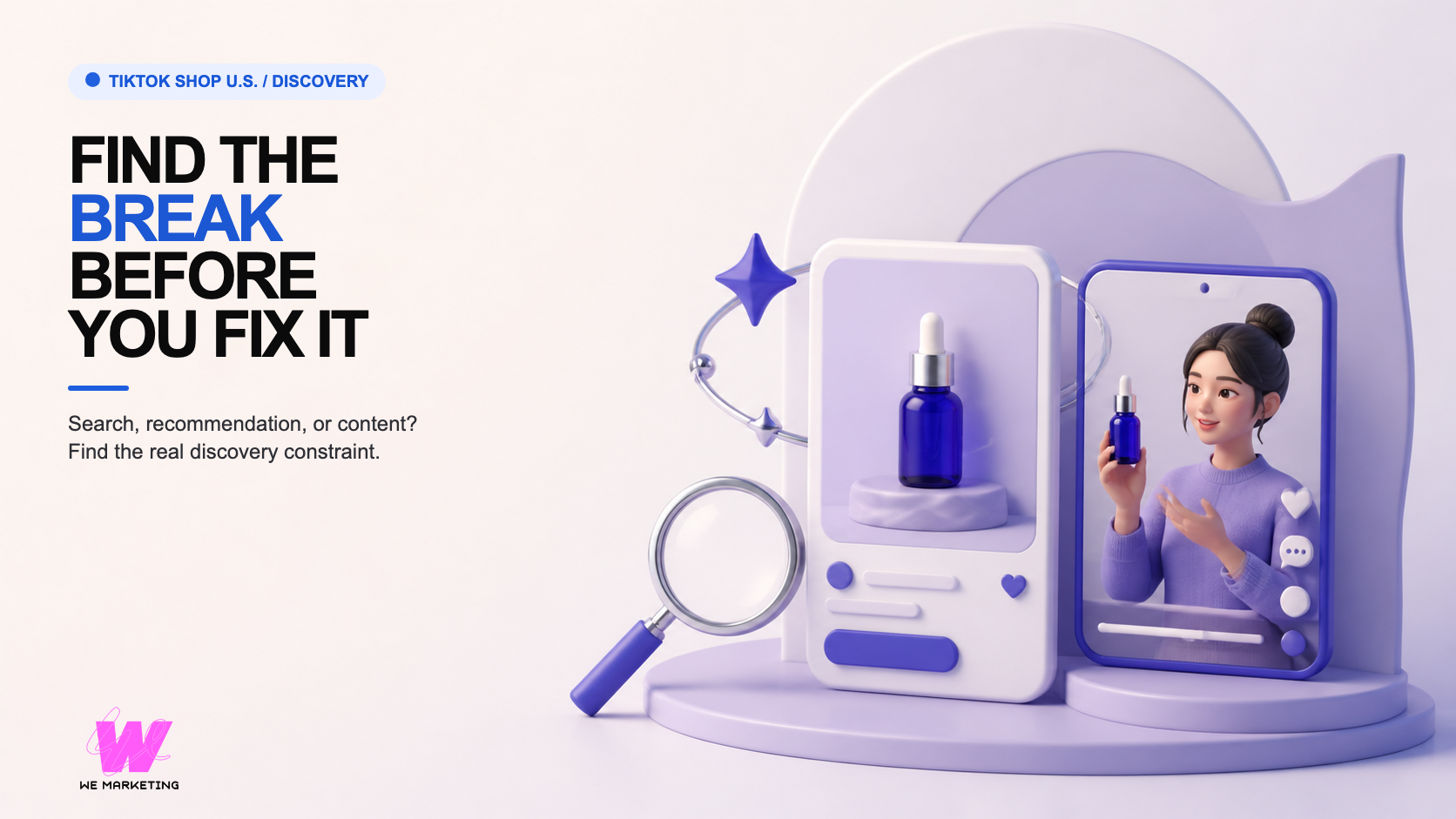
Search, Recommendation, or Content: Where Is TikTok Shop Discovery Breaking?
WE Marketing Team · Aug 10, 2026 · 16 min read
Direct answer: do not fix every discovery surface at once
When a TikTok Shop product stops getting enough qualified attention, teams often respond by doing more of everything: rewriting titles, adding creator outreach, posting more videos, lowering prices, and starting ads. That creates activity, but it can erase the evidence needed to find the real break. Discovery is not one channel. A shopper may find a product through Shop Tab and Search, a recommendation surface, seller content, affiliate content, or LIVE. The first job is to identify which of those paths lost contribution, then inspect the constraint inside that path.
TikTok Shop's current U.S. ACE diagnostics separates performance into five operating channels: Seller LIVE, Seller Video, Affiliate LIVE, Affiliate Video, and Shop Tab and Search. It also frames the underlying work through Assortment, Content, and Empowerment. This is useful because a weak discovery result does not automatically mean the team needs more content. It may mean a product is unavailable, the product card does not explain the offer, the creator supply is thin, the content job is wrong, or a campaign and paid lever are being used before the product can convert. Use the live Seller Center diagnostics as the account-specific starting point, then make one repair that the next readback can test.
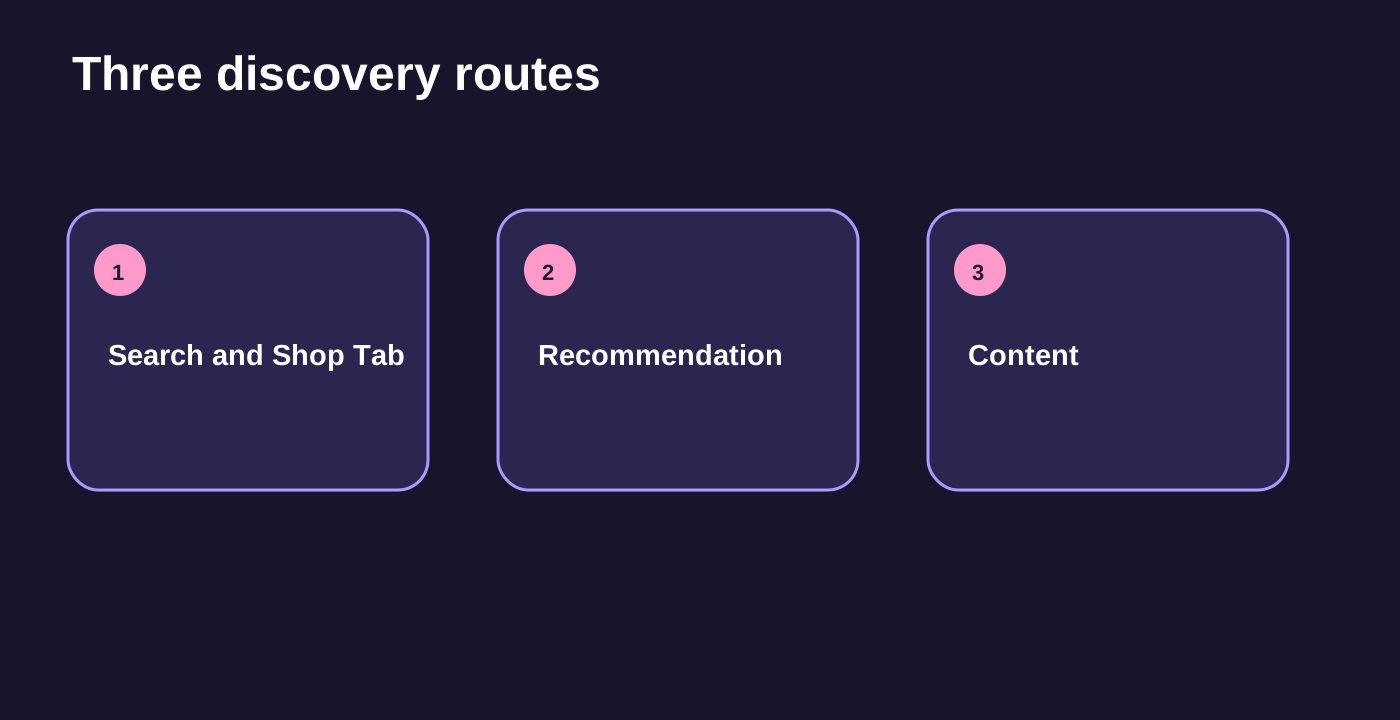
Three discovery routes, three different questions
| Route | What the shopper is doing | First diagnosis question | Do not assume |
|---|---|---|---|
| Shop Tab and Search | Looking for or comparing a product. | Can the title, image, product facts, price, availability, and offer earn a useful click and complete the buying decision? | That more videos will repair an unclear or unavailable product card. |
| Recommendation | Being shown a product before actively searching for it. | Is the selected SKU eligible, in stock, credible, and competitive enough for the current shopper experience? | That an impression is proof of product-market fit. |
| Content | Learning a product need from a seller or creator video, LIVE, or affiliate post. | Does the content make one buyer understand what the product is, why it fits, and which linked item to choose? | That volume alone will create a useful content supply. |
These routes can support one another, but they fail differently. A product card with weak product facts, images, variants, availability, or price clarity can limit search and recommendation even when a creator video is good. A useful video can make people curious but still fail to convert if the product card does not carry the same promise. A clean product card cannot create demand if no content or recommendation signal gives the right shopper a reason to look. The operating question is always the same: what changed in the buyer path, and what one owner can repair before we add another lever?
Start with channel contribution, not a single top-line number
Open Seller Center Analytics or Growth Opportunities and look at the current GMV distribution and the top diagnostic items. The Academy says the updated tools use channel-specific diagnostics, recent self-comparison, peer benchmarking, and actionable tasks. Treat the platform's red, yellow, and green labels as a prompt to investigate, not as a substitute for judgment. Check the date range, the selected channel, the product set, and whether a stock, price, campaign, or content change happened during that period.
Then choose the largest decision-relevant change. If Shop Tab and Search contribution falls while creator views remain steady, start at the product card and offer rather than asking creators to make more videos. If the product card receives clicks but the path to purchase weakens, inspect variation clarity, price, shipping, reviews, availability, and product proof before increasing exposure. If a creator lane has little qualified content supply, separate three possibilities: the product is not a believable fit for the selected creators, the brief is not useful, or the sample and follow-up system is not functioning. If seller and affiliate content are both active but recommendation is weak, verify the product's current eligibility, stock, customer-experience signals, and account notices rather than guessing that a new creative concept is the only answer.
Search and Shop Tab: make the product card answer the next question
Search is not only a keyword task. TikTok Shop's current product-card guidance covers accurate titles, product descriptions, image quality, stock, product information, and policy-compliant presentation. The operational meaning is simpler: once a shopper sees the card, they should quickly understand what the product is, what version they are choosing, what it costs, why the offer exists, and how it will arrive. A search term can earn discovery, but the card needs to finish the decision.
Use one product card audit for the priority SKU. Compare the exact phrase or product need reflected in content and search with the main image, title, first visible product facts, variation names, price, shipping promise, bundle rules, reviews, and availability. Record repeated customer questions, not just an aggregate conversion rate. If shoppers repeatedly ask which size, formula, color, or bundle is right, the task is probably a product-information repair. If they reach the card but cannot justify the price, inspect the offer and proof before using a broader discount. If a key variant is unavailable, pause the content or offer that leads to it rather than paying to create a dead end.
Recommendation: protect eligibility and product competitiveness
Recommendation surfaces are not a promise that every well-made product will receive the same distribution. Current Academy material connects product discovery with listing quality, availability, customer experience, and the current account's operational status. Do not claim a hidden ranking formula. Instead, use the evidence visible in the current Seller Center: the priority task, the channel diagnosis, product availability, product-quality requirements, service or risk notices, and the before-and-after trend.
A practical recommendation review asks: Is the SKU sellable today? Is the displayed price and offer coherent? Are images and product facts accurate? Has an out-of-stock period, customer-service issue, returns pattern, or policy concern changed the product's ability to be surfaced? Is the team comparing the same product and time window? These are not reasons to panic or endlessly edit a listing. They are reasons to remove the clearest constraint, wait for the stated data refresh, and read back the same route again.
Content: give each video one discovery job
Content should not be judged only by whether it looks polished. For discovery, a video has a job: introduce a problem, demonstrate the product, compare a choice, make a use case believable, clarify an offer, or answer a repeated question. If every creator receives the same generic brief, the team gets repeated volume rather than a useful learning pool. Define one customer, one product truth, one content angle, one linked SKU, and one next question the product card must answer.
Affiliate content and seller content should also be separated in the readback. A creator may be excellent at product discovery while the brand's own content is better at comparison, instructions, or trust. A weak result can come from wrong creator fit, a confusing brief, missing samples, slow follow-up, or a product that does not have a believable story for that audience. Do not solve all of those problems by raising commission. First decide which part of the creator-content system is actually missing.
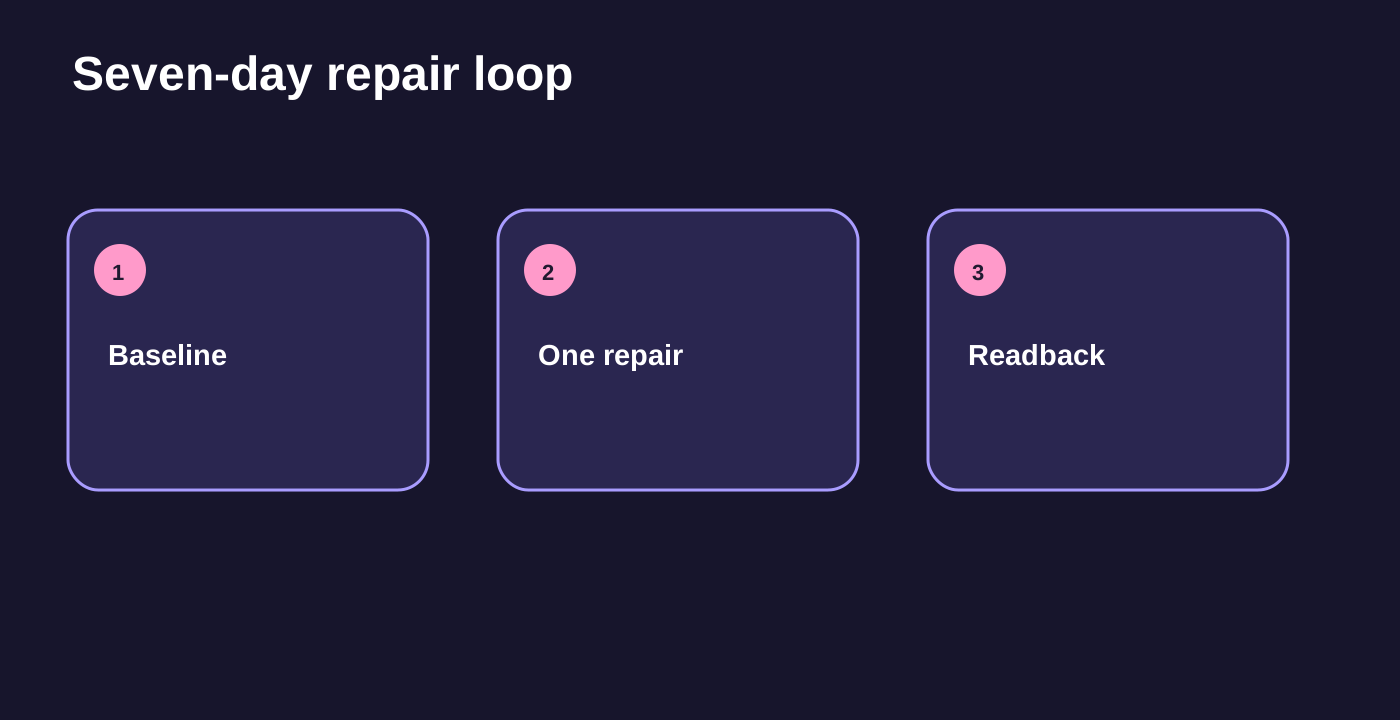
A seven-day discovery repair loop
Choose one priority SKU, one discovery route, one named constraint, one repair, and one readback date. Do not change the whole system before the readback.
- Day 1: Save the channel, product, date range, contribution trend, and the exact customer or diagnostic signal.
- Days 2 to 3: Fix one constraint, such as an unavailable variant, a misleading product-card detail, an unclear offer, or a brief that lacks a product truth.
- Days 4 to 6: Keep other large variables stable. Record content, price, inventory, or campaign changes that cannot be held still.
- Day 7: Reopen the same channel and product view. Decide to continue, make one further repair, or hold the growth lever.
Here is a hypothetical example, not a WEM client result. A skincare product gains creator-video views but Shop Tab and Search conversion drops. The team first checks whether more creator volume is needed. The product-card audit instead finds that the lead video describes a skin concern while the product page presents several similar variants without a comparison. The repair is a variant guide in the product images and a matching creator brief frame. The team does not add a broad discount or new ad budget until the same SKU and route have been read back. The diagnosis turns a vague traffic problem into a specific buyer-path repair.
Smallest useful next action
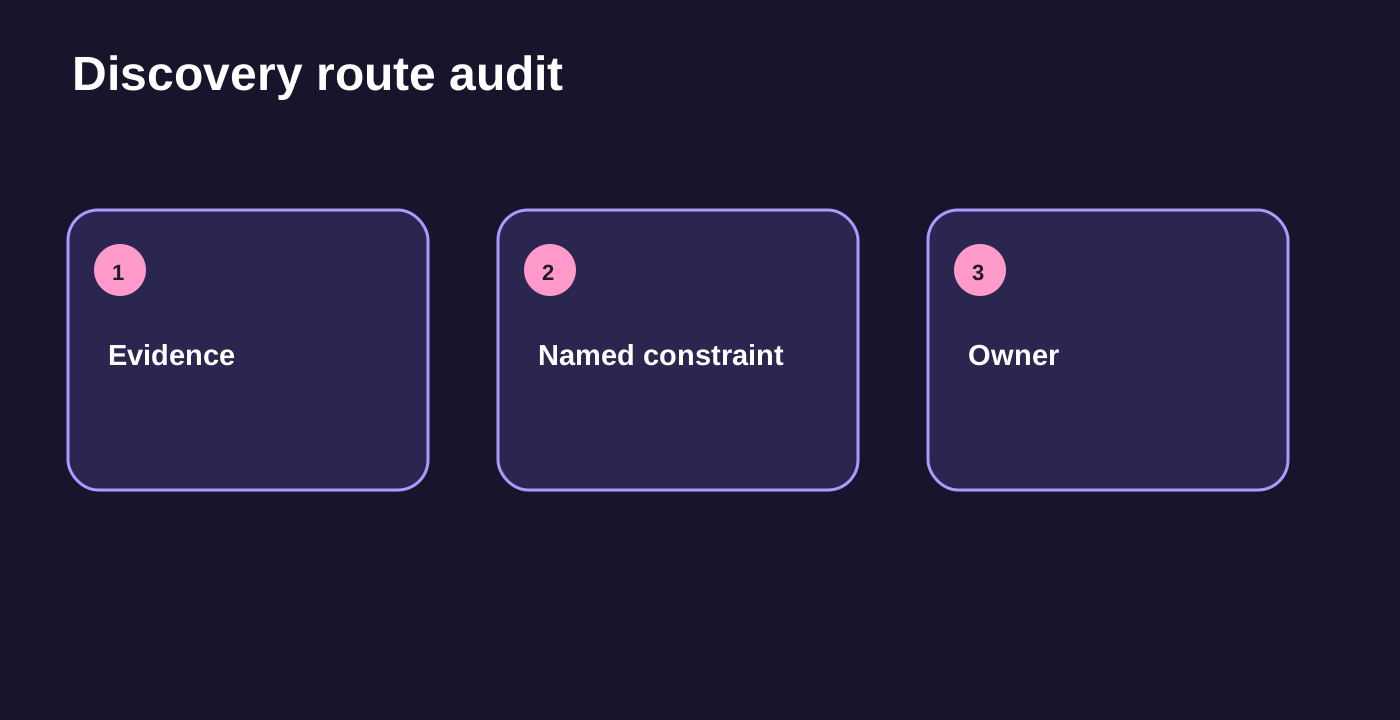
Choose the priority SKU and open the current ACE diagnostic or Analytics view. In one shared sheet, write the route with the clearest change, the evidence, the most likely constraint, the owner, the single repair, and the date to recheck. If the evidence is missing, the first task is to retrieve it, not to invent a remedy. This gives a brand a disciplined way to decide whether the next dollar belongs in product information, inventory, creator content, an offer, or paid testing.
Source notes
Primary sources read in full on August 10, 2026: TikTok Shop U.S. Academy, TikTok Shop Seller Growth ACE-Powered Insights, ACE Your Shop: Powering Growth Across Discovery Channels, and New Seller Growth Strategy Step 2: Getting Started by Leveraging Product Card. Features, diagnostic labels, eligibility, recommendations, and account access can change. Confirm the current U.S. Seller Center before acting.
Frequently asked questions
Should a brand fix search, recommendation, and content at the same time?
Usually no. Start with the route showing the clearest decision-relevant change, repair one named constraint, and read it back before adding another major lever.
Do more product views always mean the discovery problem is solved?
No. Views can increase while the product card, offer, variant selection, availability, or customer experience still blocks the purchase decision.
What should a brand check first when Shop Tab and Search weakens?
Check the selected SKU's title, images, facts, variants, price, offer, shipping, reviews, availability, and any repeated customer question before changing creator volume.
Can a strong creator video repair a weak product page?
It can create attention, but it cannot reliably finish the purchase if the linked product page contradicts or fails to answer the video's promise.
When should a brand add paid testing?
After the selected product, offer, inventory, creative authorization, and buyer path are clear enough to learn from the added exposure. Keep a named budget and stop rule.
How often should discovery be reviewed?
Use the current account's data cadence. The Academy recommends regular review and more frequent attention during major promotions. Make each review end with one accountable next action.